REFERENCEevery number opens its own provenance
At a glance
ISSUES IN THE SET
15
DOLLARS DELIVERED, 1794–1805
1,439,517
SOURCES HELD
KEY DATES & CROWNS
6
IDENTIFIED SPECIMENS
34
- SOURCE
- —
- LOCATOR
- —
- CLASS
- OBSERVED — read directly from the document
- ACCESSED
- —
- METHOD
- —
- CAVEAT
- Counted as this site defines the series: Flowing Hair and Draped Bust as one family, following the BB sequence, plus the three classes of 1804-dated dollar.
This figure carries no source reference. It is shown because the record contains it, and labelled so you know what it is not.
- LOCATOR
- —
- CLASS
- DERIVED — calculated by OunceDesk from a sourced figure
- ACCESSED
- —
- METHOD
- OunceDesk arithmetic over every attributable delivery in the Mint's registry.
- CAVEAT
- For this series, "mintage" is a trap. The United States Mint never recorded how many coins of a given DATE it struck. It recorded how many coins the Chief Coiner DELIVERED to the Treasurer within a calendar year — and those are not the same number, because dies were used until they broke, not until the year changed.
- SOURCE
- —
- LOCATOR
- —
- CLASS
- OBSERVED — read directly from the document
- ACCESSED
- —
- METHOD
- —
- CAVEAT
- Of 43 cited. A source is "held" when the Archive has a copy, not merely a citation.
This figure carries no source reference. It is shown because the record contains it, and labelled so you know what it is not.
- SOURCE
- —
- LOCATOR
- —
- CLASS
- DERIVED — calculated by OunceDesk from a sourced figure
- ACCESSED
- —
- METHOD
- —
- CAVEAT
- OunceDesk's classification, defined on this page. It is an editorial judgement about collecting, not a record.
This figure carries no source reference. It is shown because the record contains it, and labelled so you know what it is not.
- SOURCE
- —
- LOCATOR
- —
- CLASS
- OBSERVED — read directly from the document
- ACCESSED
- —
- METHOD
- —
- CAVEAT
- Individually identified coins in the OunceDesk specimen graph, each with its own evidence record. Not a census of survivors.
This figure carries no source reference. It is shown because the record contains it, and labelled so you know what it is not.
The series, in parts
- IssuesAll 15 dates, with delivery, attribution and class
- Varieties & AttributionFour catalogue systems, and how to read a die
- Key Dates & RaritiesWhat gates a set, and what merely costs
- Grading & AuthenticationIncluding the 1795-altered-to-1794 field test
- CollectingThree honest paths through a series with museum coins in it
- HistoryThe carousel: why 97% of them left the country
- ChecklistOwn it, want it, and what the set is missing
- Primary record43 sources, 37 held in the Archive
- Open questions6 registered contradictions, unreconciled
- The book10 chapters, free to read
REFERENCE15 in the set
Issues
Two columns, because they are two different facts. Delivered is what the Mint's registry records being handed to the Treasurer in a calendar year. Dated attribution is what the trade assigns to coins bearing that date. Where the record does not attribute a delivery to a single issue, this table shows no figure rather than a split someone invented.
| Issue | Type | Delivered | Dated attribution | Class | Survivors | Marriages | Details |
|---|---|---|---|---|---|---|---|
| 1794 | Flowing Hair | 1,758 | 1,758 | KEY | ~150 | 1 | |
| |||||||
| 1795 Flowing Hair | Flowing Hair | no attribution | 160,295 | OBTAINABLE | — | Haseltine listed 13 obverse/reverse combinations for 1795 flowing-hair alone | |
| |||||||
| 1795 Draped Bust | Draped Bust, Small Eagle | no attribution | 42,738 | OBTAINABLE | — | Haseltine Nos. 14–15 | |
| |||||||
| 1796 | Draped Bust, Small Eagle | 72,920 | 79,920 | SCARCE | — | Small/Large Date × Small/Large Letters — three of four combinations exist | |
| |||||||
| 1797 | Draped Bust, Small Eagle | 7,776 | 7,776 | SCARCE | ~3,000+ | 9 | |
| |||||||
| 1798 Small Eagle | Draped Bust, Small Eagle | no attribution | 40,000 | KEY | — | 13 | |
| |||||||
| 1798 Heraldic Eagle | Draped Bust, Heraldic Eagle | no attribution | 287,536 | OBTAINABLE | — | the series' largest year — 30 obverses with 17 reverses, per Haseltine | |
| |||||||
| 1799 | Draped Bust, Heraldic Eagle | 423,515 | 423,515 | OBTAINABLE | ~9,380 | 9 | |
| |||||||
| 1800 | Draped Bust, Heraldic Eagle | 220,920 | 220,920 | OBTAINABLE | ~5,725 | at least six distinct pairs described in Chapman's 1907 Stickney catalogue | |
| |||||||
| 1801 | Draped Bust, Heraldic Eagle | 54,454 | 54,454 | SCARCE | ~2,000 | at least 3, distinguished by reverse leaf position | |
| |||||||
| 1802 | Draped Bust, Heraldic Eagle | 41,650 | 41,650 | SCARCE | — | at least 3 — 2/1 overdate in Narrow and Wide Date, plus Perfect Date | |
| |||||||
| 1803 | Draped Bust, Heraldic Eagle | 66,064 | 85,634 | OBTAINABLE | — | at least 2 — Small 3 and Large 3 | |
| |||||||
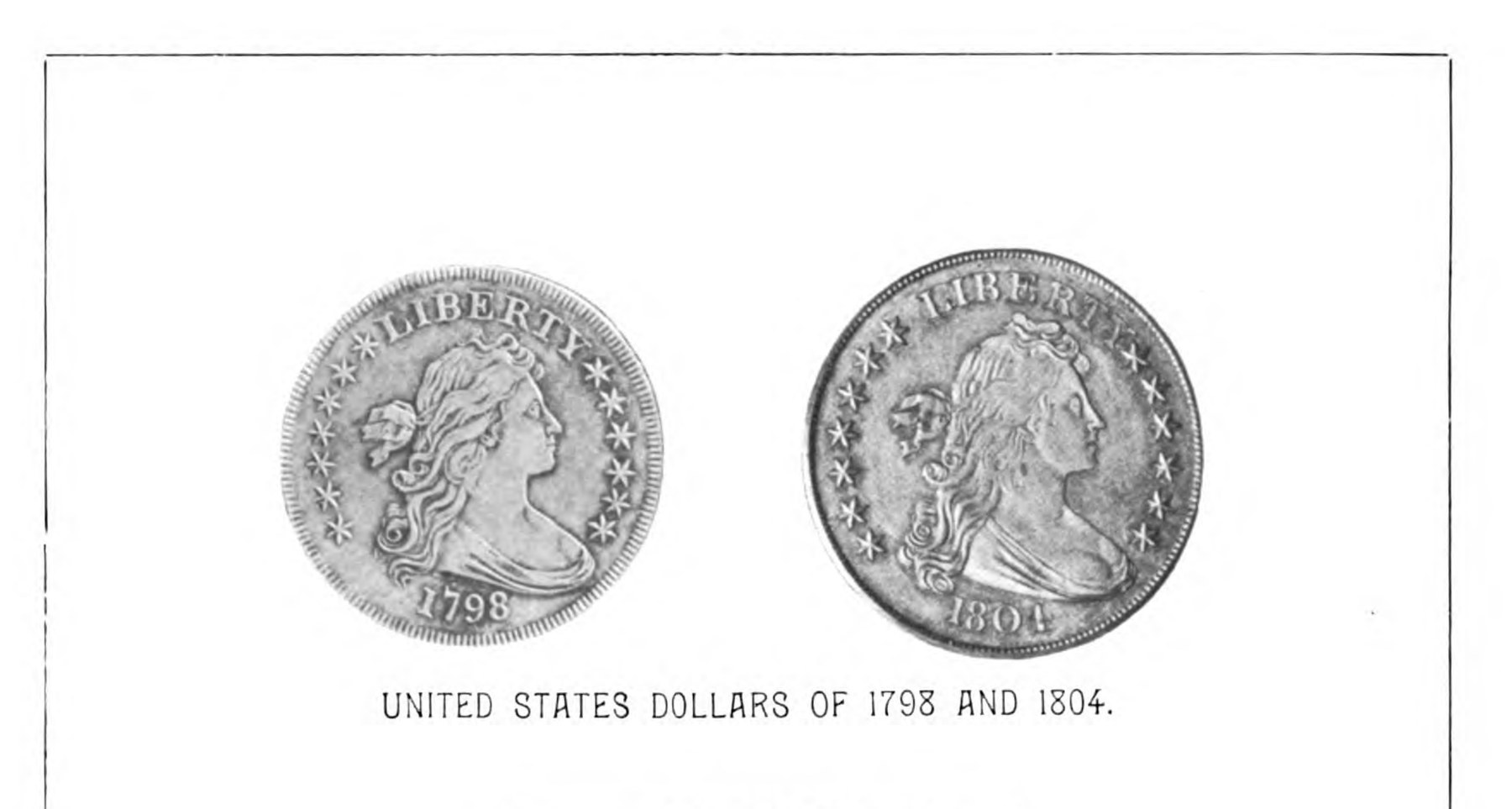
| 1804 Class I | Draped Bust, Heraldic Eagle — struck c. 1834–35 | no attribution | 8 | CROWN | — | one obverse, one reverse | |
| |||||||
| 1804 Class II | Draped Bust, Heraldic Eagle — struck c. 1858, plain edge | no attribution | 1 | CROWN | — | the Class I obverse, struck without a collar | |
| |||||||
| 1804 Class III | Draped Bust, Heraldic Eagle — struck c. 1858–60, edge lettered afterwards | no attribution | 7 | CROWN | — | recut obverse, substitute reverse | |
| |||||||
GUIDE
Why the early dollars matter
This is where American money starts. A mint powered by horses, in a building whose authorising statute kept nearly expiring, struck1,439,517 dollars between 1794 and 1805 and then stopped for thirty years. Almost all of them went abroad, one profitable shipment at a time. There is no hoard, no bag, no vault find — when a 1794 dollar appears, it appears alone.
And because the Mint counted deliveries rather than dates, the series also produced the most famous bookkeeping error in the hobby: a coin dated 1804 that was struck thirty years later for a king who did not collect coins.
NOTE.—Not susceptible of exact statement by years of actual date of coin, the registry of annual coinage being of coin delivered by coiners of mints within the given year, and these deliveries not having been invariably completed within the year of the date of coin, as now required.
This series has no hoard. There is no keg, no bag, no vault find, no Randall-style discovery that reset the market for an early dollar date. When a 1794 dollar appears, it appears one at a time. That absence is not a gap in the research — it is the story, and it is why the survival estimates are as low as they are.
BOOKSfree to read, in full
From The American Series
The Early Dollars — An OunceDesk Family Guide — 10 chapters covering exactly this span, built from 32 primary sources. Every citation in it resolves to a document in the Archive.
- The First SilverReadA shop with horses, a statute about to expire, and 1,758 coins on an October afternoon — where every early dollar comes from.
- The CarouselReadAccepted by count, exported by the crate: the banker's habit that consumed ninety-seven percent of the series.
- The Way of SeeingReadNo two dies were ever alike. An 1881 auction catalogue taught the hobby to read them — and the skill has never stopped paying.
- Twelve MarriagesReadA teaching set, ranked by lesson rather than price: attribute these twelve and you can attribute the series.
- IMPRINT
- The American Series
- CHAPTERS
- 10
- SOURCES
- 32
- FORMATS
- PDF · EPUB · Web
- PRICE
- Free
ARCHIVE43 sources · 37 held
The primary record
Grouped as the Archive classes them. A source that OunceDesk holds has a page of its own showing every other place the site uses it.
- S1Mint Report 1803 (American State Papers, Finance) — United States Mint · Director Elias Boudinot; Treasurer Benjamin Rush
- S2Message from the President communicating the report of the Director of the Mint (received January 25, 1805) — United States Mint · Elias Boudinot
- S3Annual Report of the Director of the Mint, FY1888 — United States Mint
- S4Annual Report of the Director of the Mint, FY1889 — United States Mint
- S5Message from the President transmitting a report of the Director of the Mint (1840) — United States Mint
- S6Annual Report of the Director of the Mint, FY1971 — United States Mint
- S7A Manual of Gold and Silver Coins of All Nations (1842) — Jacob R. Eckfeldt & William E. DuBois, Assayers of the Mint
- S8The American Numismatical Manual (1859) — Montroville W. Dickeson
- S9A Description of Ancient and Modern Coins in the Cabinet Collection at the Mint of the United States (1860) — James Ross Snowden, Director of the Mint
- S10American Journal of Numismatics, vols. 1–5 (1866–71) — American Numismatic and Archæological Society
- S11Priced catalogue of the numismatic collection formed by Joseph J. Mickley (October 28 – November 2, 1867) — W. Elliot Woodward
- S12Catalogue of the numismatic collection formed by Joseph J. Mickley — unpriced copy — W. Elliot Woodward
- S28"Dollars and Half Dollars of 1794 and 1795", The Numismatist, March 1927, p. 151 — Theodore J. Venn
- S30Coinage Laws of the United States, 1792 to 1894 — US Senate (S. Rept. 235 pt. 2, 53d Cong., 2d sess., 1894)
- S31PCGS CoinFacts — Professional Coin Grading Service
ARCHIVE6 registered, unreconciled
Open questions
Where two records disagree, OunceDesk records the disagreement rather than picking a winner. These are not gaps in the research; they are the research.
OPEN QUESTION
1796 — 72,920 (Mint) vs 79,920 (trade)
Every Mint printing the OunceDesk Archive holds gives 72,920, and Venn reported "perfect accord" on the figure in 1927. PCGS carries 79,920 on all three 1796 varieties. A single transposed digit, propagated for a century.
- STATUS
- Recorded, not reconciled
OPEN QUESTION
1803 — 66,064 (Mint) vs 85,634 (trade), and the 19,570 fossil inside it
The Mint's own 1803 quarterly abstract sums to 66,064 and the registry agrees. PCGS gives 85,634 for the 1803 Small 3. The gap is 19,570 — precisely the 1804 delivery figure. Somewhere in the twentieth century the 1804 delivery was moved onto the 1803 date and nobody wrote it down. That reassignment is probably physically right and documentarily unsupported, and it is published here as an interpretation, not as a record.
- STATUS
- The series' most instructive arithmetic — see The 1803 dollar
OPEN QUESTION
1799 — 423,515 (every Mint printing) vs 429,515 (Snowden)
The Numismatist noted in 1899 that Snowden gave 429,515 while Dickeson gave 423,515. Every Mint printing this Archive holds gives 423,515.
- STATUS
- Recorded, not reconciled
MARKET
What they cost
No melt module on this series, deliberately: the cheapest genuine early dollar trades in four figures and the best-known one has realised $10,016,875. A live silver price is not a floor under any of them, and showing one would imply it was.