Early Half Dollars 1794–1836
For forty years the half dollar was the workhorse of American money — struck by the million, stacked in bank vaults, and counted by weight rather than by date. Almost all of it came after 1807: the first thirteen years are 1.93% of the pieces and a far larger share of everything anyone wants.
Half dollars — each to be of half the value of the dollar or unit, and to contain one hundred and eighty-five grains and ten sixteenth parts of a grain of pure, or two hundred and eight grains of standard silver.
Act of April 2, 1792 §9
Six benchmark issues
39 issues across three designs and forty years. These six decide what an early-half set costs — and they are the clearest picture on the site of what a partial record looks like.
1817
The 1817/4 is the crown rarity of the series and the only mintage column in it that tells the truth: PCGS gives “N/A”, because nobody knows how many coins came off this obverse before it was pulled. Ten or eleven are known, R-9.5, from a year in which the Mint delivered 1,215,567 half dollars. Fewer survive than the Class I and Class III 1804 dollars combined. Described in print in October 1930 by E. T. Wallis of the California Stamp Company, Los Angeles; “rediscovered” by Al Overton in 1951, offered unsold in his own sale of January 1953 at lot 200, then sold privately that year for $1,500. Auction record $333,500 for the AU53 in November 2004.
1796
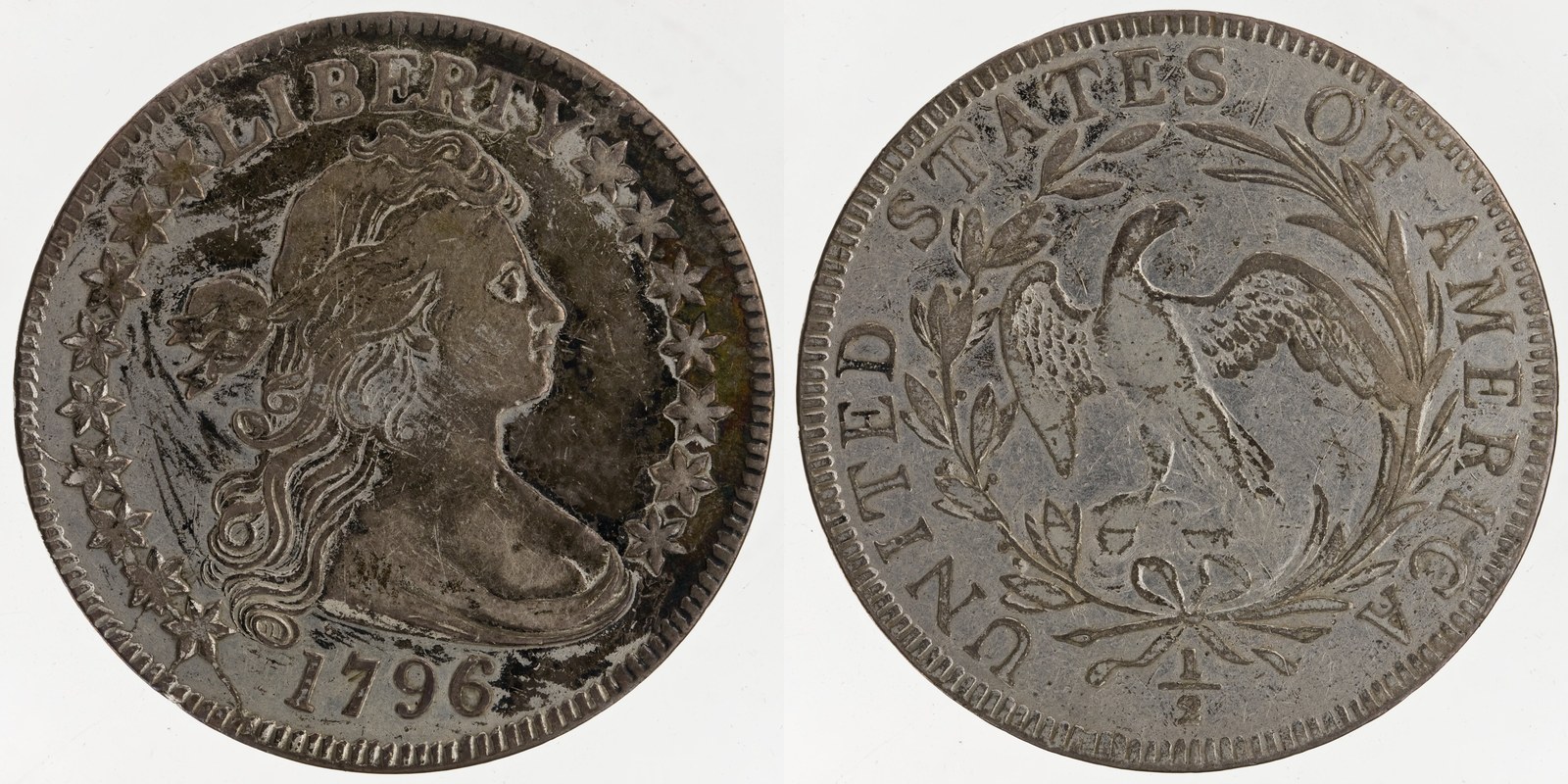
1796 and 1797 together are a delivery of 3,918 coins, and the registry read literally says there were no half dollars of 1796 at all. Two obverses, fifteen stars and sixteen: PCGS estimates 75 known of the 15 Stars at R-8.2 and 40 of the 16 Stars at R-8.7, the latter with an auction record of $822,500. Two of them were in the Economite hoard and were paid out at face value before anyone realised what they were.
1797
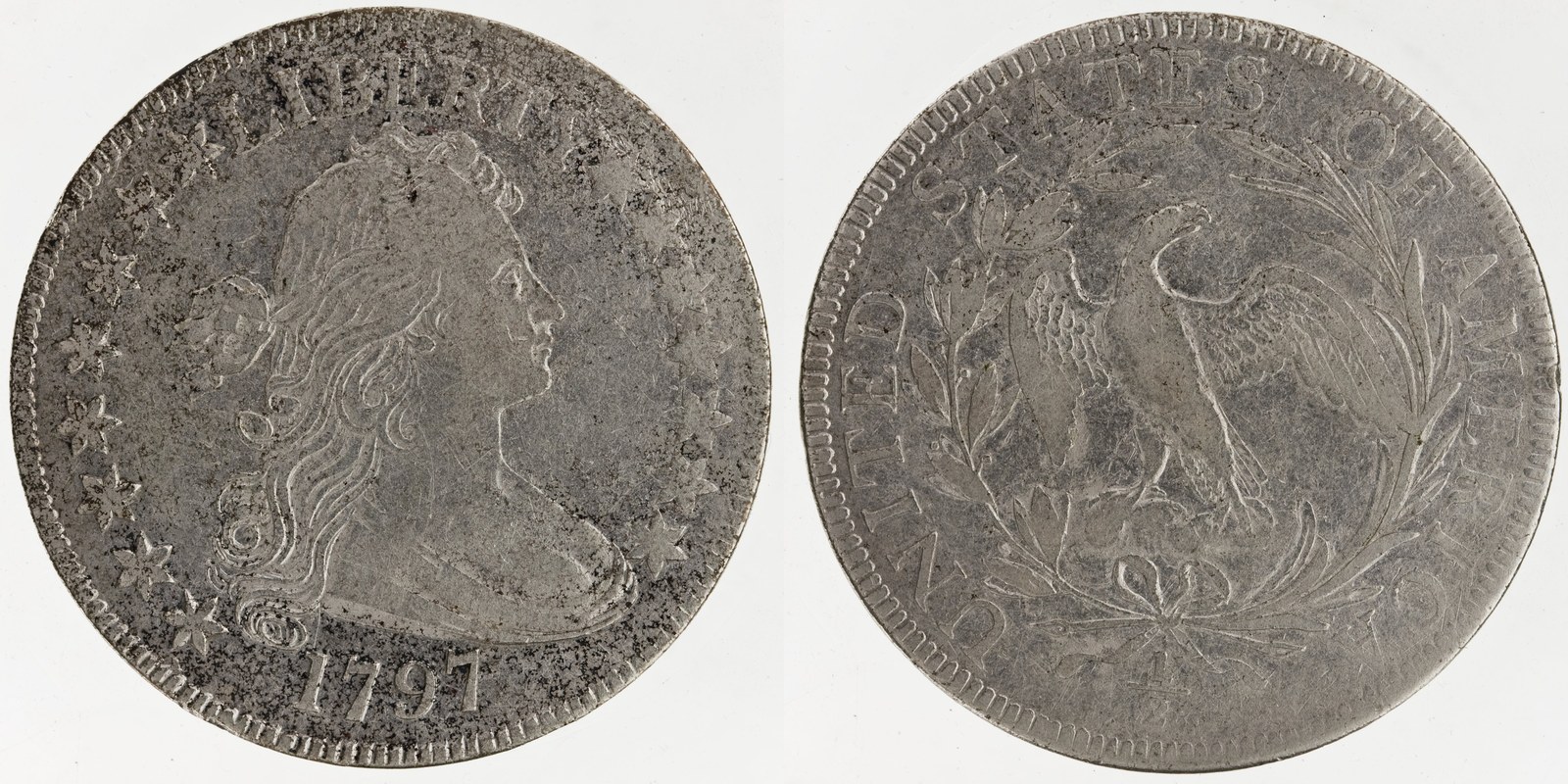
The balance of the same 3,918. PCGS estimates 175 known at R-7.2 — and this date holds the series' price record: $1,560,000 for an MS65+ in January 2023.
1794
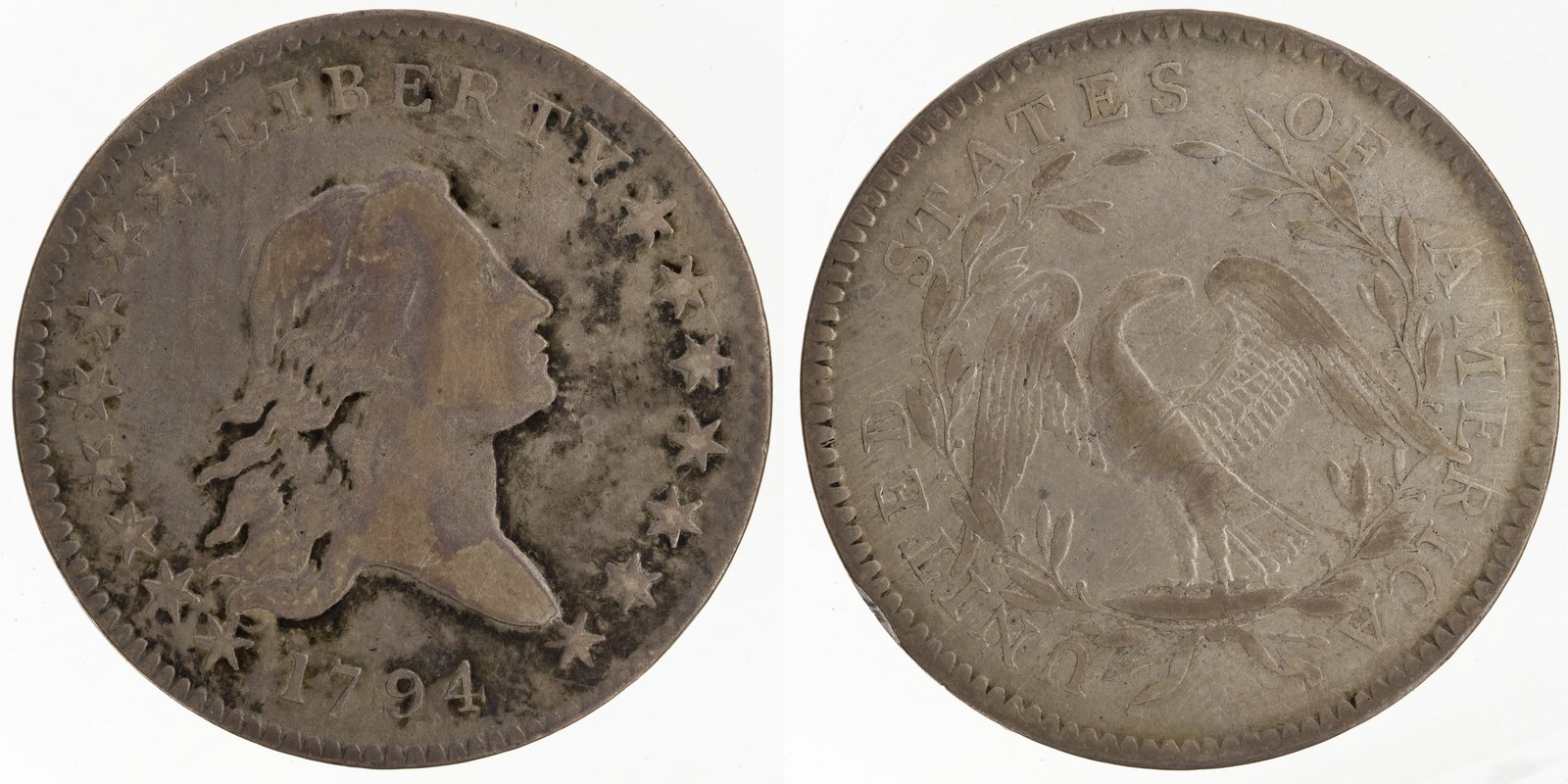
The Mint's second silver delivery ever, on December 1, 1794, and the softest number in the series: the published 23,464 is a date-attribution estimate, not a delivery figure. PCGS estimates 1,200 known at R-4.9, auction record $252,000. The condition-census head is an MS64 ex F.C.C. Boyd that sold for $210 in 1945 and $763,750 in 2015. One hoard is reported to have held 150 of them.
1815
The whole delivery-versus-date problem in one coin. Every 1815 half dollar is an overdate, 5 over 2; the Mint delivered none in calendar 1815 and 47,150 in calendar 1816; and no half dollar bears the date 1816, because a barrel of wood ashes was leaned against a wooden wall on the night of January 11, 1816. PCGS estimates 800 known at R-5.4. The Economite hoard held 100 of them.
1806
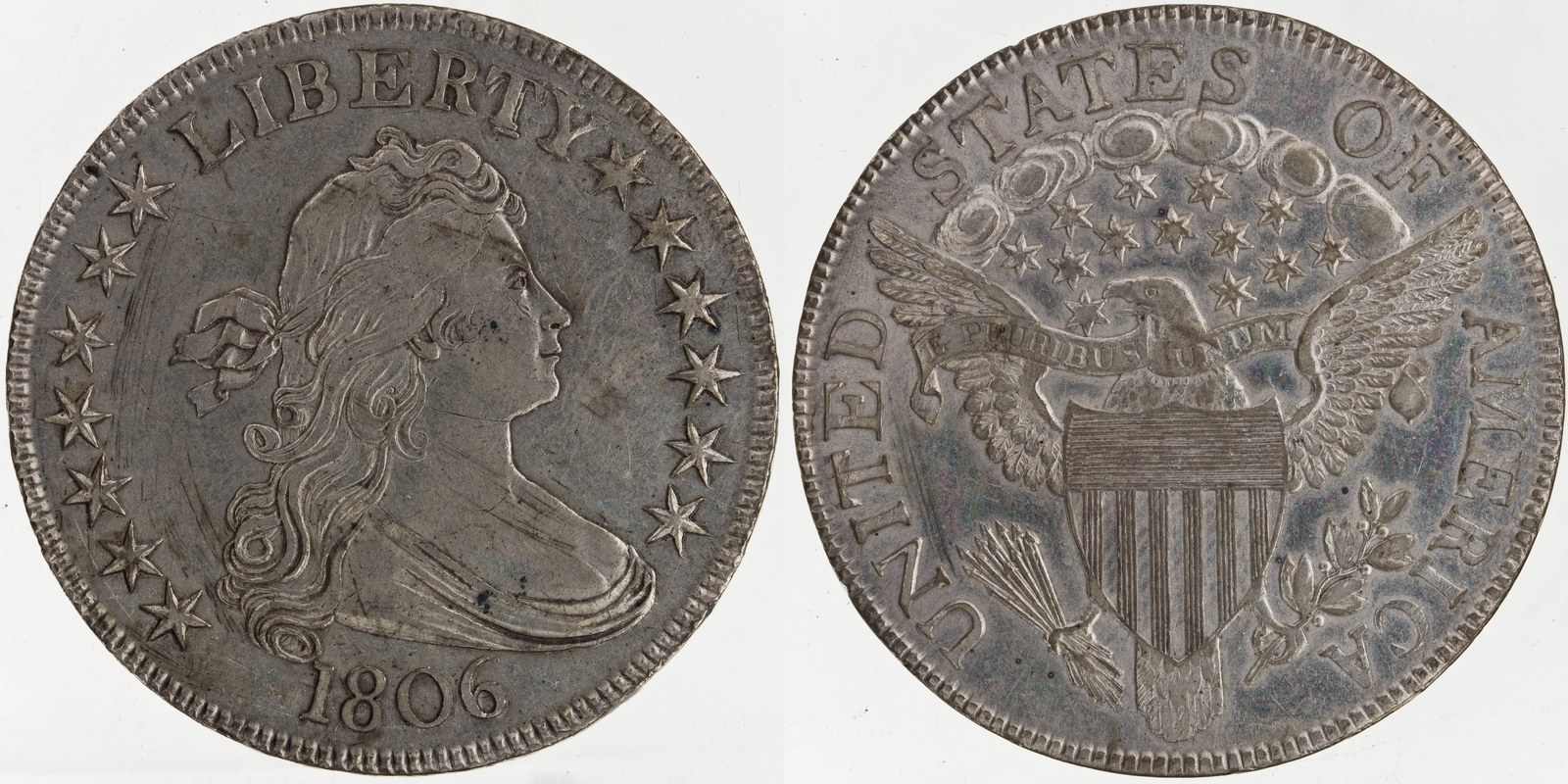
The best available demonstration that in this series the date is not the unit. Six major varieties share one delivery figure, and the Knob 6 No Stem is five known at R-9.7 against the Pointed 6 Stem at 2,500 — a rarity spread of 500 to 1 inside a single year and a single recorded number.
Survivor counts are ESTIMATED, attributed to PCGS CoinFacts as of 23 August 2026 — an estimate of how many of each issue still exist in any grade, not a count of coins anyone has seen. 2 of these 6 have no sourced census yet and show none; a figure is not invented to fill the column. The mintage beside it is OBSERVED, read from the Mint's delivery registry, which counts deliveries rather than dates. Market strips read the eBay Browse API live and are affiliate-tracked; asking prices, not realised sales, and nothing in them reorders this grid. Coins marked “photography pending” await rights-cleared imagery, per house rule.
The delivery registry
The United States Mint never recorded how many coins of a given DATE it struck. It recorded how many coins the Chief Coiner DELIVERED TO THE TREASURER within a calendar year — and it printed the warning itself. This series is where that lesson was first diagnosed, and the half dollar is the denomination that proves it: in April 1891 the American Journal of Numismatics listed the dates the printed figures literally require you to believe in, and two of the nine phantoms and two of the eight erasures are half dollars.
Half dollars delivered by the Chief Coiner to the Treasurer
That 1.93% is the single most important number for anyone pricing, writing about or building a page for this series. The pre-1807 run is two per cent of the pieces and a much larger share of the rarity, and this reference carries it at full depth rather than compressing it into a prologue.
Hard Money. Hard Numbers. · Not investment advice. Some links pay us a commission — disclosures. Affiliate economics never determine research conclusions or rankings. © 2026 OunceDesk. Every figure classed OBSERVED / DERIVED / ESTIMATED / SPECULATIVE.