Three things about this series are unusual enough to be worth knowing before you look at a coin: its characteristic “errors” are manufacturing process, its wear was measured by the Mint's own assayers, and its best authentication images are in museums rather than in price guides — because museums catalogue counterfeits as counterfeits.
Read this first
Edge errors are diagnostic, not damage
The legend FIFTY CENTS OR HALF A DOLLAR was rolled onto the blank planchet by a pair of parallel bar dies before striking. On most pre-1807 coins there are stars, boxes and circles between the words; afterwards a shifting repertoire of stars, X's, I's and straight or angled lines. Snowden describes the 1794 edge as “FIFTY ** [ornament] CENTS **** OR ** HALF ** A ** DOLLAR”, and notes that on the 1807 Capped Bust edge “the ornaments [are] omitted.”
Missing letters, doubled letters and mis-spaced ornaments are inherent to that process. They are not post-mint damage and they are not errors in the pejorative sense. PCGS treats the 1809 XXX Edge and the 1809 III Edge as separate major varieties with materially different rarity — R-6.2 against R-5.2 — which is a grading service saying out loud that the edge is a legitimate attribution axis.
The corollary matters for buying: you cannot authenticate an edge from a face-on photograph. That is most acute in 1836, where the edge is the thing that decides which coin series a piece belongs to and how much it is worth.
And edge dies date the coins
Edge dies wore out and were replaced, so tracking which edge die struck which marriage produces a probable emission order — the sequence in which marriages were struck. It is this series' most distinctive research method and it has no equivalent in the early dollars. The foundational work is the Leaman–Gunnet study presented at the ANS Coinage of the Americas Conference in 1986, which the OunceDesk Archive does not hold.
Measured, not estimated
The Mint assayed the wear on this exact series
“Wear of our Silver Coins. — Half-dollars of the old standard, previous to 1837, of average wear, are found to have lost 5½ tenths of one per cent. A recoinage of $38,000 produced $37,800, in June, 1845.”Jacob R. Eckfeldt & William E. DuBois, Assayers of the Mint, 1850
After up to fifty years in circulation, an average early half dollar had lost 0.55% of its weight. That is a remarkable number and it does two things at once.
It tells you these coins were tough: heavy, low-relief, 89.24% fine silver, designed to be piled by cashiers. And it tells you what actually happened to the ninety-nine-plus per cent that do not survive. They were not worn out. They were melted — and that same passage quantifies one melt, because $38,000 of pre-1837 half dollars is 76,000 coins of this series, recoined in a single Mint operation in June 1845.
Cleaned and re-toned surfaces are the commonest condition problem in this series, and unlike most series there is a documented reason for a large chunk of it. When the Economite hoard came out of its vault in 1878 the silver “was black or tarnished from oxidation,” and the correspondent who inventoried it recorded what happened next: “sore fingers were plenty in Economy” from cleaning the coins, “as all were scrubbed before sold or circulated.”
117,184 early half dollars were in that vault, including a reported 150 of the 1794 against a modern survival estimate of 1,200. Every one of them was scrubbed. When you are looking at a hairlined early half dollar you may well be looking at 1878 rather than at a later collector's mistake — which changes nothing about the grade, and quite a lot about how you think about the population.
From public collections
Three fakes a museum keeps, and what each one teaches
Commercial sources publish photographs of genuine coins. Museums publish photographs of the other kind, catalogued honestly, which makes them the best authentication imagery available anywhere. All three below are the American Numismatic Society's, under a public-domain rights statement, and all three are labelled as counterfeit or altered in the Society's own catalogue rather than by us.
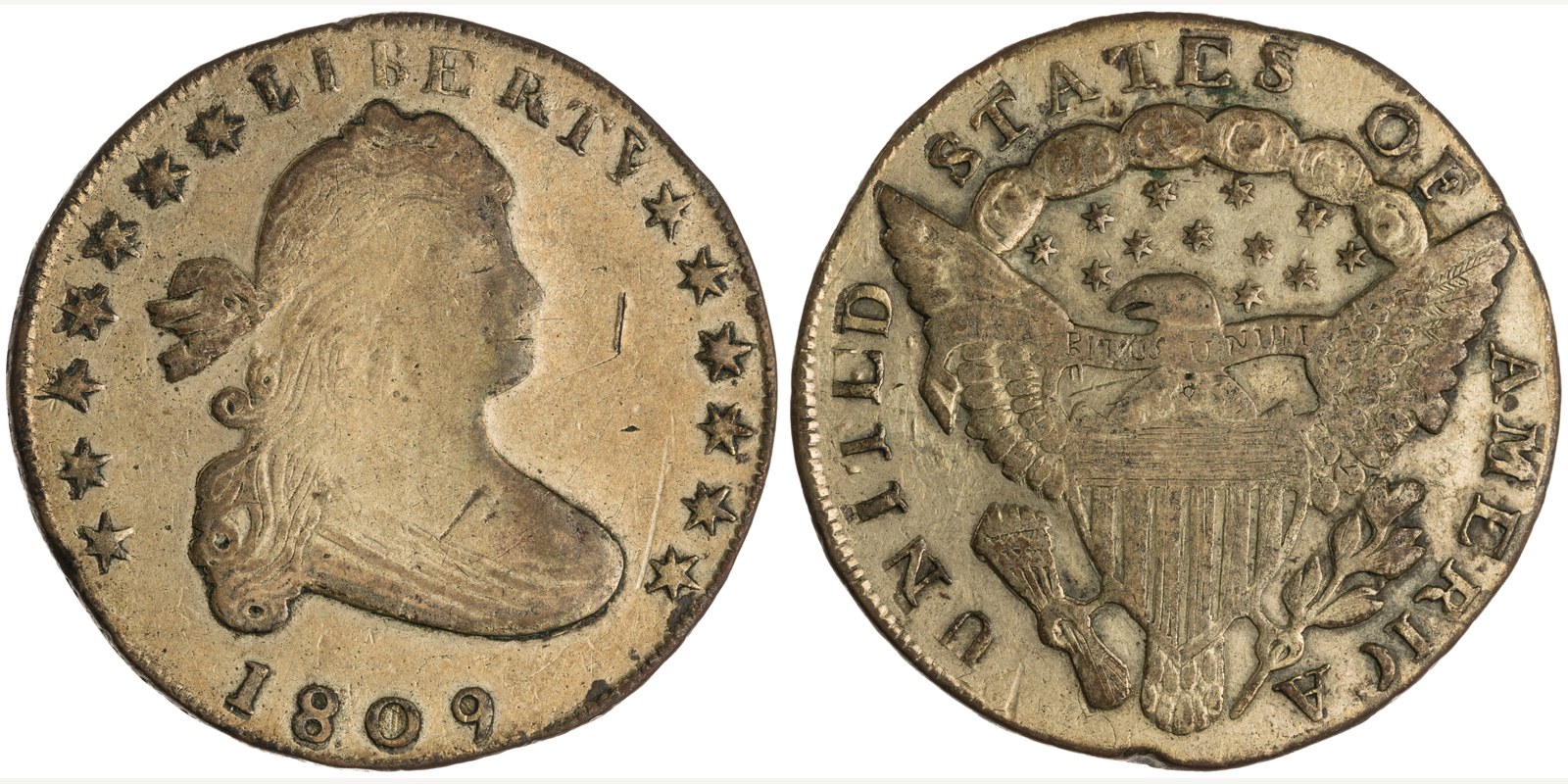
American Numismatic Society 1896.30.1 — Public Domain Mark / No Copyright – United States.
NOT A GENUINE COIN
A brass half dollar dated 1809
Catalogued by the ANS as BRASS, and it looks it — the colour in the photograph is the object's, not the lighting's. But the decisive tell is not the metal. Look at the portrait: this is a DRAPED BUST obverse with a heraldic eagle reverse, on a coin dated 1809. The Mint replaced that design with Reich's Capped Bust in 1807. The counterfeiter copied the wrong decade.
What it teaches. Design-versus-date is the cheapest authentication check in this series and it costs nothing. Know which portrait belongs to which years — Flowing Hair 1794–1795, Draped Bust small eagle 1796–1797, Draped Bust heraldic eagle 1801–1807, Capped Bust 1807–1836 — and a whole class of period fakes falls out immediately.
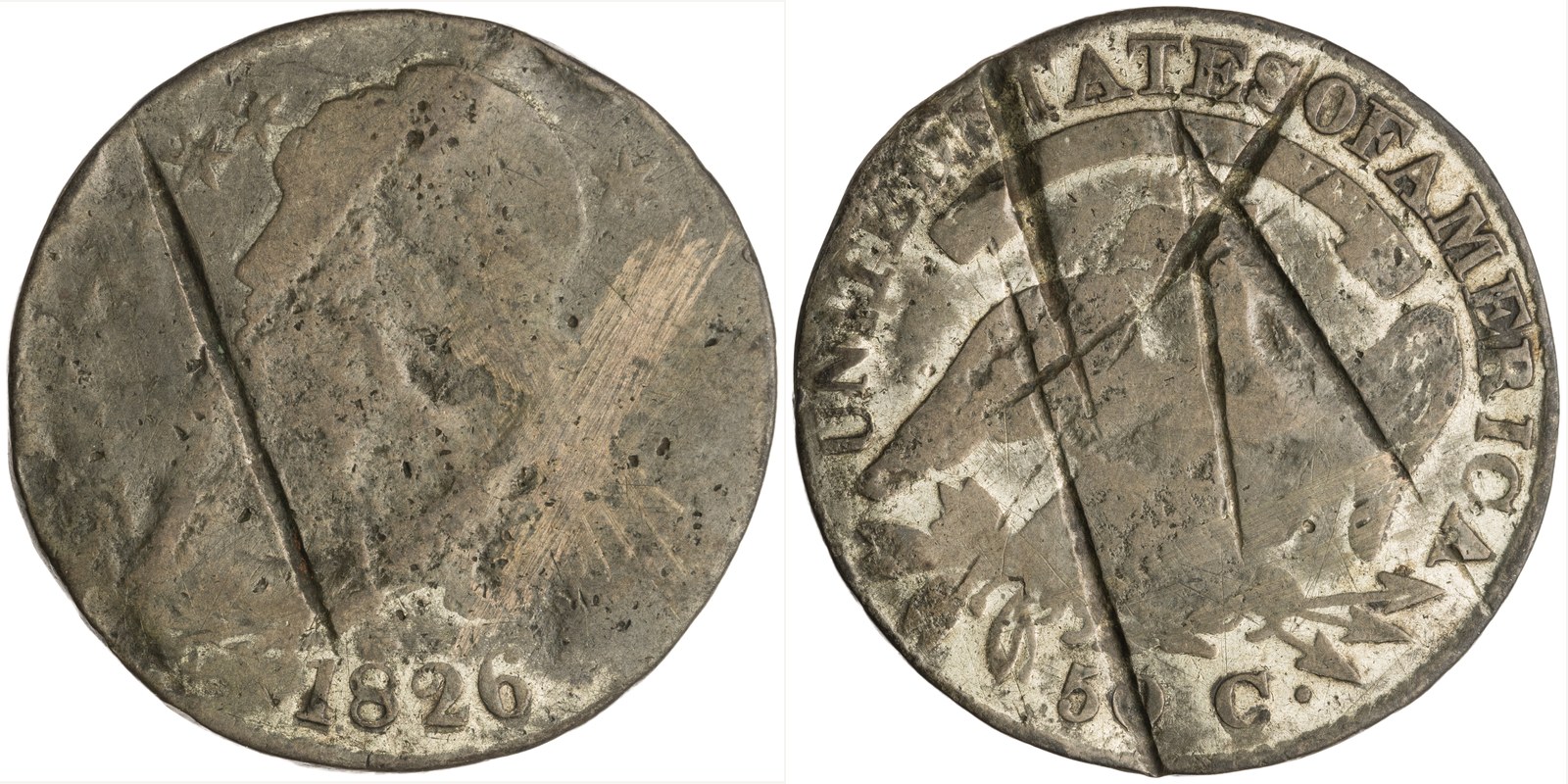
American Numismatic Society 1945.14.21 — Public Domain Mark / No Copyright – United States.
NOT A GENUINE COIN
A copper half dollar dated 1826, cancelled
Catalogued as COPPER, and defaced: someone cut deep lines across both faces so the piece could never pass again. That is what people did with a counterfeit they had detected and did not want back in circulation — and it is why so few contemporary counterfeits survive intact.
What it teaches. Contemporary counterfeits are a real and understudied part of this series. Keith Davignon's Contemporary Counterfeit Capped Bust Half Dollars is the standing reference; the OunceDesk Archive does not hold it, which is a genuine gap in this page's coverage and is stated rather than hidden.
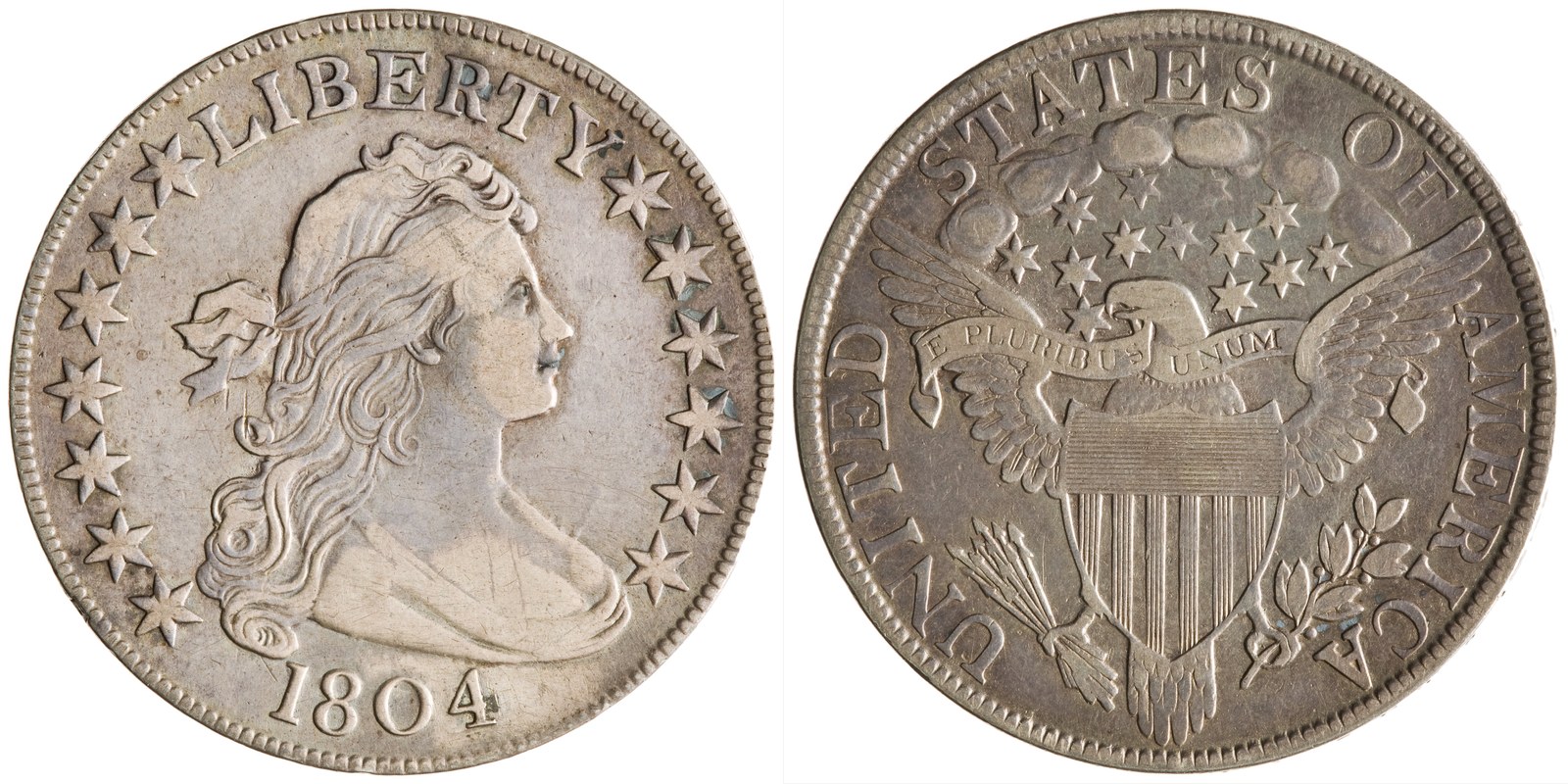
American Numismatic Society 2010.11.27 — Public Domain Mark / No Copyright – United States.
NOT A GENUINE COIN
An 1804 half dollar — which does not exist
The Mint recorded 156,519 half dollars delivered in calendar 1804 and no 1804-dated half dollar has ever been authenticated. This object bears the date 1804, weighs 13.305 g and measures 32.6 mm — and the ANS catalogues it with the reference “Overton.1806.118 (fake)”. It is an 1806 die variety, altered. The Society holds a second piece filed under 1804, accession 1956.122.48, described simply as “Altered Date” with a date range of 1803 to 1804.
What it teaches. Notice what is most striking about the picture: this is the SHARPEST, best-preserved coin in this entire series' shipped image set. A genuine survivor of an early date is normally worn. A coin that looks better than everything around it, on a date the record cannot support, is telling you something.
In hand
The checks that are worth doing
Weight, against 208 grains
13.48 g standard, and the Mint's own assay says a genuinely circulated example should be within about half a per cent of it. A base-metal counterfeit will usually miss badly — brass and copper are both lighter than silver at the same volume.
Design against date
Flowing Hair 1794–1795 · Draped Bust small eagle 1796–1797 · Draped Bust heraldic eagle 1801–1807 · Capped Bust 1807–1836. It costs nothing and it catches a whole class of period fakes, including the ANS's brass 1809.
The last digit of the date
This series' overdates are ordinary rather than exceptional — 1805/4, 1808/7, 1811/10, 1812/1, 1814/3, 1815/2, 1817/3, 1817/4, 1818/7, 1819/8, 1820/19, 1822/1, 1824/1, 1824/4, 1827/6, 1829/7. Identify the overdate FIRST, then attribute the marriage. The overdate is not the attribution.
The edge, physically
Not from a photograph. In 1836 the edge decides which series the coin belongs to; in 1809 it decides which of two separately catalogued major varieties you are holding.
Whether the date has a plain-date page at all
For eleven of this series' thirty-nine issues PCGS publishes only variety pages — 1796, 1803, 1806, the 1807 Capped Bust, 1811, 1820, 1827, 1828, 1830, 1832 and 1834. If somebody is selling you “an 1806 half dollar” without saying which one, they have not looked at it.
The attribution's vintage
Overton renumbered the entire system in the 1970 revision. An O-number quoted from a pre-1970 source does not mean what it appears to mean, and old holders and old catalogues are full of them.
What this page cannot yet do
There is no photographic wear ladder here. A proper grading guide shows the same design at G-4, VG-8, F-12, VF-20, XF-40, AU-50 and Mint State, on the same date, photographed the same way. Doing that honestly needs seven rights-clean photographs of one date, and this series has sixteen photographs across thirty-nine issues. Twenty-three issues have no rights-clean photograph at all. Rather than assemble a ladder out of mismatched sources, or borrow one, this page describes what to look at and says the ladder is missing.
Nor is there a wear sequence for Reich's portrait. Which device flattens first on a Capped Bust half dollar, and in what order, is genuinely useful knowledge and it is not in the OunceDesk Archive. Edgar Souders' Bust Half Fever is the specialist work on this series' striking characteristics and is in copyright and not held.
And the counterfeit literature is a real gap. Keith Davignon's Contemporary Counterfeit Capped Bust Half Dollars is the standing reference for the objects in the three photographs above. Not holding it means this page can show you three catalogued fakes and cannot tell you how common their series are, who made them, or where. The museums are doing the work that the price guides will not — and there is a book about it that we have not read.
At the prices the key dates command, none of this is a substitute for certification. At the prices the workhorse dates command — a few hundred dollars for an attributable die marriage — learning to do it yourself is the whole point of the exercise, and the Bust Half Nut Club will not let you in until you can. How the club works →
Sources
OBSERVED
76 sources
ESTIMATED
1 source
DERIVED
2 sources
Sourced figures on this page trace to the ledger below. Editorial judgement is labelled as ours, and prices we have not sourced are not published.
The wear assay and the June 1845 recoinage are Eckfeldt & DuBois, New Varieties of Gold and Silver Coins (1850) — Assayers of the Mint writing about this exact series (S55). The edge descriptions are Snowden's (S40). The cleaning account is The Coin Collector's Journal, March 1881 (S52). The counterfeit and altered-date photographs and their identifications are the American Numismatic Society's own catalogue records, under a per-object Public Domain Mark; the fake attributions — “Overton.1806.118 (fake)”, “Altered Date” — are the Society's, not ours. Variety rarity is PCGS CoinFacts' (S61). Davignon, Souders and Leaman–Gunnet are cited as the standing references and are not held.
OunceDeskPrecious Metals IntelligenceIndependent research, market data, tools and coin intelligence for people who take hard assets seriously.