Nothing in this series is common. The most-struck date in the run — 6,546,200 pieces in 1836 — has a survival estimate for the plain lettered-edge variety of a few thousand. Read the tiers below as relative.
Read this before the tables
The rarest object in this series is not a date
In this series the rarest objects are not issues. 1817 was a 1,215,567-piece year and the 1817/4 marriage inside it is ten or eleven coins — fewer than the Class I and Class III 1804 dollars combined. 1806 was an 839,576-piece year and the Knob 6 No Stem inside it is five. A date-level rarity class cannot carry that, so this reference does not pretend it can: the issue classes below are structural, and the rarity that matters is carried on the varieties and key-dates pages, at the level where it actually exists.
1,215,567
half dollars delivered in 1817
10
1817/4 half dollars known
“N/A”
PCGS's mintage field for it
“N/A” is the correct answer and a rare piece of honesty in a mintage column: nobody knows how many coins came off that obverse before it was pulled. Ten survive — fewer than the Class I and Class III 1804 dollars combined.
Tier one
The coins that define the series
1817/4
Specimen photography — pending No rights-cleared photograph of this issue yet. We show nothing rather than the wrong coin.
DIE MARRIAGE RARITY · “N/A”
1817
The 1817/4 is the crown rarity of the series and the only mintage column in it that tells the truth: PCGS gives “N/A”, because nobody knows how many coins came off this obverse before it was pulled. Ten or eleven are known, R-9.5, from a year in which the Mint delivered 1,215,567 half dollars. Fewer survive than the Class I and Class III 1804 dollars combined. Described in print in October 1930 by E. T. Wallis of the California Stamp Company, Los Angeles; “rediscovered” by Al Overton in 1951, offered unsold in his own sale of January 1953 at lot 200, then sold privately that year for $1,500. Auction record $333,500 for the AU53 in November 2004.
Plain date, PCGS estimate as of 2026-08-23: 3,000 all grades · 100 in mint state · 12 at MS65+ · R-4.4
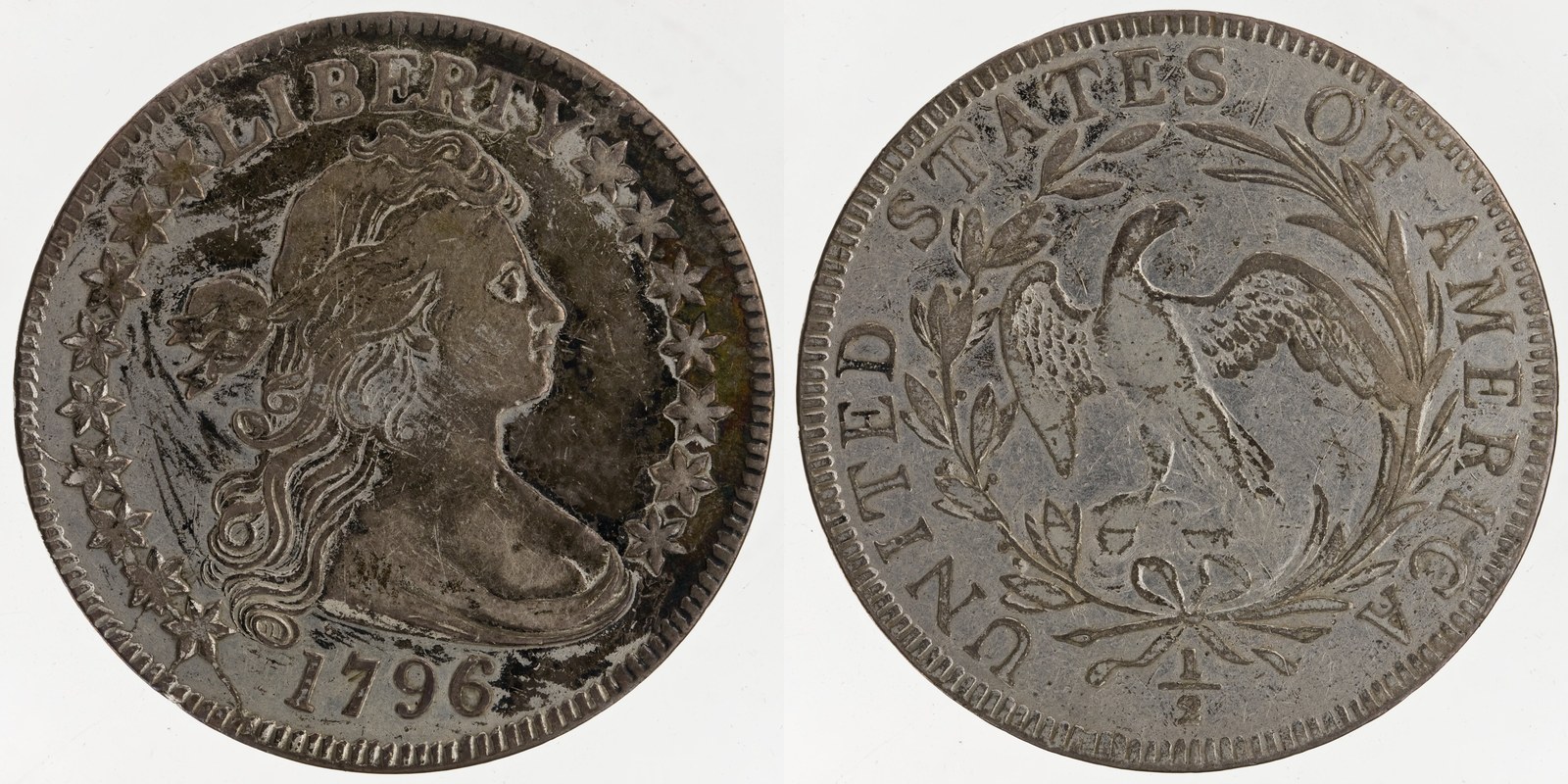
1796 · reference example · American Numismatic Society, Overton 1796 O-102 · public domain
TWO YEAR COMBINED DELIVERY · 934 (est.)
1796
1796 and 1797 together are a delivery of 3,918 coins, and the registry read literally says there were no half dollars of 1796 at all. Two obverses, fifteen stars and sixteen: PCGS estimates 75 known of the 15 Stars at R-8.2 and 40 of the 16 Stars at R-8.7, the latter with an auction record of $822,500. Two of them were in the Economite hoard and were paid out at face value before anyone realised what they were.
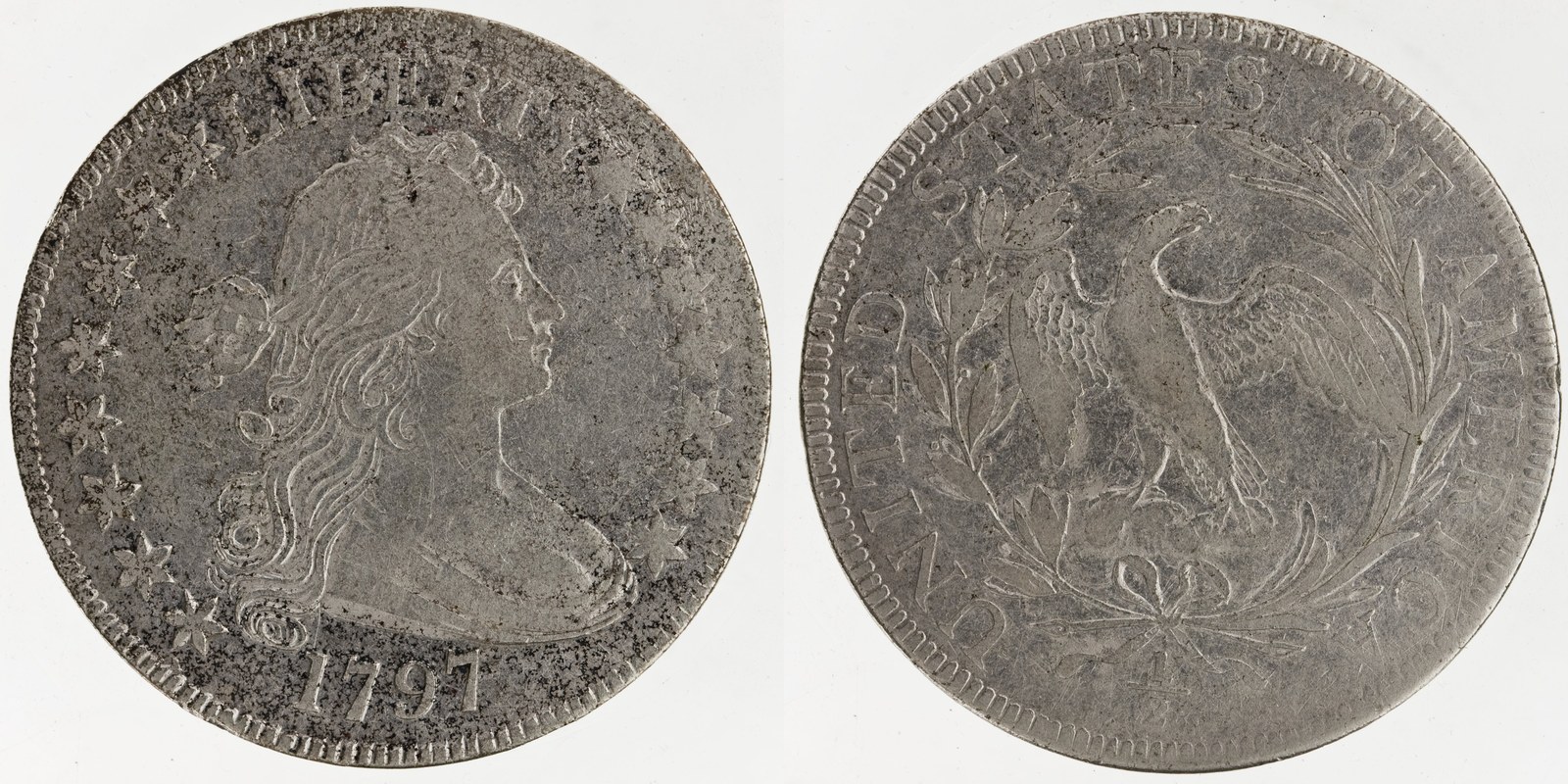
1797 · reference example · American Numismatic Society, Overton 1797 O-101/2 · public domain
TWO YEAR COMBINED DELIVERY · 2,984 (est.)
1797
The balance of the same 3,918. PCGS estimates 175 known at R-7.2 — and this date holds the series' price record: $1,560,000 for an MS65+ in January 2023.
Plain date, PCGS estimate as of 2026-08-23: 175 all grades · 3 in mint state · 1 at MS65+ · R-7.2
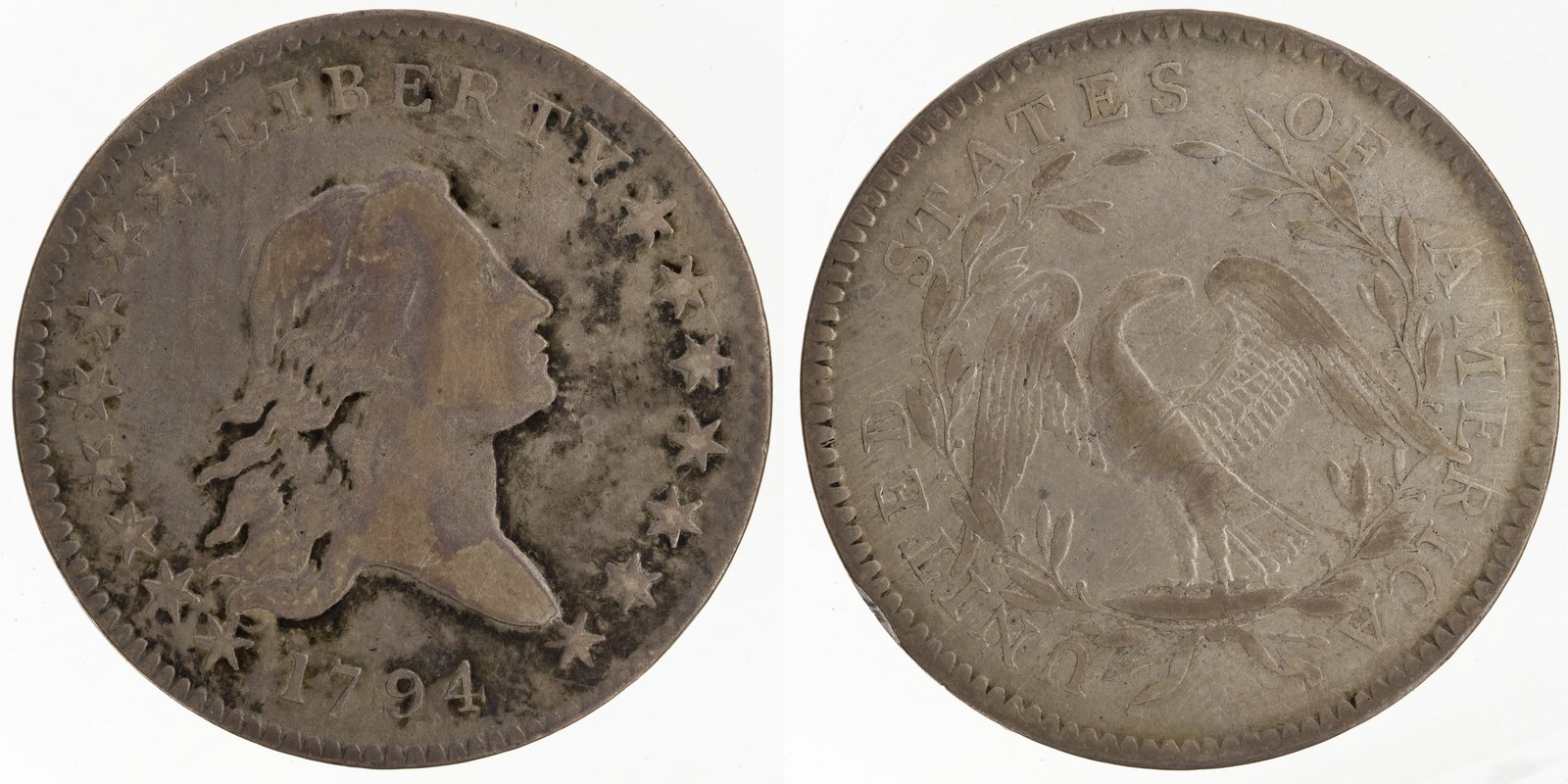
1794 · reference example · American Numismatic Society, Overton 1794 O-110 · public domain
FIRST YEAR RARITY · 5,300 delivered
1794
The Mint's second silver delivery ever, on December 1, 1794, and the softest number in the series: the published 23,464 is a date-attribution estimate, not a delivery figure. PCGS estimates 1,200 known at R-4.9, auction record $252,000. The condition-census head is an MS64 ex F.C.C. Boyd that sold for $210 in 1945 and $763,750 in 2015. One hoard is reported to have held 150 of them.
Plain date, PCGS estimate as of 2026-08-23: 1,200 all grades · 5 in mint state · 0 at MS65+ · R-4.9
Specimen photography — pending No rights-cleared photograph of this issue yet. We show nothing rather than the wrong coin.
DELIVERED IN THE FOLLOWING CALENDAR YEAR · 47,150 (dated)
1815
The whole delivery-versus-date problem in one coin. Every 1815 half dollar is an overdate, 5 over 2; the Mint delivered none in calendar 1815 and 47,150 in calendar 1816; and no half dollar bears the date 1816, because a barrel of wood ashes was leaned against a wooden wall on the night of January 11, 1816. PCGS estimates 800 known at R-5.4. The Economite hoard held 100 of them.
Plain date, PCGS estimate as of 2026-08-23: 800 all grades · 12 in mint state · 1 at MS65+ · R-5.4
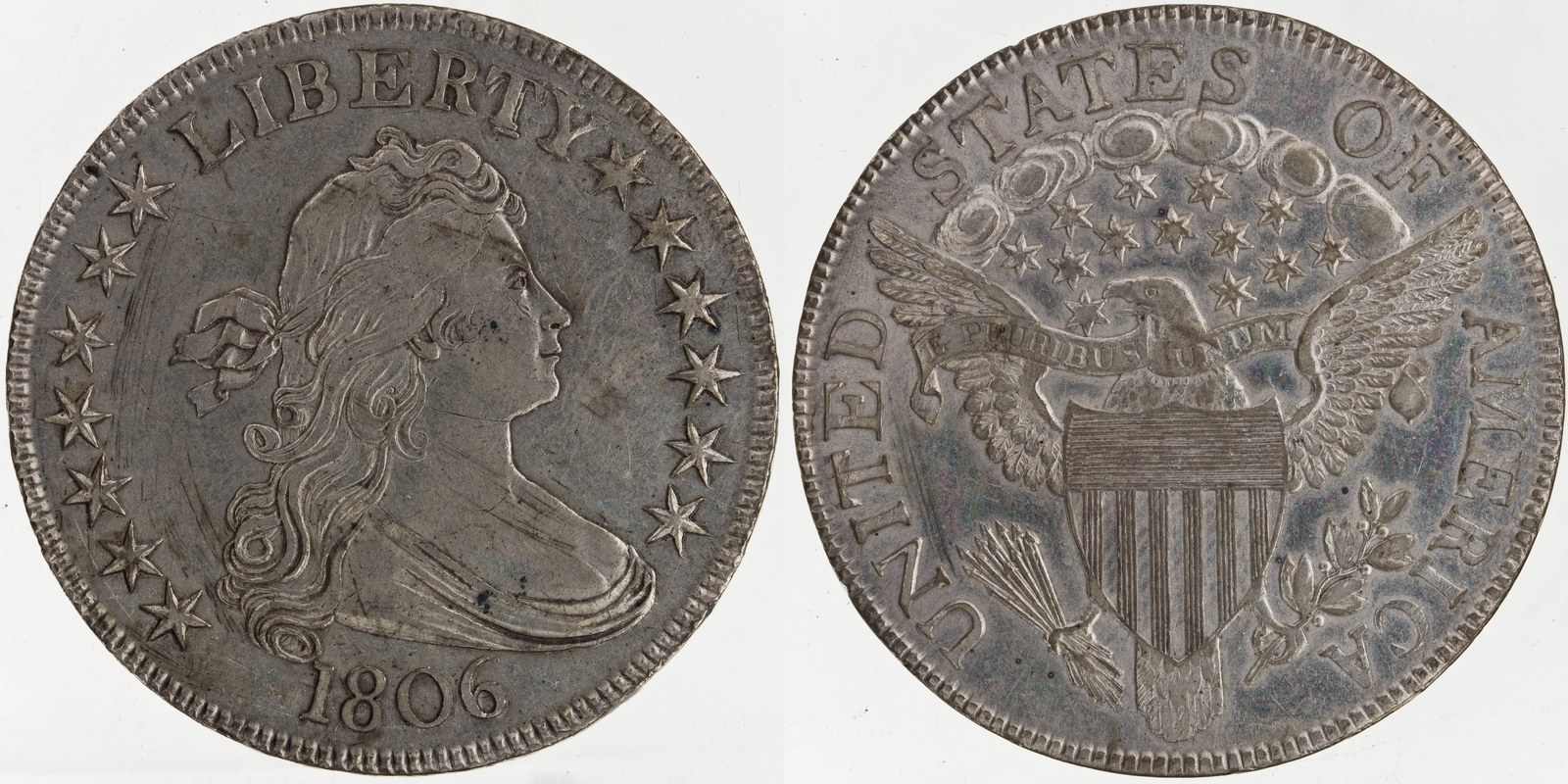
1806 · reference example · American Numismatic Society, Overton 1806 O-115 · public domain
VARIETY RARITY INSIDE A LARGE DATE · 839,576 delivered
1806
The best available demonstration that in this series the date is not the unit. Six major varieties share one delivery figure, and the Knob 6 No Stem is five known at R-9.7 against the Pointed 6 Stem at 2,500 — a rarity spread of 500 to 1 inside a single year and a single recorded number.
Condition rarities and the varieties that carry premiums
41 major varieties PCGS estimates separately, sorted from rarest. Survival is all grades / 60 or better / 65 or better, with PCGS's Numismatic Rarity — all of it PCGS's own estimate, observed 2026-08-23. Note how many of these rows are a variety rather than a date, and how far apart two rows of the same year can sit.
Issue or variety
Rarity
All / 60+ / 65+
Auction record
1806 Knob 6, No StemThe rarest listed major variety in the series — five known from a delivery of 839,576.
R-9.7
5 / 0 / 0
$126,500 EF40 (2009)
1817/4PCGS gives the mintage as “N/A”. Ten or eleven positions in the condition census.
R-9.5
10 / 0 / 0
$333,500 AU53 (2004)
1796 16 StarsSixteen stars for Tennessee's admission in June 1796.
Two varieties this reference discusses have no PCGS page and therefore no link: the 1807 “Bearded Goddess” O-111a and the 1795 A over E in STATES. Both are named in PCGS's own variety tables. They are left unlinked rather than guessed at, because a fabricated PCGS URL returns a clean HTTP 200 and a generic page rather than an error.
Tier three
The workhorse dates, for calibration
These are what a type collector or a beginning marriage collector actually buys. Survival figures are for the plain date only — each year also has separately listed varieties with their own estimates — so read every number here as a floor.
PCGS's estimates for the 1824 read 7,000 across all grades, 300 in 60-or-better and 210 in 65-or-better. That last figure would mean 70% of Uncirculated 1824 half dollars grade MS65 or finer, against 5–7% in every neighbouring year: 1825 is 400 / 22, 1826 is 700 / 50, 1829 is 400 / 25. It is almost certainly a transposition of 21.
Not used. Treated as an error until independently confirmed.
The high-grade tail is the hoard signature
Set 1826 (700 in mint state, 50 at MS65 or better) and 1831 (750 and 50) against 1819 (100 and 7). Uncirculated bust halves are not evenly distributed across the run; they cluster where bags survived, because coins used as bank reserve were counted rather than spent. The hoards →
Treated as secondary
The proof strikings
PCGS separately catalogues proof half dollars of 1818 through 1832 and 1834, 1835 and 1836, plus three “Crushed Lettered Edge” proofs of 1833, 1834 and 1835 — an already-lettered planchet struck in a close collar, flattening the edge legend. PCGS gives the 1833 Crushed Lettered Edge a mintage of 5 and an auction record of $141,000 for a PR65 in February 2016, and records a proof 1836/1336 O-108 with a mintage of 10. These are Mint products in the same institutional sense as the early-dollar restrikes: made in tiny numbers, often years after the date, and sold or given out of the building.
Treated as secondary, because this reference has done no independent work on them. The OunceDesk Archive holds no source on the proofs of this series beyond PCGS, and no independent work has been done on them. Everything above is PCGS's, attributed to PCGS, and should be read as secondary until this reference can do better.
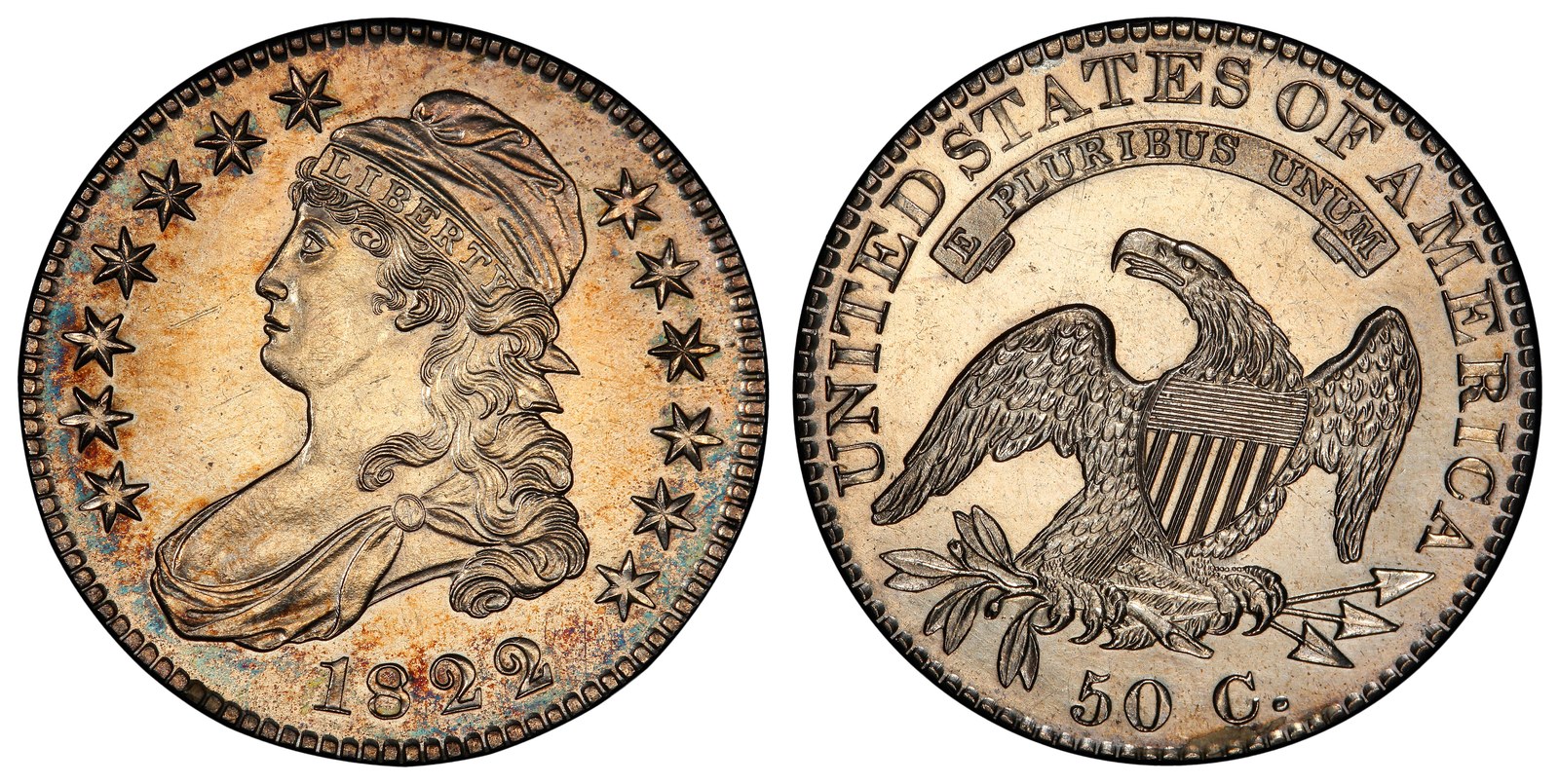
An 1822 proof half dollar. National Numismatic Collection, National Museum of American History; public domain. The 1822 issue page →
What is missing from this page, and why
No population-report figures. Grading-service population data is proprietary. Everything above is a survival estimate, published with the name of the party that made it and the date it was observed.
No die-marriage rarity ratings. The rarity of an individual O-number is Overton's, Parsley's and the Bust Half Nut Club's work, revised in the 1987 supplement and again in each edition. The OunceDesk Archive holds none of it and invents none. Every rarity number above is PCGS's Numismatic Rarity for a major variety.
No condition census below the top few positions, except for the 1817/4 and the 1815/2, where PCGS publishes pedigreed chains and this reference reproduces them with their sourcing labelled.
And not the BHNC census. The club's confidential biannual census of every member's holdings by die marriage and grade is the best survival data that exists for this series. It is private, and OunceDesk has not sought it.
Sources
OBSERVED
76 sources
ESTIMATED
1 source
DERIVED
2 sources
Sourced figures on this page trace to the ledger below. Editorial judgement is labelled as ours, and prices we have not sourced are not published.
Survival estimates, Numismatic Rarity, condition census and auction records are PCGS CoinFacts' (S61), observed 2026-08-23. Narrative judgements about this series are Q. David Bowers', because PCGS's own pages carry that credit line. Delivery figures are the Mint's own contemporaneous reports. Coin photographs are the American Numismatic Society's and the National Numismatic Collection's, both public domain.
OunceDeskPrecious Metals IntelligenceIndependent research, market data, tools and coin intelligence for people who take hard assets seriously.