This series' attribution system is the most fully developed in American numismatics, and it is the only one with an end date announced by the manufacturer. Both facts come from the same place: for forty-two years the Philadelphia Mint could not make two identical dies, and in 1836 it reported that it could.
First principles
Why the unit is the marriage, not the die
Every element on an early half-dollar die that is not the central device was entered into the die face by hand, one punch at a time: the dentils of the border, the four digits of the date, the thirteen — or fifteen, or sixteen — stars, the letters of the legends, the denomination, and on the Capped Bust reverse the lines of the shield on the eagle's breast, which were engraved freehand on each die. The Bust Half Nut Club states the consequence plainly: the position of each of these items relative to the others is different for every die produced.
The unit of study is therefore not the die but the marriage — one specific obverse used with one specific reverse. A date is not a variety. “1814/3” is not the 1814 variety, because there are several 1814 marriages and several 1814/3 marriages. That distinction is the first thing the club insists on and the first thing a beginner gets wrong.
The 1794 makes the point before anything else does: eleven obverse-and-reverse pairings are catalogued for a delivery of 5,300 coins. Dies failed constantly, and a series that needed eleven pairings to strike five thousand pieces was always going to be collected by marriage.
Die states are the second axis
Lower-case suffixes are die STATES, not marriages. O-101 and O-101a are the same pair of dies at different points in their working life — before and after a crack, a clash, a lump or a lapping — and some marriages run to a second and third state. The Bust Half Nut Club counts them as one marriage for membership purposes while collecting them avidly. Die states are the series' second axis and its deepest rabbit hole.
What you actually read
Three axes — and one the dollars barely have
Obverse
Star positions relative to the dentils and to Liberty's portrait are the primary diagnostic, with date position and star-to-star spacing as secondary. Stars are numbered clockwise from the lowest left star: 1–13 on the Capped Bust and Heraldic Eagle issues, 1–15 for 1794–1797, and 1–16 for the 1796 sixteen-star obverse.
Reverse
On the Capped Bust reverse the ribbon carrying E PLURIBUS UNUM was in the master die and is the same on every die — so the position of the legend letters relative to the ribbon, and to each other, identifies the die. The denomination's position relative to the eagle's claws and the stem end of the olive branch is a second key; the shield lines, engraved freehand on each die, are a third. On the Flowing Hair and Draped Bust reverses the diagnostic is different and older: berry counting, which is what Haseltine was doing in 1881 and what a Pittsburgh collector was still doing in 1924.
Edge
The axis this series has and the dollars barely do. FIFTY CENTS OR HALF A DOLLAR was rolled onto the blank planchet by a pair of parallel bar dies BEFORE striking. On most pre-1807 coins there are stars, boxes and circles between the words; afterwards a shifting repertoire of stars, X's, I's and straight or angled lines. Snowden describes the 1794 edge as “FIFTY ** [ornament] CENTS **** OR ** HALF ** A ** DOLLAR” and notes that on the 1807 Capped Bust edge “the ornaments [are] omitted.”
Two consequences of the edge
▪Edge errors are diagnostic, not damage. Missing letters and doubled letters are inherent to the process — compare the 1809 XXX Edge and III Edge, which PCGS treats as separate major varieties with different rarity, R-6.2 against R-5.2.
▪Edge dies wore out and were replaced, so they date the coins. Tracking which edge die struck which marriage produces a probable EMISSION ORDER — the sequence in which marriages were struck — “even if a common die was not used on each marriage.” This is the series' most distinctive research method and it has no equivalent in the early dollars. The foundational work is the Leaman–Gunnet edge-die study presented at the ANS Coinage of the Americas Conference in 1986, which the OunceDesk Archive does not hold.
One thing this reference records rather than asserts: the club's own image captions pair an O-number with a T-number — “1794 O-105 / T-3”, “1807 O-112 / T-4”. The T-series is very probably the edge-die designation from the Leaman–Gunnet work. That has not been confirmed and is not claimed here.
The convention
How Overton numbers work
They restart at 101 for every date. 1794 O-105 and 1836 O-105 have nothing whatever to do with each other. Compare the BB-numbers of the early dollars, which run in one continuous sequence across the whole series: BB says “this is one run”, and O says “this is one run of dated runs.” Overton went the other way deliberately, and the difference matters every time somebody quotes a bare number.
The sequences are long. As listed on PCGS's die-variety index: 1794 runs to O-111, 1795 to O-133, 1806 to O-130, 1817 to O-113 and 1836 to O-123. Those are PCGS's listings rather than Overton's full census — treat them as a floor.
Named varieties sit on top of the numbers. PCGS carries 1836 O-108 as “1836/1336”, five 1836 marriages as “Bar Dot”, O-106 as “Beaded Reverse”, and an 1817 O-106a as “Single Leaf”. Those names are trade shorthand for particular O-numbers, and a published page should give both.
This site's citation convention
Give the O-number with its date and, where it exists, the die state: 1807 O-111a “Bearded Goddess”. Never a bare O-number — Overton restarts at 101 for every date, so 1794 O-105 and 1836 O-105 have nothing to do with each other. Where the coin also has a PCGS major-variety name, give it in quotes, because that is what appears on holders and in auction titles; and where PCGS has NO such name, say so, because a reader will otherwise assume the coin does not exist. Where an O-number comes from a pre-1970 source, flag it: Overton renumbered in the 1970 revision.
Twelve marriages, ranked for pedagogy
The teaching set
Ranked by what each one teaches, not by price or rarity, and balanced deliberately across the 1807 seam — five before and seven after — because the pre-1807 run is two per cent of the pieces and half the difficulty. A student who can attribute these twelve can attribute the series.
OBVERSE
Schematic locator — the date and the stars. Diagnostic photography pending.
01 · THE DATE AS THE LESSON
1794 — eleven marriages for five thousand coins
What to look at. Eleven obverse-and-reverse pairings, O-101 through O-111, several with die states — from a delivery of 5,300 pieces on December 1, 1794. Read star positions against the dentils first; date position second.
What it teaches. The single most important fact about this series before it teaches anything about dies: eleven pairings were needed to strike five thousand coins, because dies failed constantly. It is also the entry point for the delivery-versus-date lesson — the trade's 23,464 is an estimate, not the Mint's number.
Caution. An O-number is meaningless without its date. 1794 O-105 and 1836 O-105 have nothing to do with each other; Overton restarts the sequence at 101 for every date.
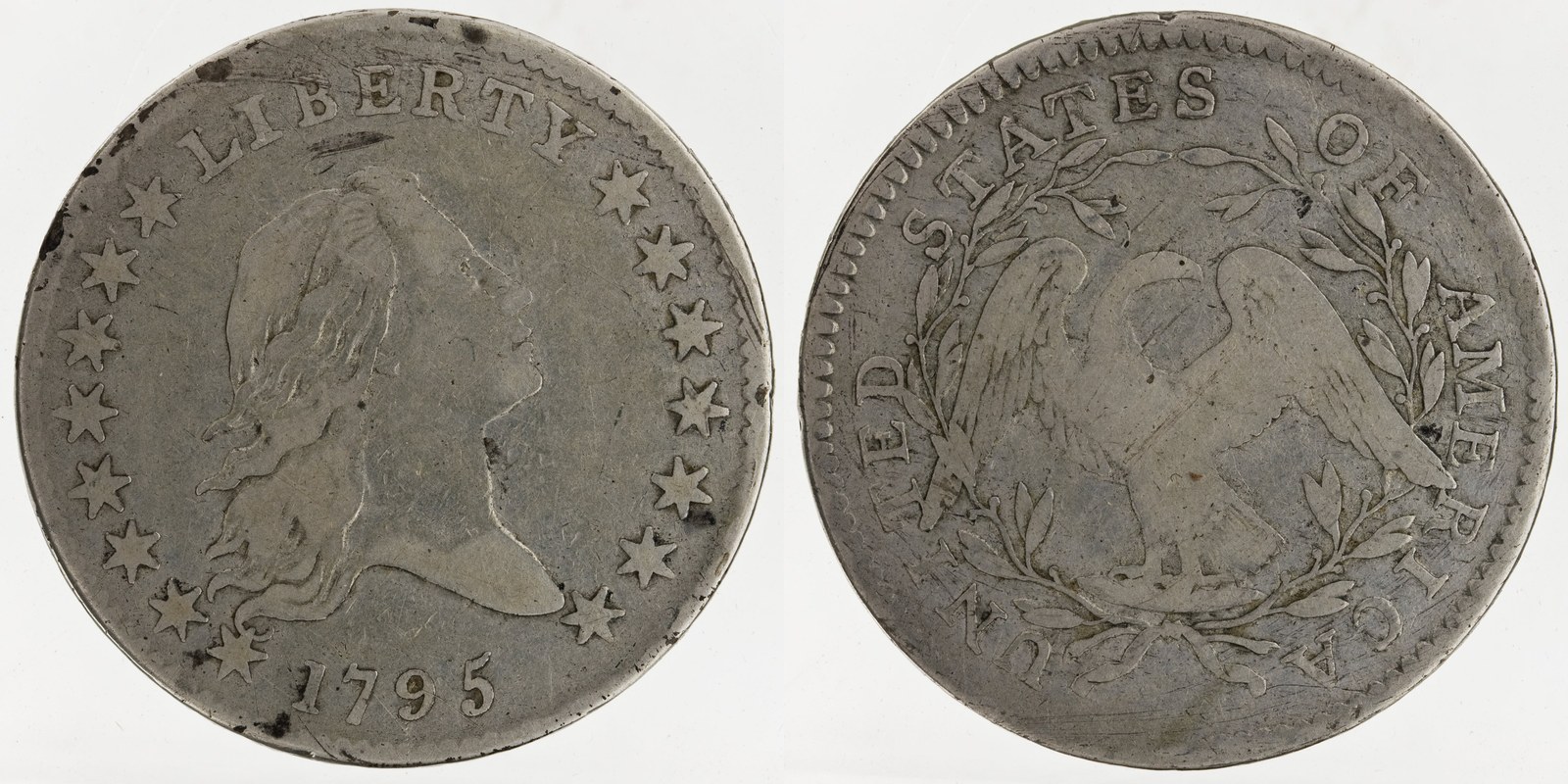
American Numismatic Society — Overton 1795 O-129, the institution's own attribution. Public Domain Mark.
02 · PUNCH vs PLANCHET
1795 recut dates and heads — the die was reused, not replaced
What to look at. The series' widest date — PCGS lists to O-133 — with five separately catalogued major varieties: Recut Date 3 Leaves (400 / 2 / 0, R-6.2), Recut Date 2 Leaves (100 / 0 / 0, R-8.0), Small Head (400 / 1 / 0, R-6.2), A over E in STATES (500 / 0 / 0, R-6.0) and a Silver Plug.
What it teaches. Four separate things a beginner conflates: a recut DATE (the punch struck twice), a different HEAD punch, a LETTER-punch error, and a PLANCHET correction. The leaf count under the eagle's wing is the same 2 Leaves / 3 Leaves diagnostic that runs through the 1795 dollars — one lesson, two denominations.
Caution. The A over E in STATES is cheap for its rarity precisely because it is hard to see. Cheapness here is a statement about legibility, not about scarcity.
Schematic locator — the star field left of the portrait. Diagnostic photography pending.
03 · STAR COUNT
1796 Fifteen Stars vs Sixteen Stars — count the states
What to look at. Two obverses inside a two-year delivery of 3,918 coins for 1796 and 1797 combined. 15 Stars: 75 / 5 / 0 at R-8.2. 16 Stars: 40 / 2 / 1 at R-8.7, auction record $822,500 for an MS66 in May 2015.
What it teaches. That a star count can be a political fact. Tennessee was admitted in June 1796 as the sixteenth state and the Mint added a star; by 1798 the count is back to thirteen, in Snowden's words “being emblematic of the original thirteen States.”
Caution. Two 1796 half dollars and one 1797 were in the Economite hoard and were paid out at face value before anyone realised what they were.
Schematic locator — the final digit of the date. Diagnostic photography pending.
04 · OVERDATE
1805/4 — the overdate that proves a phantom
What to look at. An 1805 obverse cut from an 1804 die, with the 4 visible under the 5. PCGS: 500 / 3 / 2 at R-6.0, auction record $152,750 for an MS65.
What it teaches. How to read an undertype — and then something better. In April 1891 Sylvester S. Crosby used this exact coin to argue that 1804 half dollars must have been struck, asking “what can have become of all the half dollars of 1804 if struck, — not a single undoubted specimen of this coin being now known?”
Caution. Crosby was right about the evidence and wrong about the conclusion. The 1805/4 proves an 1804 die was MADE, not that it was USED. It is the best worked example of that trap in either early-silver series.
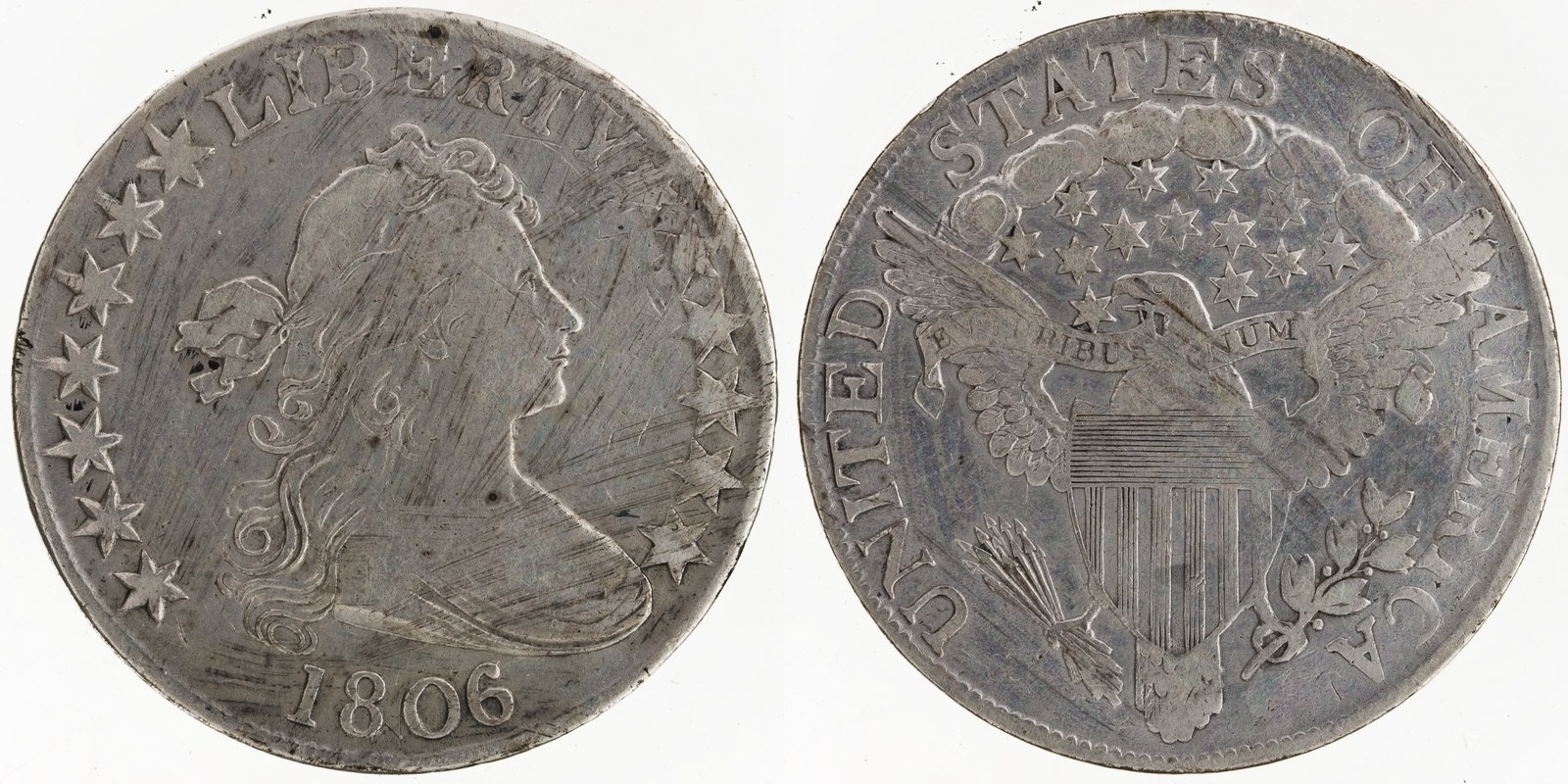
American Numismatic Society — catalogued as 1806/5, Overton 1806 O-103. Public Domain Mark.
05 · TWO INDEPENDENT AXES
1806 Knob 6 / Pointed 6 × Stem / No Stem — the coordinate pair
What to look at. Six PCGS major varieties over a single delivery of 839,576, two orders of magnitude apart in rarity: Knob 6 No Stem at 5 known (R-9.7, record $126,500 EF40 in 2009) against Pointed 6 Stem at 2,500 / 100 / 12 (R-4.5). In between: Knob 6 Small Stars (300 / 1 / 0, R-6.4), 1806/5 Large Stars (750 / 6 / 0, R-5.5), 6 over Inverted 6 (800 / 4 / 0, R-5.4), Pointed 6 No Stem (2,000 / 30 / 1, R-4.6).
What it teaches. That a variety name is often a COORDINATE PAIR — one obverse feature (the shape of the 6) crossed with one reverse feature (whether the olive branch has a stem through the claw) — and that the two axes are independent.
Caution. “No stem” is a DIE feature, not a strike weakness. A weakly struck stem is still a stem.
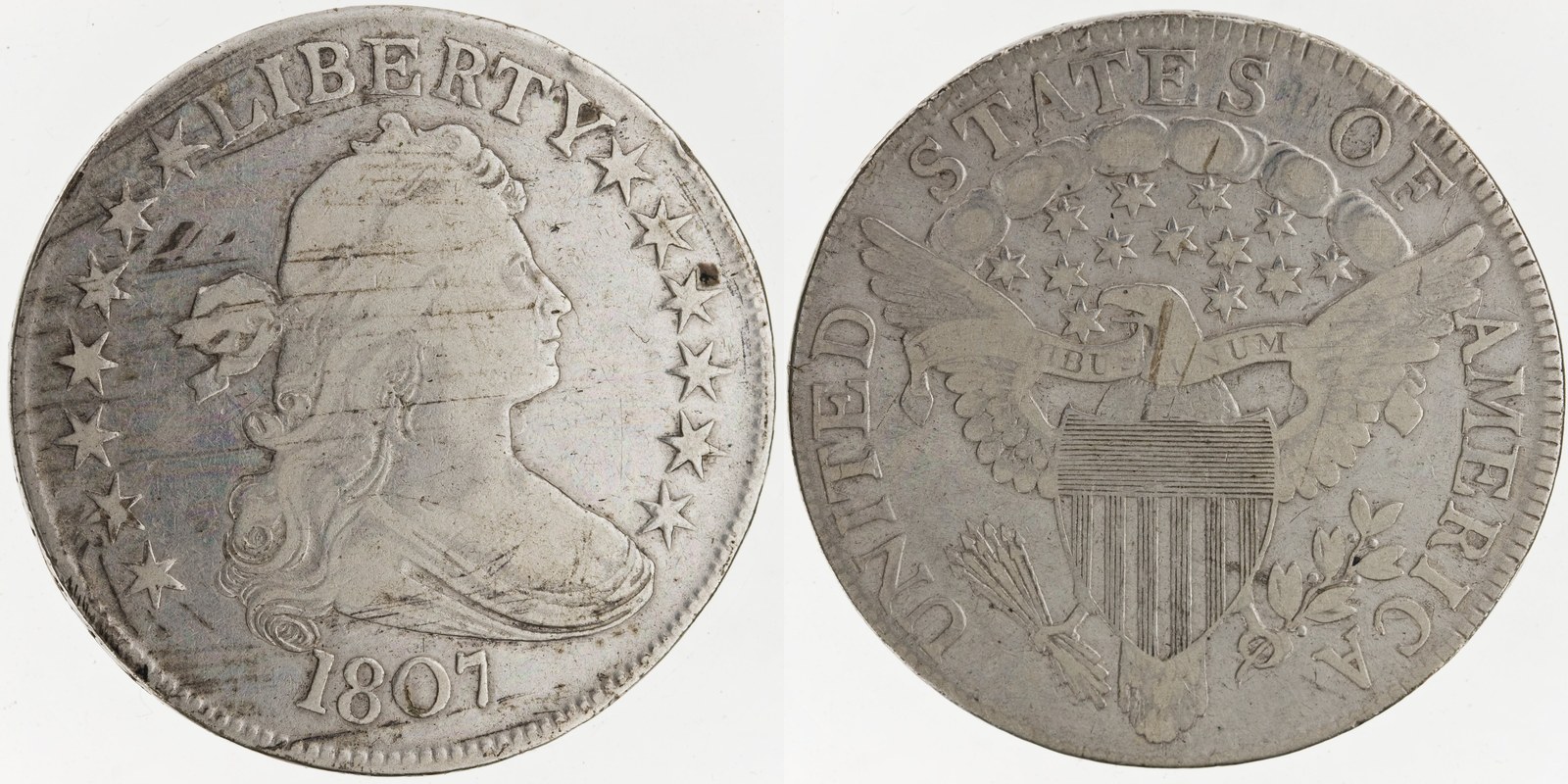
American Numismatic Society — Overton 1807 O-102, the last Draped Bust design. Public Domain Mark.
06 · TYPE SEAM
1807 Draped Bust vs Capped Bust — the redesign, inside one year
What to look at. Two coins that share nothing but a denomination and an edge legend, from one recorded delivery of 1,051,576 split by judgement into 301,076 and 750,500. Draped Bust: 3,000 / 150 / 7 at R-4.4. Capped Bust Small Stars: 600 / 10 / 2 at R-5.8.
What it teaches. That design transitions happen MID-DELIVERY, and that a mintage figure attached to a design type is usually a partition, not a count. The split traces to Snowden reading the Mint's books in 1860.
Caution. Only one of the two published figures for the old type closes against the delivery. See the registered contradiction.
1807 Small Stars, Large Stars, 50/20 and the “Bearded Goddess”
What to look at. The Capped Bust's first year carries two star-punch sizes (Small Stars 600 / 10 / 2 at R-5.8; Large Stars 450 / 6 / 0 at R-6.1); the 50/20, a denomination punched over a 20 (3,000 / 40 / 1 at R-4.4); and the “Bearded Goddess” O-111a, a die crack running from Liberty's chin that looks like a beard (100 / 0 / 0 at R-8.0, record $9,250 XF40 in 2016).
What it teaches. The difference between what the ENGRAVER did and what the DIE did afterwards. The 50/20 is a human error — the engraver reaching for the wrong punch. The Bearded Goddess is a steel event. Teaching them side by side is the cleanest way in this series to fix that distinction.
Caution. The Bust Half Nut Club uses an 1807 O-111a “Bearded Goddess” as the picture on its own home page. A famous die crack is still a die crack.
Schematic locator — between the 18 and the 11. Diagnostic photography pending.
08 · SYSTEM vs SYSTEM· NOT A PCGS MAJOR VARIETY
1811 “18.11” punctuated date — the two lists are different objects
What to look at. An 1811 obverse with what reads as a period between 18 and 11 — Overton O-110. PCGS's major-variety list for 1811 carries only 1811/10, Large 8 and Small 8. The punctuated date is not on it.
What it teaches. The most practically important thing a collector of this series learns: the commercial major-variety list and the Overton die-marriage list are different objects. A coin famous inside the club can be invisible on the holder.
Caution. Its 1817 cousin went the other way — the 181.7 Punctuated Date IS a PCGS major variety (500 / 8 / 1 at R-6.0, record $35,250 MS64+ in 2021). Two nearly identical phenomena, opposite treatment. That is a fact about grading services, not about coins.
Schematic locator — the last two digits of the date. Diagnostic photography pending.
09 · SEQUENCING
The overdate axis, 1808–1829 — one date is not one die
What to look at. Not a single coin. In the record: 1808/7, 1811/10, 1812/1 (Large 8 and Small 8), 1814/3, 1815/2, 1817/3, 1817/4, 1818/7 (Small 8 and Large 8), 1819/8 (Small 9 and Large 9), 1820/19 (Square Base 2 and Curl Base 2), 1822/1, 1824/1, 1824/4, 1824 “Over Various Dates”, 1827/6, 1829/7.
What it teaches. Sequencing: identify the overdate FIRST, then attribute the marriage. This inoculates against the commonest beginner's error, which is thinking the overdate IS the attribution. In several years there are multiple different die marriages of the same overdate.
Caution. The best single specimen for the lesson is the 1824 “Over Various Dates”, where the undertype is genuinely ambiguous and the trade has given up naming it: 1,000 / 60 / 1 at R-5.0.
Schematic locator — the 5 of the date. Diagnostic photography pending.
10 · OVERDATE + DELIVERY FOSSIL
1815/2 — the coin that dates itself wrong twice
What to look at. Every 1815 half dollar is an overdate, 5 over 2, from a die cut in a year when the Mint struck no half dollars at all — and the 47,150 pieces were delivered in calendar 1816. PCGS: 800 / 12 / 1 at R-5.4, record $182,125 for an MS66+ in August 2012.
What it teaches. The delivery-versus-date problem, the die-reuse economy and the war economy in one object. It is the only coin in the series whose story requires reading a Director's letter about a barrel of ashes.
Caution. The published “1815 mintage: 47,150” is correct as a DATE figure and wrong as a YEAR figure. The Economite hoard held 100 of them — one in eight of PCGS's entire survival estimate.
Schematic locator — the 7 of the date. Diagnostic photography pending.
11 · THE RAREST OBJECT IN THE FAMILY
1817/4 — the capstone
What to look at. Ten or eleven known. PCGS gives its mintage as “N/A”, which is the correct answer and a rare piece of honesty in a mintage column. Survival 10 / 0 / 0 at R-9.5; auction record $333,500 for the AU53 in November 2004, the same coin since traded at $310,500 (2006) and $356,500 (2009).
What it teaches. That in a die-variety series the rarest coin is not a DATE — 1817 was a 1.2-million-piece year — but a MARRIAGE, and that a marriage can be rarer than most of the coins in the 1804-dollar census. Ten coins survive from one pairing inside a million-piece year.
Caution. Nobody knows how many coins came off this obverse before it was pulled, and “N/A” is what an honest mintage column says when nobody knows.
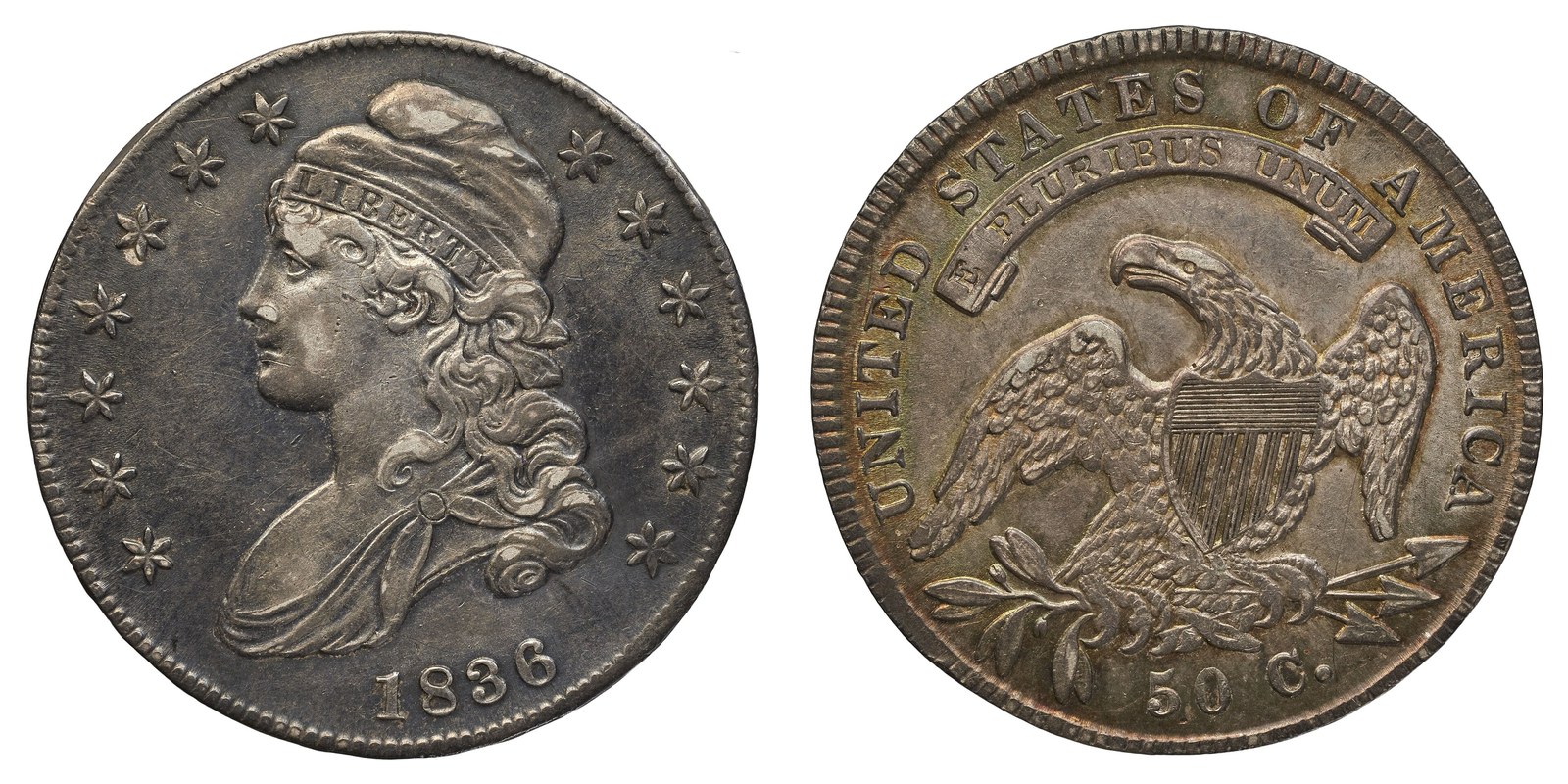
Bibliothèque nationale de France — an 1836 half dollar. The edge is not visible in this view, and 1836 is the year the edge decides which series a coin belongs to. Public domain.
12 · THE END
1836 50/00 and the lettered/reeded seam — the series ends inside a date
What to look at. The 1836 50/00, where the denomination is punched over an inverted or mis-struck 00 (600 / 20 / 2 at R-5.8), is the last great punch error of the lettered-edge era. Set it beside the plain 1836 Lettered Edge and the 1836 Reeded Edge and the year teaches the whole boundary.
What it teaches. One recorded delivery of 6,546,200, split 6,545,000 / 1,200; a screw press giving way to a steam press on March 23; hand milling giving way to steam milling; and hubs about to make every die a facsimile of the last. 1836 also carries the series' oddest named varieties — 1836/1336 (O-108), five “Bar Dot” marriages and a “Beaded Reverse” (O-106) — a last flourish of hand-work.
Caution. 1836 is not where the DESIGN changed. It is where the MANUFACTURING changed, and that is why the series ends there.
The OunceDesk Archive can document this chain end to end, including the part everybody forgets: the three separate attempts between Haseltine and Beistle to crowdsource a register, none of which produced a book.
Prose descriptions1859by date
Montroville W. Dickeson, The American Numismatical Manual
“One type and eleven varieties,” with no diagnostics a buyer could use.
Superseded. Cite as evidence of belief. · S60
H-numbers1881dollars, halves and quarters
John W. Haseltine, Type Table
Sequential per date. The half-dollar section runs lots 653–961, 1794 No. 1 to 1836 No. 6, described by berry count, star position, die crack and letter placement.
The ancestor — and still live commercial currency in 1928, when a dealer priced “1794 Haseltine No. 5 … $60.00.” · S41 · S50
The crowdsourcing decades1914 · 1922 · 1924half dollars
United States Coin Company Bulletin; Chas. E. Moellering, Fort Wayne, Ind.; correspondence in The Numismatist
Haseltine's table reprinted and collectors asked to send in what he missed — “totaling thirty-two varieties for these two years.”
The forgotten middle. All three episodes are in the OunceDesk Archive and none of them produced a book. · S46 · S47 · S48
Beistle numbers19291794–1929 — the whole denomination
M. L. Beistle, A Register of Half Dollar Die Varieties and Sub-Varieties, Shippensburg, Pa.
The first systematic register.
Superseded but foundational: Overton's first book was a supplement to it. Published in 1929, so it is PUBLIC DOMAIN by publication date — and the OunceDesk Archive does not hold it. · S63 · S49
O-numbersSupplement 1964; book 1967; revised 1970 with a NEW numbering system1794–1836
Al C. Overton, Early Half Dollar Die Varieties 1794–1836
Restart at 101 for every date; lower-case suffixes for die states.
The standard. The 1970 renumbering is why an O-number from a pre-1970 source must be treated with care. · S62
Bust Half Nut Club supplements1981 · 19871794–1836
The club as the system's maintainer
Ten new marriages in 1981; thirteen new in 1987, plus revised rarity ratings for every marriage.
Club-published additions. The OunceDesk Archive holds neither and quotes no O-number rarity. · S73
Every marriage photographed — at 2½× in 1990, 2× on coated paper in 2014 — with revised rarity.
Current. · S62 · S65
The boundary was found four times independently
Haseltine drew his line at the lettered/reeded seam inside 1836 in 1881, breaking his catalogue at lot 962 with the note that everything following is reeded edge. The hobby press named “between 1794 and 1836” in 1924. Overton put it in a book title in 1967. And the Mint had already drawn it in 1836, in a paragraph about hubs. Nobody was copying anybody; they were all looking at the same manufacturing change.
And one of them is public domain
Beistle's Register of Half Dollar Die Varieties and Sub-Varieties was published in Shippensburg, Pennsylvania in 1929 — which puts it in the public domain by publication date. The foundational register of half-dollar die varieties, the book Overton's first work was a supplement to, is free to reproduce and annotate. The OunceDesk Archive does not hold it, and that is an acquisition problem rather than a rights problem.
Where the die varieties stop
A terminal diagnosis, written by the Director
“Before the last year, the dies were formed only in part from the hub — much work still remaining to be executed by the engraver before they were ready for coining. By a modification of the process lately introduced, the entire impression on the die is transferred by the aid of the press alone; thus, not only saving much unnecessary labor to the engraver, but securing the desirable object of making the dies, for the same denominations of coins, exact fac-similes of one another.”Robert Maskell Patterson, Director of the Mint, reporting on 1836 · MR1836
That is a coin series' terminal diagnosis, written by the man who signed the death warrant. Every element on an early half-dollar die that is not the central device was entered by hand, one punch at a time — the dentils, the four digits of the date, the stars, the letters of the legends, the denomination, and on the Capped Bust reverse the lines of the shield, engraved freehand on each die. The unit of study is therefore not the die but the MARRIAGE: one specific obverse used with one specific reverse. And then, in one paragraph about hubs, it stops.
1836 is not where the design changed — the Capped Bust obverse survives to 1839. It is where the manufacturing changed, and that is why this series ends there and the reeded-edge halves begin.
The culture
The Bust Half Nut Club
Informally in 1966, with six charter members. The first official meeting was at the 1969 ANA convention in Philadelphia, with nine members present. Today it has roughly roughly 120 active collectors. It is not a club in the ordinary sense and says so: “No by-laws, elections, or club officers; just correspondence by mail, telephone, occasional road trip gatherings and meetings at coin shows.”
What makes it worth a section is that its entry requirement is a collection, not a cheque:
▪Regular membership: own at least 100 different die marriages attributed to Overton — or 30 for a candidate who collects only the Flowing Hair and Draped Bust types.
▪Associate: 30 marriages, or 10 for early-type-only. Junior, under 18: five.
▪You must be sponsored by a member in good standing, who must personally attribute and grade your collection to verify your application.
▪You must submit a full listing by date, die marriage and grade — and continue to do so semi-annually to the club's census keeper, under a signed confidentiality undertaking.
▪Then a thirty-day review period by the existing members. Dues are $12.50 a year; the application fee plus first year is $25.
The early-type concession is the honest complication. By lowering the bar to 30 marriages for a Flowing Hair / Draped Bust collector, the club's own rules concede that 1794–1807 is a different pursuit — which is the strongest available argument for the 1807 split this reference rejects. It is recorded here, not buried.
The club therefore maintains something almost no other American series has: a confidential, comprehensive biannual census of every member's holdings by die marriage and grade. That is a research asset of the first order, it is not public, and OunceDesk has not sought it and will not. Everything on this site about the club comes from its own public pages, credited.
The whole culture in one sentence
The candidate “must be full of the ‘fever’ and of course be ‘nuts’ for Bust Halves.”
What this page does not do
It publishes no O-number rarity rating. The rarity of an individual die marriage is Overton's, Parsley's and the Bust Half Nut Club's work — revised in the 1987 supplement and again in each edition — and the OunceDesk Archive holds none of it. Inventing one would be worse than having none, so there are none here. Where you see a rarity number on this site it is PCGS's Numismatic Rarity for a major variety, and it is labelled that way.
It publishes no die-variety photography beyond the museum pieces above. Modern die-variety close-ups are almost entirely copyrighted, and the diagnostic images that would be most useful here — a photographed 1817/4 date, a Bearded Goddess crack — belong to photographers who have not licensed them to us. The schematic locators say where to look and say plainly that the photograph is pending.
For what the marriages are worth in money rather than in learning, see key dates & rarities, which carries every major variety PCGS separately estimates — and the one estimate this reference declines to print.
Sources
OBSERVED
76 sources
ESTIMATED
1 source
DERIVED
2 sources
Sourced figures on this page trace to the ledger below. Editorial judgement is labelled as ours, and prices we have not sourced are not published.
The attribution method is the Bust Half Nut Club's own public description of it (S65), quoted under a LIMITED posture with attribution. Survival estimates and Numismatic Rarity are PCGS CoinFacts' (S61), observed 2026-08-23. The 1836 hubbing passage is the Director's report for that year (MR1836); the 1881 catalogue break is Haseltine's own (S41); the “between 1794 and 1836” sentence is from The Numismatist for August 1924 (S48). Coin photographs are the American Numismatic Society's and the Bibliothèque nationale de France's, both public domain, with the Overton attributions taken from the ANS's own catalogue records.
OunceDeskPrecious Metals IntelligenceIndependent research, market data, tools and coin intelligence for people who take hard assets seriously.