Every survival estimate below is labelled with the party that made it. Where a figure comes from PCGS CoinFacts it says PCGS — not Bowers, even where PCGS's own prose may paraphrase him. Where a nineteenth-century writer counted, the count carries his name and the year he counted it. Nothing here is “the” survival figure. These are opinions with owners.
Read the numbers correctly
Class, and date, on every census figure
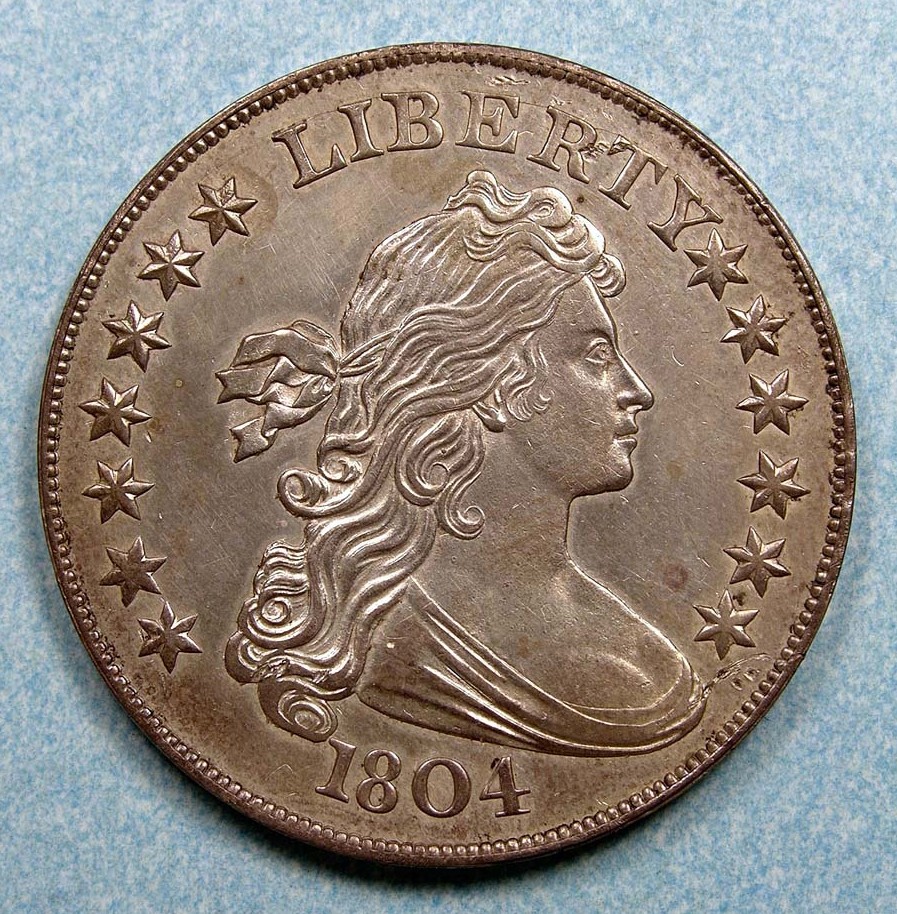
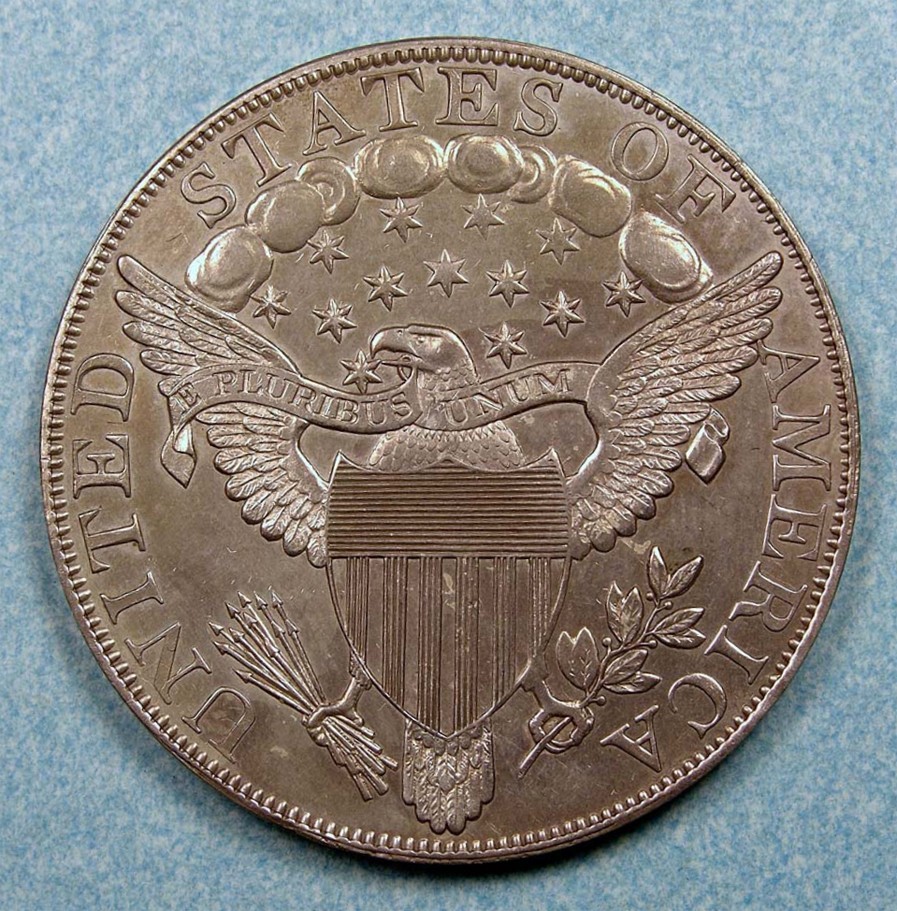
Published counts of the 1804 dollar, in order: 4 (Woodward, 1867) · 6 (Nexsen, April 1887) · 7 or 8 (Evans and Chapman, 1885) · 12 (Nexsen, 1891) · 13 (Nexsen, 1905) · 6 “originals” (Chapman, 1907) · “from twelve to fifteen” (The Numismatist, 1899) · 15 (Newman & Bressett, 1962, and everyone since) · 16 (as of 2026).
The count went down in 1907 because Chapman was counting a narrower class, not because coins vanished. It went up in 2025 because a coin nobody had published came out of a collection. Neither movement is about the coins; both are about the counting.
Site-wide editorial rule
Always say which class is being counted, and always date the count. A number without both is not a fact about the coins. It is a fact about a year.
Sixteen 1804 dollars across three classes, as of 2026.
Tier one
The coins that define the series
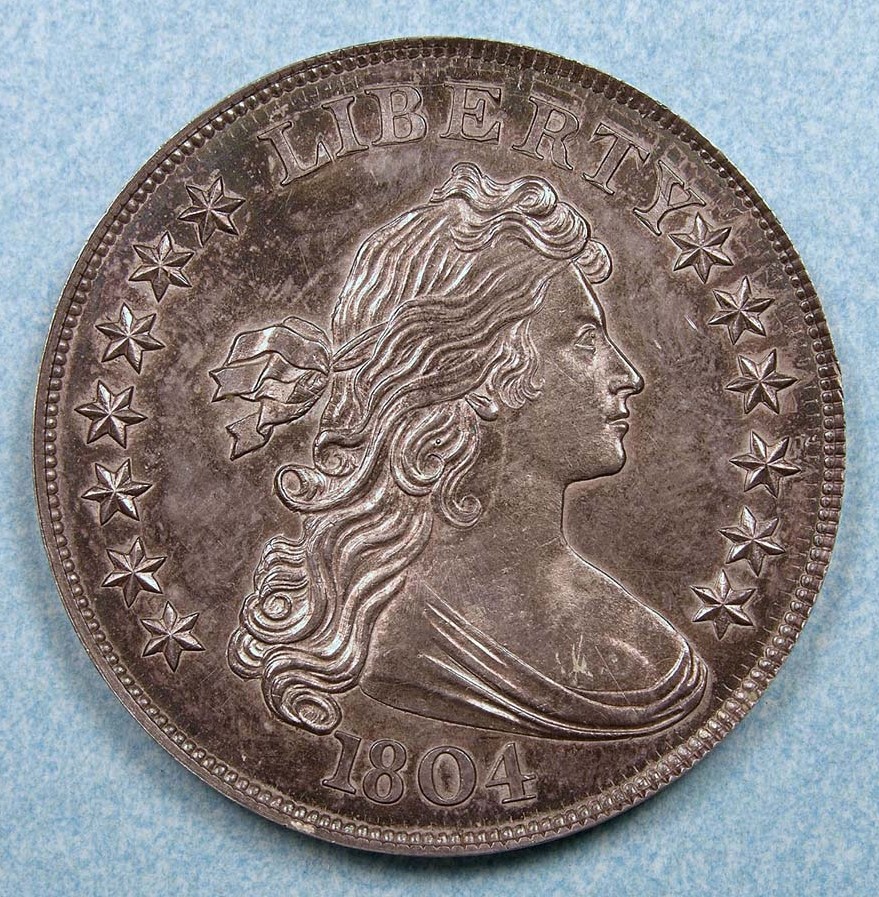
The Mint Cabinet specimen — National Numismatic Collection, National Museum of American History (public domain). Uncertified; no grade is published for this coin.
Struck c. 1834–35 for diplomatic presentation sets, not in 1804. PCGS's survival estimate is 8 and its mintage field also reads 8 — for this issue the two are the same number. It is the only coin in the series whose EXISTENCE is the subject, and the reason the series has a literature at all. Auction record $7,680,000 for the PR68 Watters–Childs coin, August 2021.
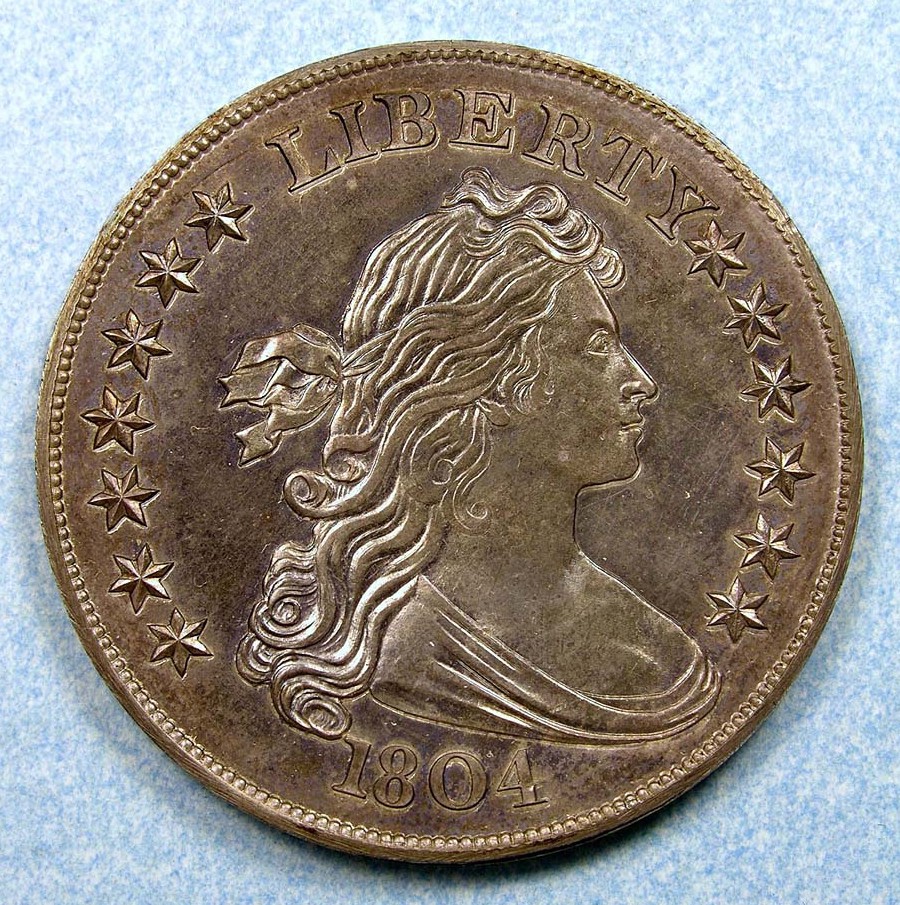
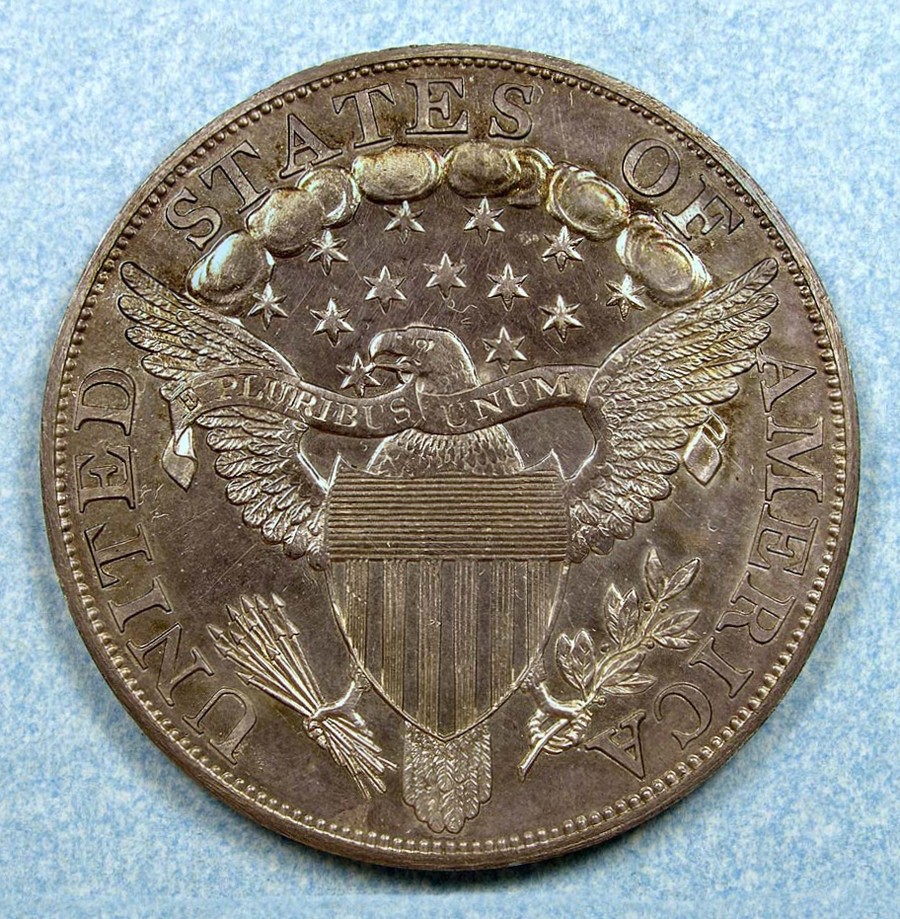
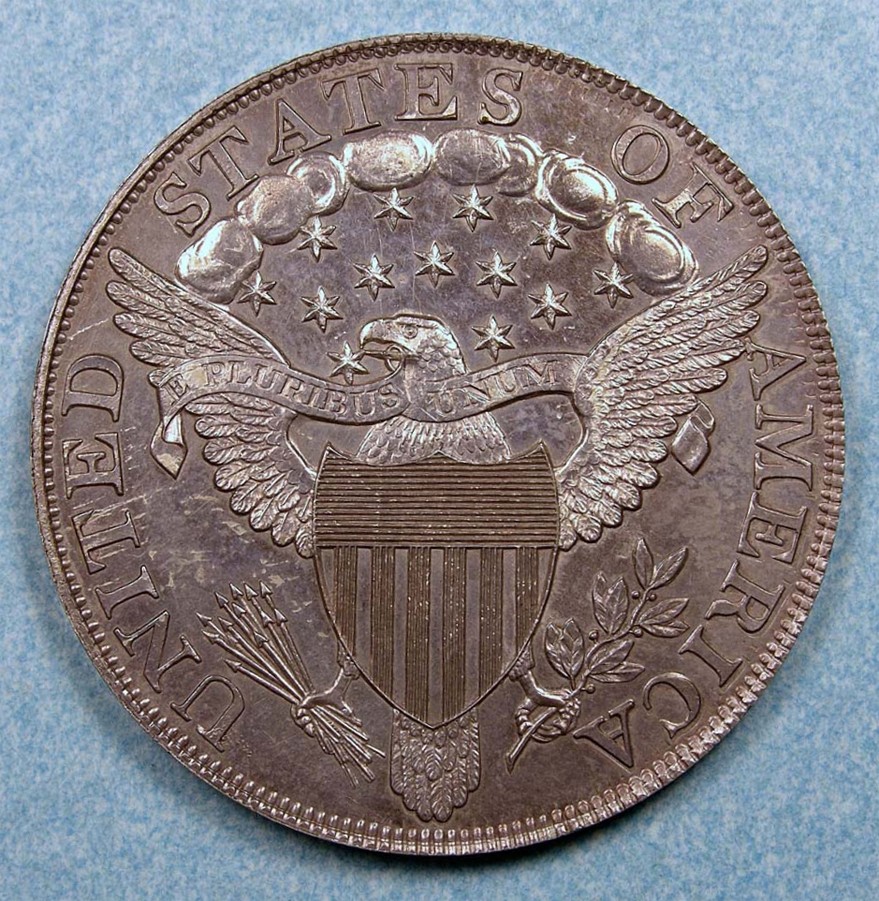
The Linderman specimen — National Numismatic Collection, National Museum of American History (public domain). Uncertified; no grade is published for this coin.
Struck c. 1858–60 at the Mint, without authority, from a recut obverse and a substitute reverse, then edge-lettered afterwards with partial collar segments — which is why the lettering repeats and drops letters. The count changed in living memory: the standing figure was six until the James A. Stack coin, unpublished until 2025, sold for $6,000,000 in December 2025.
The unique Class II — the plain-edge piece — National Numismatic Collection, National Museum of American History (public domain). Uncertified; no grade is published for this coin.
The unique plain-edge piece retained by the Mint in 1858 and now in the National Numismatic Collection. The Mint's own Assistant Curator described it in 1887 as "only a re-strike… much lighter in weight, and intended merely to exhibit the reverse side of the coin" — 381.5 grains against 415–416 for a standard dollar. It has no market and never will.
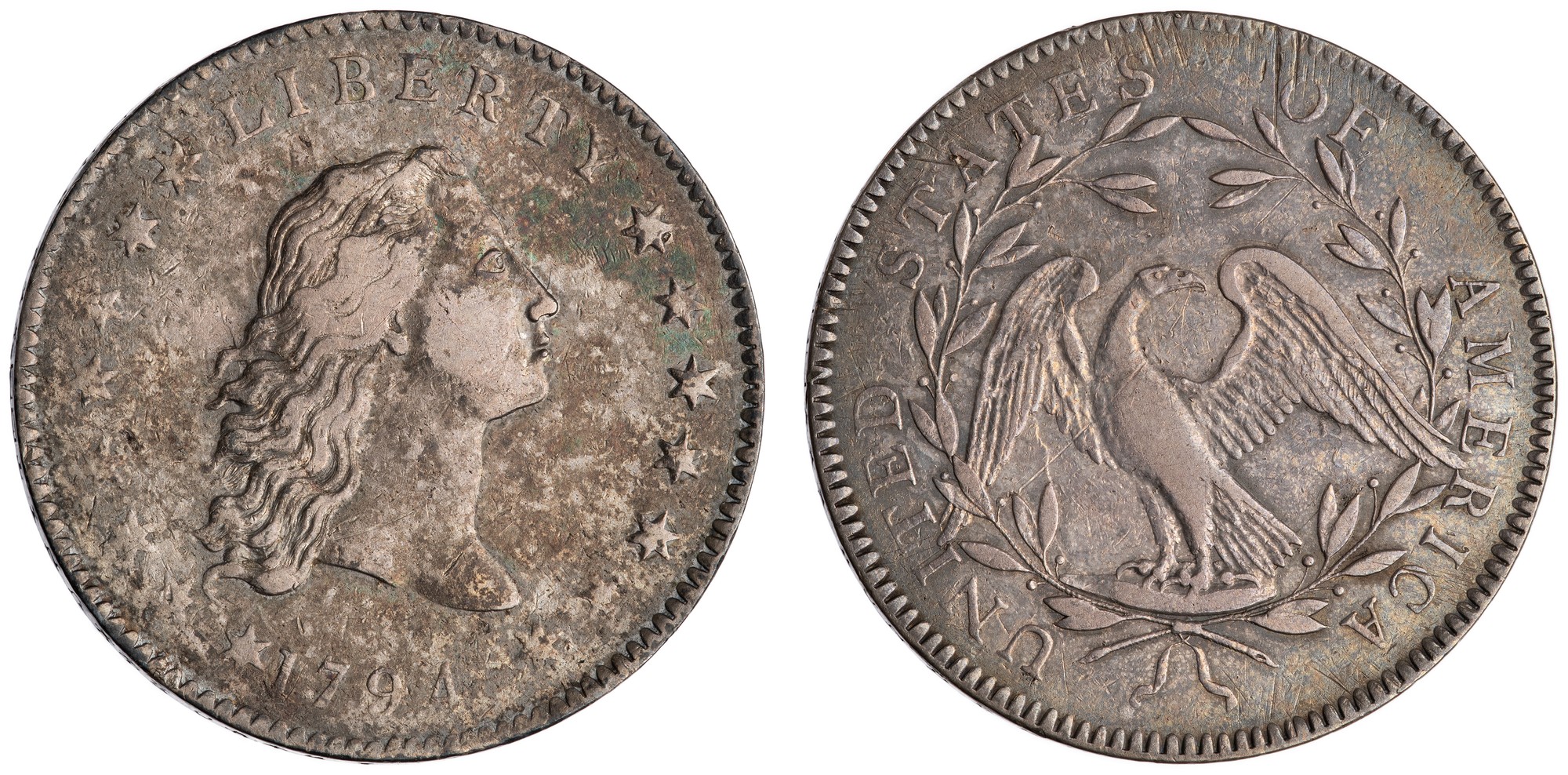
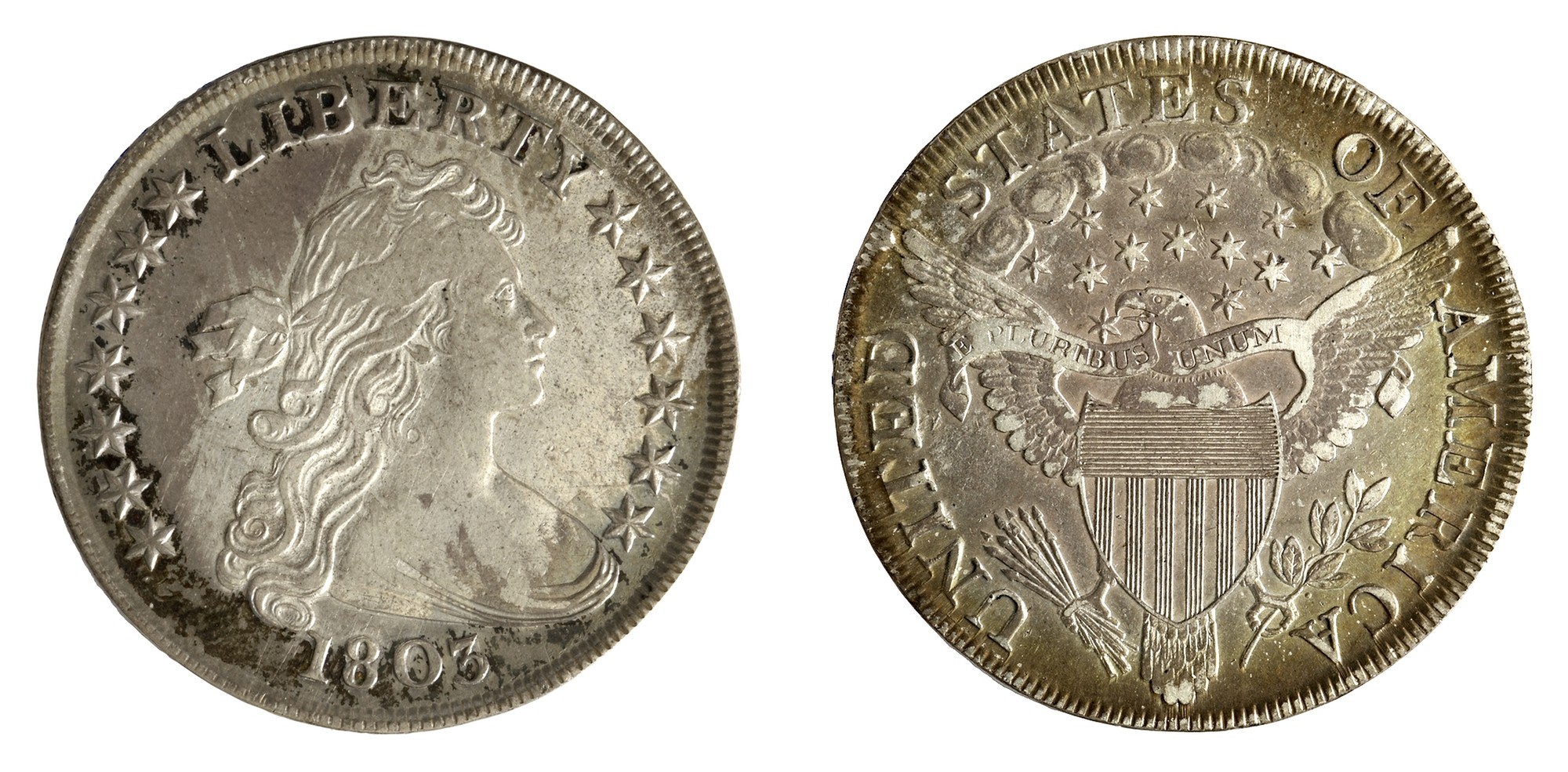
The first United States silver dollar, delivered October 15, 1794. One die marriage — BB-1 / B-1 — so there is no 1794 variety set to complete, which makes it a type collector's coin and a pure condition play. PCGS estimates 150 survivors across all grades, 10 in mint state, 4 at MS65 or better. Auction records $10,016,875 (silver-plug SP66, January 2013 — the first coin of any nation to cross eight figures), $6,600,000 (the Lord St. Oswald MS66+, August 2021) and $4,500,000 (MS63+, November 2025).
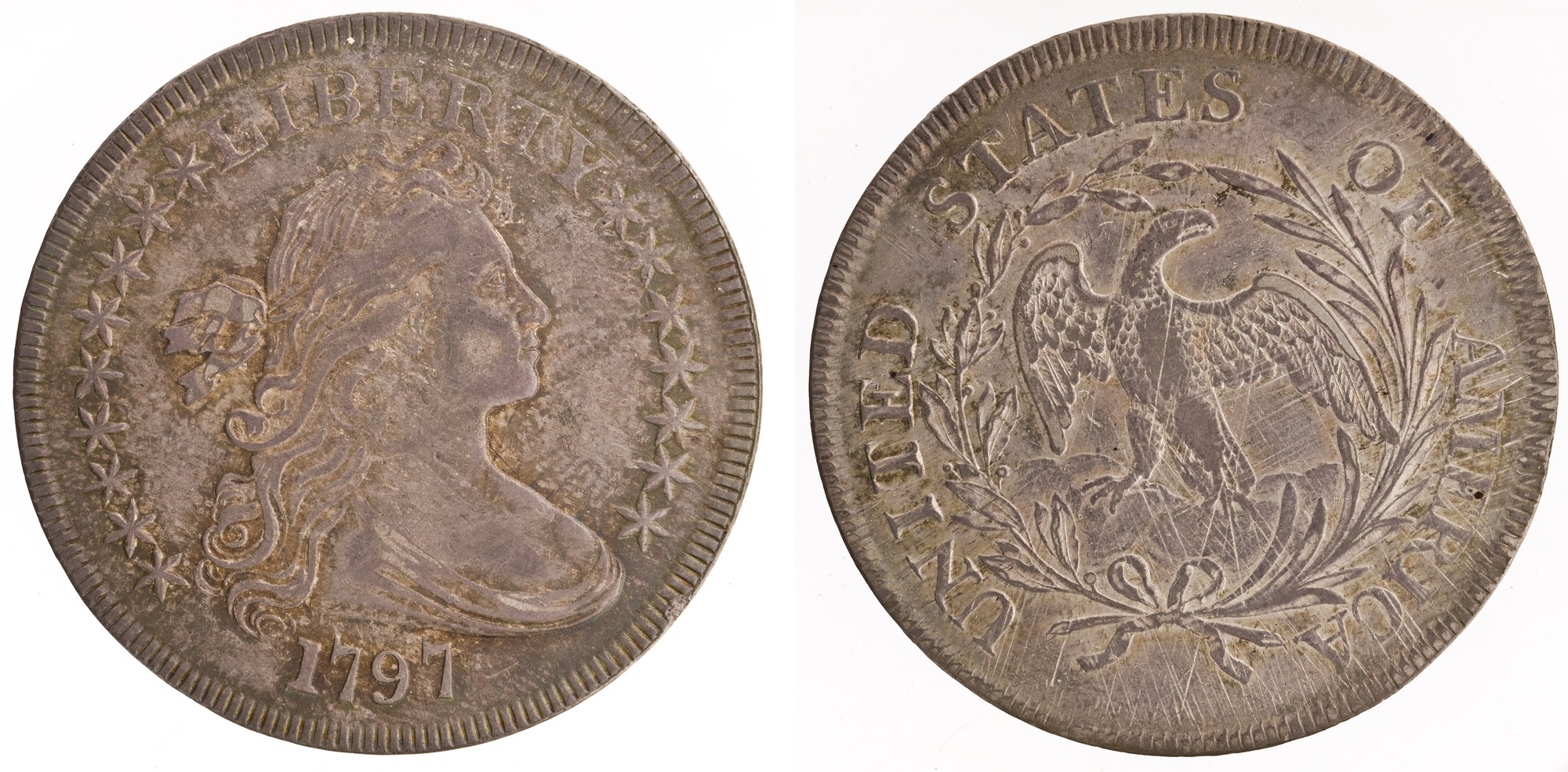
The lowest delivery figure of any regular-issue year in the series, and lower than most collectors expect. It is also the series' loudest arithmetic anomaly: a delivery of 7,776 against PCGS survival estimates totalling roughly 3,000 across the varieties implies a survival rate near 40%, against 2–3% for 1798–1803. Either 1797 dollars were saved at an extraordinary rate, or 7,776 is not the number of coins dated 1797 — and the second explanation is the likelier one.
An obtainable date carrying the series' most interesting piece of arithmetic. The Mint recorded 66,064; the reference literature carries 85,634; the difference is 19,570, exactly the 1804 delivery. The 1804 coinage was quietly reassigned to the 1803 date at some point in the twentieth century, and the fossil is still sitting in every price guide.
The Mint delivered 7,776 dollars in calendar 1797 — lower than any other regular-issue year in the series, and lower than most collectors expect. PCGS's survival estimates for the 1797 varieties total somewhere above 3,000 coins.
That implies a survival rate near 40%, against low single digits for 1798 through 1803. Either 1797 dollars were saved at an extraordinary rate for no reason anyone has ever proposed, or — far more economically — 7,776 is not the number of coins dated 1797.
This is the delivery-versus-date problem surfacing as an arithmetic anomaly two centuries later. It is the same problem the 1804 dollar exposes, in a date nobody argues about. The full attrition table →
Condition rarities and the varieties that carry premiums
Sorted by PCGS's Numismatic Rarity, rarest first. Survival is given in PCGS's own form — all grades / 60 or better / 65 or better — with “—” where PCGS publishes no figure. These are attributions, not dates: each of them is a die-marriage or punch distinction inside a year whose base issue is obtainable.
Variety
Rarity
Survival (all / 60+ / 65+)
Auction record
Note
1798 Knob 9
R-7.7
125 / 2 / —
$39,100 MS63 (2005)
Rarest of the Heraldic Eagle 1798 sub-varieties on PCGS's estimate.
1800 Wide Date, Low 8
R-7.7
125 / 2 / —
$115,000 MS64 (2005)
1799 Irregular Date, 13 Stars reverse
R-7.7
130 / 2 / —
$115,000 MS64 (2011)
1798 5 Stripes
R-7.0
200 / 4 / —
$126,500 MS63 (2006)
Shield-stripe count as an attribution point.
1795 Flowing Hair, Silver Plug
R-6.6
250 / 6 / 2
$210,000 MS61 (2023)
The plug is a Mint process, not damage.
1799 8×5 Stars obverse
R-6.6
250 / 4 / —
$143,750 MS64 (2005)
1800 Dotted Date
R-6.3
350 / 2 / —
$126,500 MS66 (2008)
A die-chip artefact, not a punch.
1800 AMERICAI
R-6.1
450 / 6 / —
$223,250 MS65 (2013)
A die break — the most famous "error" name in the series.
1798 15 Stars Small Eagle
R-6.0
500 / 4 / —
$129,250 AU58+ (2013)
1798 Wide Date
R-6.0
500 / 6 / —
$270,250 MS65 (2020)
1796 Large Date, Small Letters
R-5.6
700 / 6 / —
$123,375 MS62 (2021)
1798 13 Stars Small Eagle
R-5.3
850 / 2 / —
$258,500 MS63 (2013)
The last-year small-eagle type.
1799/8 15 Reverse Stars
R-5.0
1,000 / 20 / —
$168,000 MS65 (2021)
The series' most collected overdate.
ESTIMATED All figures PCGS CoinFacts, observed 2026-08-23. Auction records are as published by PCGS; OunceDesk did not independently retrieve the individual lot pages.
Tier three
The obtainable dates, for calibration
These are the dates a type collector buys. Nothing in this series is common in absolute terms — roughly 1.44 million dollars were delivered and the published survival estimates for the whole series total in the low tens of thousands — but these are the ones that come to market. Read the numbers below against the tier-two table and the scale of this series becomes clear: its common dates have populations a twentieth-century series would call a condition rarity.
1799
8,000 / 125 / 8 all / 60+ / 65+
R-3.4
1795 Flowing Hair, 3 Leaves
6,000 / 40 / 4 all / 60+ / 65+
R-3.8
1798 Large Eagle
5,000 / 35 / 1 all / 60+ / 65+
R-4.0
1800
4,500 / 40 / 2 all / 60+ / 65+
R-4.1
1795 Flowing Hair, 2 Leaves
4,000 / 25 / 3 all / 60+ / 65+
R-4.2
1795 Draped Bust, Centered
3,000 / 50 / 10 all / 60+ / 65+
R-4.4
Routinely omitted, which is why they are here
The restrike proofs of 1801, 1802 and 1803
Routinely omitted from series write-ups, which is exactly why they belong in one. PCGS recognises proof issues of 1801 (6 known, R-9.7), 1802 (10 known, R-9.5) and 1803 (10 known, R-9.5). These are Mint products of the restrike era, made from the same institutional impulse and by the same hands as the Class III 1804 dollars, and sold out of the same building. The 1803 proof brought $1,110,000 in May 2025.
1801 proof
6 known
R-9.7
1802 proof
10 known
R-9.5
1803 proof
10 known
R-9.5
Treat them as one chapter with the Class II and Class III 1804 dollars: the Mint as its own counterfeiter. That framing is supported by contemporary testimony from inside the building — Royal's 1887 letter admitting the Mint's second “1804 dollar” was a restrike made to display a reverse, and Haseltine's 1909 admission that Idler's coin was used to make electrotypes under an oath of secrecy. The 1804 dollar →
What this page does not have
No population-report figures. Everything above is a survival estimate. Grading-service population data is proprietary and outside what OunceDesk quotes, and it measures submissions rather than coins in any case.
No condition census for the non-1804 issues. The full census on this site covers the 1804-dated dollars and the benchmark 1794s. A condition census for the rest of the series could be built from public-domain catalogues the Archive already holds — Mickley (1867), Bushnell (1882), Stickney (1907), Mills (1904), Earle (1912) — five great cabinets, none of them yet mined for this series. That is real work and it has not been done. It is listed as an open question rather than quietly omitted.
No prices. OunceDesk publishes no price guide. Realized sales appear where we have sourced them, on the issue pages and in the 1804 census; the auction records in the tables above are PCGS's published figures, attributed as such. See methodology.
Sources
OBSERVED
39 sources
ESTIMATED
2 sources
DERIVED
2 sources
Sourced figures on this page trace to the ledger below. Editorial judgement is labelled as ours, and prices we have not sourced are not published.
Survival estimates, Numismatic Rarity numbers and auction records are PCGS CoinFacts' (S31), observed 2026-08-23, and are quoted with attribution under a limited-use posture. Delivery figures are the Mint's own registry (S1, S3, S4). Nineteenth-century counts are attributed to the writer who made them and dated: Woodward 1867 (S11), Nexsen 1887/1891/1905 (S15, S17, S20), Evans/Chapman 1885 (S16), Chapman 1907 (S23). The Class I/II/III taxonomy is Newman & Bressett's (S39).
OunceDeskPrecious Metals IntelligenceIndependent research, market data, tools and coin intelligence for people who take hard assets seriously.