In a twentieth-century series, variety collecting is a specialism you can decline. In this series it is the subject. Between 1794 and 1804 the Mint had no way to make two identical dies, so every die is an individual and every coin belongs to a specific pairing. That is the unit the market trades, the catalogues number and the auction titles name — which is why this section comes before the key dates rather than after them.
Start here
Why the die marriage exists
The portrait punch — and, from 1798, the eagle — went into the die face as a unit. Everything else did not. The stars, the letters, the numerals of the date and the berries in the wreath were entered by hand, one punch at a time, at whatever spacing and rotation the workman chose. Every die therefore carries a unique fingerprint.
Dies were then used until they failed and re-paired with whatever survived on the other side. So the unit of study is not the die but the marriage— a specific obverse used with a specific reverse. One obverse can appear with five reverses; one reverse can outlive three obverses. Haseltine counted 1798 himself: “30 different obverses of the dollar, with 17 reverses.”
The edge lettering — HUNDRED CENTS ONE DOLLAR OR UNIT — was rolled on by a Castaing machine before striking. That is a third, independent variable. It is also the loose thread the whole 1804-dollar argument hangs on: an edge that can be lettered before striking can also be lettered after.
ADJUSTMENT MARKS — NOT DAMAGE
Parallel file scratches where an overweight planchet was filed down to standard before striking. On many 1794–95 dollars they run straight across Liberty's cheek. They are original to the coin, and a coin that shows them is not a damaged coin.
SILVER PLUGS — ALSO NOT DAMAGE
Where a planchet was underweight, a small silver plug was driven into a hole punched at the centre and struck flat. PCGS treats the plug as a distinct issue for 1794 and for 1795. The finest known 1794 dollar — the $10,016,875 SP66 — is a silver-plug coin. The most valuable dollar ever sold has a hole in the middle of it, filled at the Mint, in 1794.
MARRIAGE vs. DIE STATE
A die changes while it works: it clashes, it cracks, it is polished back into service. The same marriage therefore exists in early, middle and late die states, and the diagnostic you are hunting may be bold, faint or polished away depending where in that life your coin was struck. Match the published die state, not just the feature.
The catalogue
Four numbering systems, in order
01
Type-and-variety descriptions
1859
Montroville W. Dickeson, The American Numismatical Manual · by date
Prose only — "two varieties of type and six die varieties" for 1799, described by berry counts and star positions.
Superseded. Cite as evidence of belief, not as attribution.
02
H-numbers
1881
John W. Haseltine, Type Table · dollars, halves and quarters
Sequential per date, running from No. 1 (1795); the dollar section begins at sale lot 78. Haseltine assigned the numbers in the sale catalogue itself, intending them for a book he never published.
The ancestor. Still cited in early-cabinet provenance.
03
B-numbers
1950
M. H. Bolender, The United States Early Silver Dollars from 1794 to 1803 · 1794–1804
Restart at 1 for each date. "B-15" is meaningless without a date.
In use, especially in older holders and catalogues.
04
BB-numbers
1993
Q. David Bowers with Mark Borckardt, The Encyclopedia of United States Silver Dollars 1794–1804 · 1794–1804
A single continuous sequence across the whole series, beginning at BB-1 (the unique 1794 marriage) and running through the 1804 dies. Obverse dies are numbered, reverse dies lettered; the BB number names the pairing.
The current standard.
Why the numbering is the argument for one series
The BB sequence is the strongest single argument that Flowing Hair and Draped Bust are one series rather than two. A numbering scheme that runs unbroken from the first 1794 dollar to the last 1804 die — straight through the 1795 change of portrait and the 1798 change of eagle — is a statement by the two people who knew the series best that the design boundaries are not the collecting boundaries. Bolender's per-date restart makes the same point negatively: nobody ever needed the date-blind number until the whole run was treated as one.
Citation convention on this site: Cite BB first, B second — 1798 BB-xx (B-xx) — and give the PCGS variety name in quotes where one exists, because that is what appears on holders and in auction titles. Never cite a bare B-number without its date.
Where all of it starts
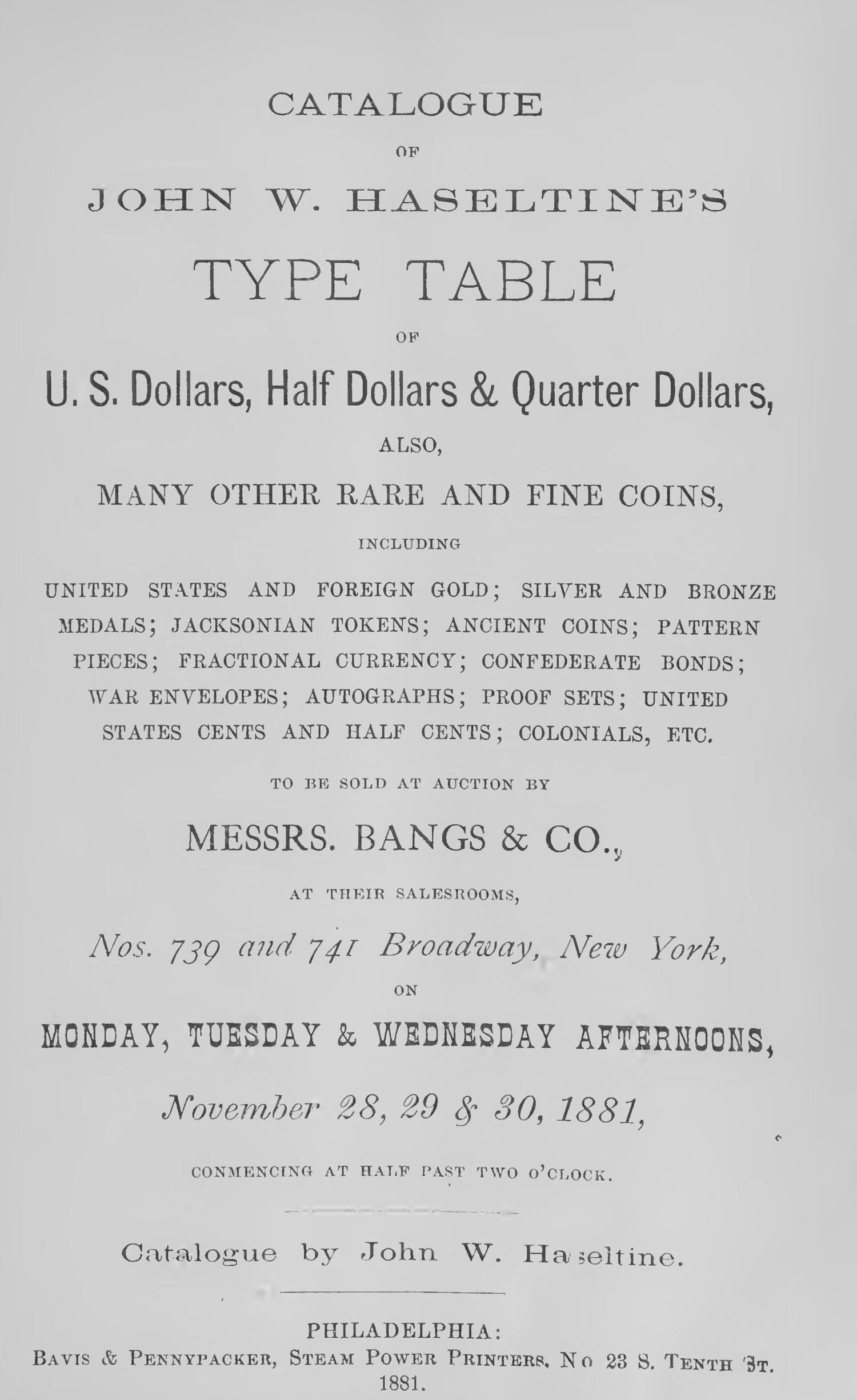
Haseltine's Type Table, 1881
The founding text of American die-variety collecting is not a book. It is a Philadelphia auction catalogue, and its author says in the preface exactly what he was doing and why:
“The following Dollars, Half Dollars and Quarter Dollars comprise the type table of John W. Haseltine, having been collected from many specimens, during the past five years, with the view of publishing a work upon the subject. Whether that will be done is not yet fully determined… The numbers of the pieces in the type table are the same as will appear in the book referred to above if it should be published.”
The book was never written. Sixty-nine years later Bolender wrote it, and Haseltine's numbers are still visible underneath.
Haseltine is also, separately, the dealer through whom most of the Class III 1804 dollars reached the market — out of his father-in-law's cabinet. The man who founded early-dollar variety scholarship and the man who marketed the restrikes are the same man, and any honest treatment has to hold both. The 1804 dollar →
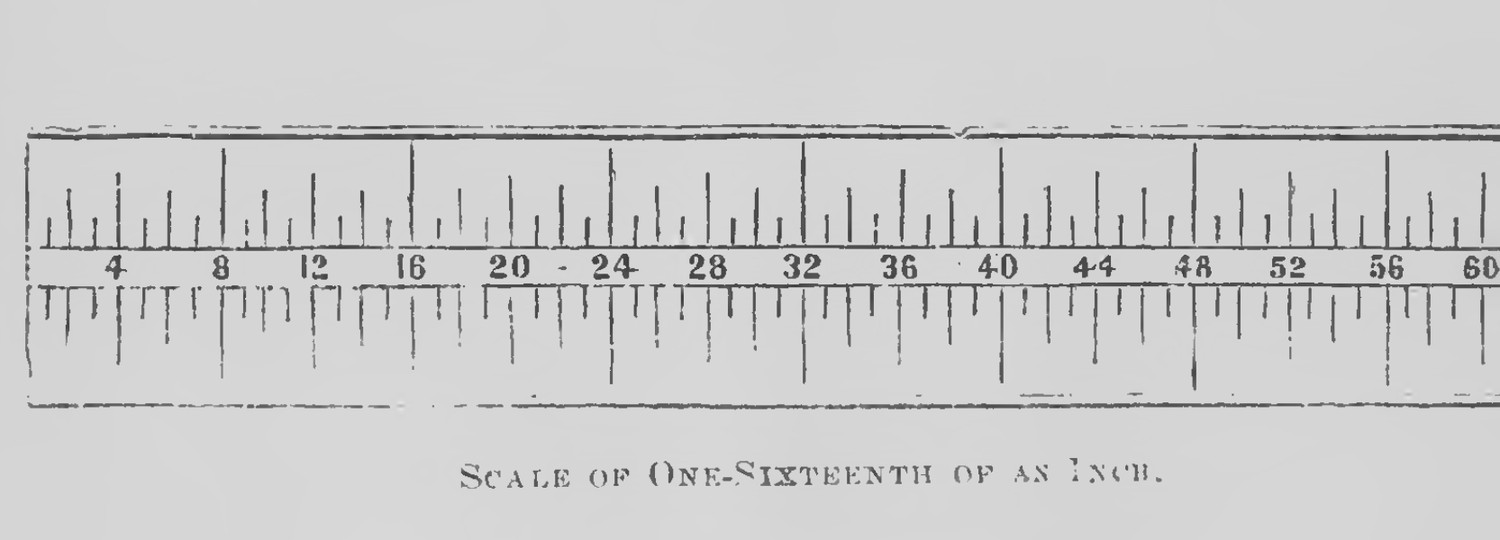
The founding text of American die-variety collecting, and note what it is: an auction catalogue, to be sold over three afternoons at Bangs & Co. on Broadway in November 1881. Haseltine assigned the numbers in the sale itself, for a book he never wrote. Haseltine, Type Table catalogue, 1881. Public domain.The measuring standard, printed in the catalogue. Haseltine engraved a scale into the book so a buyer could actually check the distances he was describing — star to curl, date spacing, leaf position. Attribution has needed a ruler from the beginning. Captioned “Scale of one-sixteenth of an inch”, numbered in sixteenths to 60. Public domain.
His method: count berries, count curls
“1795; No. 1; flowing hair; wide date; 1 point of lower star touches the curl; the hair flows back ending in 5 decided points including the curl; rev., delicate wreath; 10 berries on right and 9 on left; barely circulated.”
“1795; No. 5; wide date; the lower curl is more perfect than in any of the preceding and is not near the stars, but above them… rev., heavy wreath; 6 berries on right and 7 on left; there are 3 leaves under each wing of the eagle (there being only 2 in any of the preceding).”
That second entry is the 2 Leaves / 3 Leaves distinction PCGS still recognises as a major variety of the 1795 dollar — described, numbered and priced by a Philadelphia dealer in 1881.
And what he wished he could add
“In many of the varieties in the Type Table, I have met with but a single specimen, and in that case they are termed excessively rare… At a future time, if I should decide to issue a work upon this subject, each variety will be given a name to more easily distinguish it, and plates be given of those pieces that have but slight differences, in order that collectors could more readily determine them.”
A hundred and forty-five years later, the plates of the pieces with slight differences are still the thing the hobby most needs and least freely has. See the imagery note below.
12 marriages, ranked for pedagogy
A teaching set — what each one explains
Ranked by what each one teaches, not by price or rarity. A student who can attribute these twelve can attribute the series. They run in the series' own order, from the single 1794 marriage to the capstone — the attribution that settled a two-century argument. Diagnostics are described in words and located on an original schematic; photography follows when we have images we are free to publish.
OBVERSE
Schematic locator — the lower left, and Liberty's cheek. Diagnostic photography pending.
01
1794 BB-1 (B-1) — the marriage that is also the date
SINGLE MARRIAGE
What to look at
One obverse, one reverse, one marriage — there is nothing to attribute. Instead, look at two things that beginners mistake for damage: the characteristic weakness at the lower left, and the parallel file scratches (adjustment marks) that on many 1794–95 dollars run across Liberty's cheek.
What it teaches
The vocabulary, with no confusion possible: this is what an obverse die, a reverse die and a marriage are. It also introduces adjustment marks — filing applied to an OVERWEIGHT planchet before striking, original to the coin and not a defect.
Before you pay a premium
Trade tradition holds that the 1794s were struck on a press sized for the half dollar, which would explain the lower-left weakness. It may well be right. No document in the OunceDesk Archive supports it — not Evans, not Dickeson, not the Boudinot reports, not the journals. Treat it as tradition, not as fact.
Schematic locator — under each of the eagle's wings. Diagnostic photography pending.
02
1795 Flowing Hair — 2 Leaves vs 3 Leaves
REVERSE DIE
What to look at
Count the leaves in the sprig under each wing of the eagle: two, or three. Haseltine, 1881, describing his No. 5: "there are 3 leaves under each wing of the eagle (there being only 2 in any of the preceding)."
What it teaches
The single best first attribution exercise in American numismatics — one feature, two states, both common enough to see side by side. PCGS carries both as major varieties with different rarity, R-4.2 against R-3.8.
Before you pay a premium
The two varieties have genuinely different populations but sit close enough in price that the attribution matters less than the grade. Learn on this one precisely because the stakes are low.
Schematic locator — the centre of the coin. Diagnostic photography pending.
03
1795 Flowing Hair, Silver Plug — process is not damage
MINT PROCESS
What to look at
A round disturbance at the dead centre of the coin, sometimes visible as a differently-toned disc. Where a planchet came out UNDERWEIGHT, the Mint punched a hole at the centre, drove a small silver plug into it, and struck the coin flat.
What it teaches
That a mark on an early dollar can be the most valuable thing about it. Pair it with the adjustment-mark lesson from the 1794: one mark means the planchet was heavy, the other means it was light. PCGS estimates 250 known and treats the plug as a distinct issue for both 1794 and 1795.
Before you pay a premium
The finest known 1794 dollar — the $10,016,875 SP66 — is a silver-plug coin. That is worth knowing before you decide a central disturbance is a hole someone filled.
Schematic locator — where the head sits in the field. Diagnostic photography pending.
04
1795 Draped Bust — Centered vs Off-Center
PUNCH PLACEMENT
What to look at
Where the portrait sits relative to the stars and the field. Haseltine, 1881, on the new fillet head: "No. 14; fillet head; the head not well centered, being too far to the left" against "No. 15; fillet head; head well centered."
What it teaches
That the PLACEMENT of a punched device, not just its shape, is a diagnostic — and it shows a modern PCGS designation being read straight out of an 1881 auction catalogue.
Before you pay a premium
Placement diagnostics are the ones most often misjudged from a photograph taken at an angle. Judge them from the holder or in hand.
Schematic locator — the date, then the reverse legend. Diagnostic photography pending.
05
1796 — Small/Large Date × Small/Large Letters
PUNCH MATRIX
What to look at
Two readings, one per side: the size of the date numerals on the obverse, and the size of the legend letters on the reverse. Four combinations are possible; three exist and are separately catalogued.
What it teaches
That obverse and reverse punch sizes vary independently, and that a variety name is often a coordinate pair rather than a single feature.
Before you pay a premium
"Large" and "Small" are relative terms that mean nothing without a comparison. Have both in front of you, in photographs at the same scale, before deciding.
The 1796 issue page →PCGS recognises this variety; its catalogue number is not recorded in this Archive
OBVERSE
Schematic locator — the stars, left and right of the bust. Diagnostic photography pending.
06
1797 — 9×7 Stars vs 10×6 Stars
OBVERSE DIE
What to look at
The same thirteen stars, distributed differently: nine left and seven right, or ten left and six right. Then read the reverse letter size, which splits 9×7 again.
What it teaches
Disciplined counting, and the Large Letters / Small Letters axis — which separates two 9×7 varieties of very different rarity, R-4.6 against R-6.3.
Before you pay a premium
Nine plus seven is sixteen, not thirteen: the counts refer to the arrangement around the bust including the stars behind the head. Count from the published diagnostic, not from a description you half-remember.
The 1797 issue page →PCGS recognises this variety; its catalogue number is not recorded in this Archive
OBVERSE
Schematic locator — the star count around Liberty. Diagnostic photography pending.
07
1798 Small Eagle — 13 Stars vs 15 Stars
TYPE TRANSITION
What to look at
1798 carries the outgoing small eagle AND the incoming heraldic eagle. Within the small-eagle coins, count the stars around Liberty: thirteen or fifteen.
What it teaches
That design transitions happen mid-year and mid-delivery, and that "type" and "date" are independent axes. PCGS allocates the 1798 delivery 30,000 / 10,000 / 287,536 across the three — but see the delivery table for why that allocation is judgement, not record.
Before you pay a premium
Both small-eagle 1798s are scarce and both are heavily faked from commoner dates. This is not a variety to buy raw.
Schematic locator — the whole die, not one feature. Diagnostic photography pending.
08
1798 Heraldic Eagle — why marriages exist at all
COMBINATORICS
What to look at
No single coin. The lesson is Haseltine's count, quoted by himself in 1909: "in 1798 there were 30 different obverses of the dollar, with 17 reverses. No. 10 has 2 reverses; No. 18 has 3; No. 22 has 2; No. 14 has 2; and No. 26 has 5."
What it teaches
The combinatorics. Dies were used until they failed and then re-paired with whatever survived on the other side, which is why the unit of study is the marriage rather than the die — and why one date can carry dozens of collectable pairings.
Before you pay a premium
Haseltine deployed exactly this fact as an argument about the 1804 dollar, which is where variety study stops being bookkeeping and starts being evidence. Correct observations, self-interested conclusion — see the 1804 capstone below.
Schematic locator — the last digit of the date. Diagnostic photography pending.
09
1799/8 — the overdate
OVERDATE
What to look at
The remains of an 8 beneath the final 9 of the date. The 15-star reverse splits it further.
What it teaches
How to read an undertype, and why a die was re-dated rather than discarded — steel was expensive and the Mint was not.
Before you pay a premium
PCGS estimates 1,000 known at R-5.0, which makes this the series' most collected overdate and therefore the one most often claimed on coins that do not show it. The undertype has to be visible, not inferred.
The 1799 issue page →PCGS recognises this variety; its catalogue number is not recorded in this Archive
REVERSE
Schematic locator — the end of AMERICA. Diagnostic photography pending.
10
1800 AMERICAI — a die break is not an engraving error
DIE BREAK
What to look at
A raised line at the end of AMERICA that reads as an extra I. It is a break in the die, not a letter anyone punched.
What it teaches
The single most common beginner's mistake in this series: distinguishing what the engraver put into the die from what the steel did afterwards. Its stablemate, the 1800 Dotted Date, is the same lesson in miniature — flakes out of the die, not dots punched in. PCGS estimates 450 AMERICAI known, R-6.1.
Before you pay a premium
Die breaks grow. The same variety in a later die state shows a longer, bolder break; in an early state it may be barely there. Match the published die state, not just the feature.
The 1800 issue page →PCGS recognises this variety; its catalogue number is not recorded in this Archive
OBVERSE
Schematic locator — the date: the overdate, then its spacing. Diagnostic photography pending.
11
1802/1 Narrow Date and Wide Date — two variables at once
OVERDATE + SPACING
What to look at
First find the 1 beneath the 2. Then measure the spacing of the date as a whole — narrow or wide. Both readings are needed before the attribution resolves.
What it teaches
Sequencing. Chapman's 1907 Stickney catalogue describes the 1802/1 lots exactly this way: star-to-Y distance plus reverse leaf position. Attribution is a procedure, not a glance.
Before you pay a premium
The overdate is the commoner form of 1802 in early cabinets, so "1802/1" alone is not a rarity claim. The spacing is what finishes the sentence.
The 1802 issue page →PCGS recognises this variety; its catalogue number is not recorded in this Archive
OBVERSE
Schematic locator — the border: milling to the edge, or beading with a plain rim. Diagnostic photography pending.
12
1804 Class I vs Class III — the attribution that decided a two-century argument
THE CAPSTONE
What to look at
Four independent diagnostics, each of which a student can check. BORDER: dollars of 1794–1803 show milling running to the edge; the 1804 shows beading with a plain rim outside, a style that begins with the 1836 dollar. EDGE LETTERING: Class I edges are cleanly lettered; Class III edges were lettered after striking with incomplete collar segments, so letters repeat and drop out. WEIGHT: a standard dollar is 416 grains; the Mint's plain-edge Class II restrike is 381.5; Stickney's Class I weighed 415. REVERSE DIE: "The A touches the eagle's claw, the OF much nearer of the end of eagle's wing than S in States (in the original it is equally spaced)."
What it teaches
That a correctly observed diagnostic settles a two-hundred-year argument — and that the same observation can be pointed the wrong way. John A. Nexsen published the border argument in July 1897 and concluded the die "was cut between the year 1836 and 1842." Henry Chapman used the beading as evidence FOR 1804 ten years later: "Borders are beaded as are the dimes of this year." Same feature, opposite conclusion.
Before you pay a premium
The best example in American numismatics of a correct observation put to a wrong conclusion by an interested party: Haseltine used the arrow count — thirteen rather than twelve — to argue that his father-in-law's coin was an original. Every observation in that letter is accurate. He was also the man selling the coins. Check the observations, then check the incentive.
The commonest forgery in the series is a 1795 altered to a 1794, and the Archive holds a working field guide to it — a collector's letter printed in The Numismatist in 1895, two years before Nexsen published the border argument.
“The 1794 obverse shows two features I have not found on any die of 1795 I have seen. 1st, the curl of hair on left touches second star from bottom, while on the 1795 it either touches lowest star or is between the first two… The second point is the position or arrangement of the stars — you will see that on the 1794 the stars have each a single point presented to each other and following a curved line drawn through their centers on the right side only, while on the left two points of each star are presented to each other; the latter arrangement appears on both sides of 1795 and later dates, including 1804.”
The Numismatist, vol. 8 (1895), p. 255
Two things to notice
The star-orientation test works because star punches were entered by hand at whatever rotation the workman chose — the exact fact that makes die marriages possible in the first place. And note what the writer says in passing: the 1804 dollar's star arrangement matches 1795-and-later. In 1895, two years before Nexsen published, somebody was already looking at the 1804's punch work and finding it in the wrong company.
Buying an attributed early dollar without getting hurt
Never accept a bare B-number. Bolender restarts at 1 for every date, so “B-15” without a date is not an attribution — it is four different coins. BB-numbers are unambiguous by construction, which is why this site cites BB first.
Match every published marker, in the right die state. Real marriages have several diagnostics, not one, and a die that cracked later shows more than the same die showed earlier. A single matching feature is a coincidence.
Learn the two Mint processes before you learn anything else. Adjustment marks and silver plugs are the two things most often read as damage on a genuine early dollar — and the plug can be the most valuable thing about the coin.
Treat the date as the first authentication step, not the last. This series' characteristic fraud is not a counterfeit die, it is a genuine coin with an altered date. The 1895 star-orientation test above still works because the thing it tests — hand-entered punch rotation — is the same fact that makes marriages possible.
At these prices, certification is not optional. There is no cheap end of this series. Buy certified and verify the number with the grading service's own database.
What is missing from this page, and why
Diagnostic photography is pending
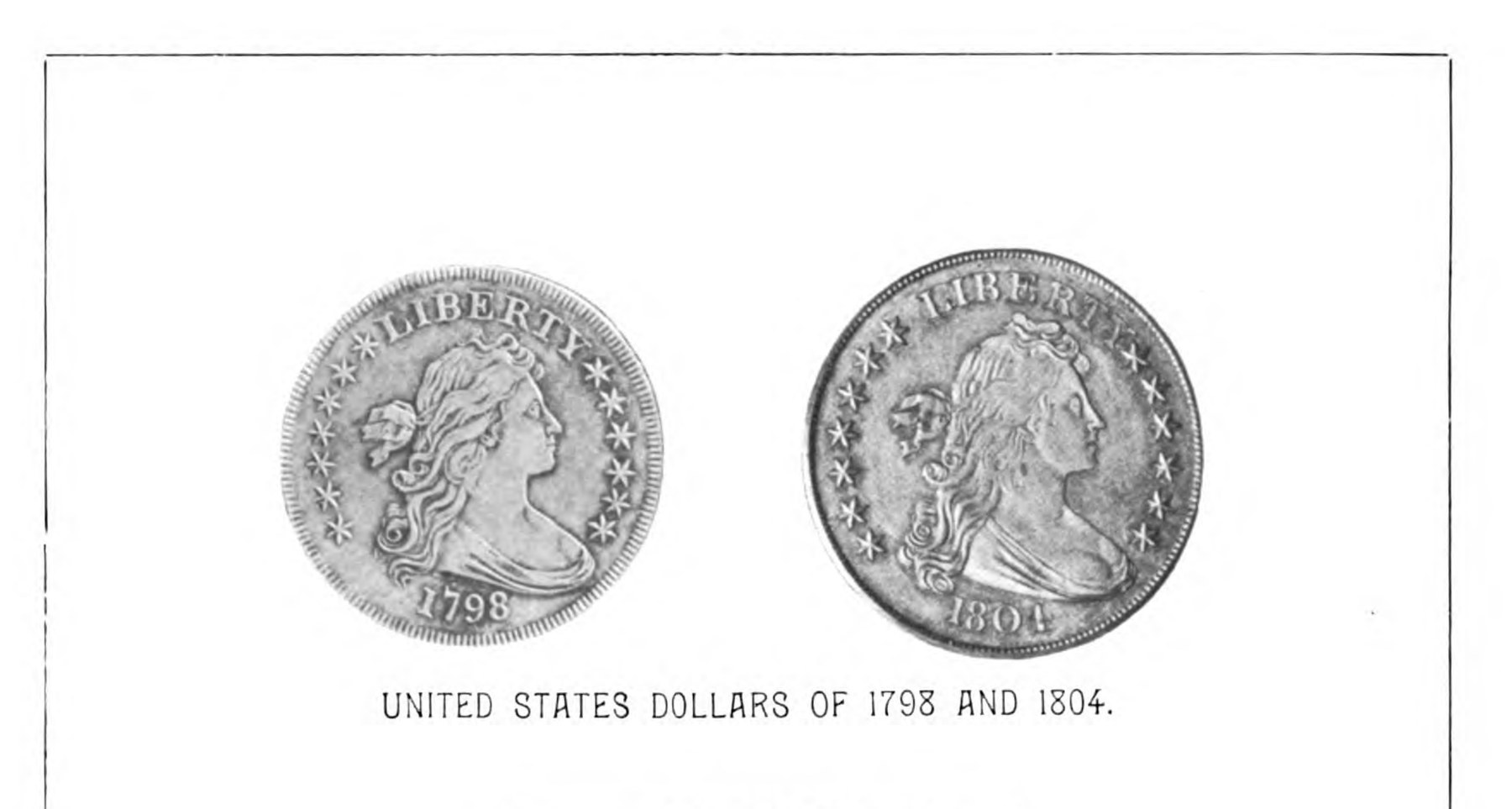
Every diagram above is an OunceDesk original. Modern close-up photography of these diagnostics is auction-house and grading-service work and is in copyright, so none of it appears here. One public-domain diagnostic figure has been extracted from the Archive and does appear on this site — Nexsen's 1897 plate comparing an 1798 border against an 1804 border, which is the one historical diagnostic illustration this series has:
The border diagnostic, as published in 1897: milling to the edge on the 1798, beading with a plain rim on the 1804. It is the capstone of the teaching set above and the reason attribution matters. The full argument →American Journal of Numismatics, July 1897 · public domain
Two other leads were chased and came back empty, which is worth recording rather than leaving as open promises. Chapman's twenty photographic plates from the 1907 Stickney sale — the obvious source of period photographs of 1794–1803 dollars — are not in either copy of that catalogue the Archive holds; both digitisations stop at the text and the plate leaves were never scanned. Haseltine's 1881 catalogue has no coin plates at all: what it has is the engraved measuring scale above, which is why that is what we published from it.
One is wide open. The American Numismatic Society publishes its collection photography under a Public Domain Mark, and its records carry the Bolender number for each coin. Every issue page in this series now shows a real dollar, most of them ANS coins with the institution's own die-marriage attribution attached — so the marriages above still get schematics for their diagnostics, but the coins themselves are no longer abstract. See key dates for the photographs alongside the survival estimates.
Two figures this series needs do not exist as public-domain images at all and would have to be made: a modern border comparison reproducing Nexsen's 1897 argument at resolution, and an edge roll-out of a Class I beside a Class III showing the repeated and dropped letters. Nobody appears to have published either.
Sources
OBSERVED
39 sources
ESTIMATED
2 sources
DERIVED
2 sources
Sourced figures on this page trace to the ledger below. Editorial judgement is labelled as ours, and prices we have not sourced are not published.
Haseltine's descriptions and preface are quoted from the 1881 Type Table catalogue held in the OunceDesk Archive (S14); the 1798 die count is Haseltine's own, in The Numismatist, 1909 (S25); the 1794/1795 diagnostics are from The Numismatist, 1895 (S21); variety recognition, rarity ratings and survival estimates are PCGS's (S31), observed 2026-08-23. Bolender (S37) and Bowers–Borckardt (S38) are cited as the origin of their numbering systems and are not held or quoted. OunceDesk publishes no variety valuations.
OunceDeskPrecious Metals IntelligenceIndependent research, market data, tools and coin intelligence for people who take hard assets seriously.