CoinsEarly DollarsGrading
Grading & authentication
These coins are too rare to illustrate a grade ladder with, so this page describes one instead — and describes it out of a primary source, because the man who founded early-dollar variety scholarship graded these exact coins in print in 1881. After that: the two Mint processes that are not damage, the weight standard as a working tool, and the 1895 field test that still catches an altered date.
How this page handles grades
Described, not illustrated
A photographic grade ladder needs the same coin type shown at every step of wear. For a series whose most available date has an estimated eight thousand survivors and whose scarcest have a hundred, that is a commissioning project, not a research one — the museum coins we are free to publish are one example per issue, and the institutions that hold them publish no grades. So this page describes the ladder instead of illustrating it, and it does so out of a source rather than out of our heads: the man who founded early-dollar variety scholarship graded these exact coins in print in 1881, and his catalogue is in the OunceDesk Archive.
Before the ladder
What a grade is worth knowing in this series
In a twentieth-century series the interesting question is which grade you can afford. Here the interesting question is whether the grade exists at all. These are PCGS's survival estimates for the series' most available dates, in its own three bands.
| Issue | All grades | Mint state (60+) | Gem (65+) | What that means |
|---|---|---|---|---|
| 1799 | 8,000 | 125 | 8 | The series' most available date. Its entire gem population would fit on one table. |
| 1795 Flowing Hair, 3 Leaves | 6,000 | 40 | 4 | Four gems, for the type most collectors start with. |
| 1798 Large Eagle | 5,000 | 35 | 1 | Five thousand survivors. One gem. |
| 1800 | 4,500 | 40 | 2 | |
| 1795 Draped Bust, Centered | 3,000 | 50 | 10 | The best high-grade showing of any obtainable date here. |
| 1794 | 150 | 10 | 4 | The whole issue is smaller than most series' gem populations. |
ESTIMATED PCGS CoinFacts survival estimates, observed 2026-08-23. Estimates, not counts, and PCGS's own.
Read the gem column again. Across six of the series' most obtainable issues, PCGS's estimates total twenty-nine coins at MS65 or better. In this series the practical grading decision is almost never “65 or 66”. It is “honest and original, or not”.
The ladder
How these coins were graded, by a man who had them in his hand
John W. Haseltine catalogued his Type Table in 1881 — the sale that founded early-dollar variety collecting — and he graded every lot. Numerical grading did not exist; the Sheldon scale was seventy years away. What he used instead was a vocabulary, applied consistently across the run, to coins of this exact series. Counted across the catalogue: fine 95 times, good 45, very fine 38, very good 24, barely circulated 19, uncirculated 18, fair 6, strictly uncirculated 4.
Strictly uncirculated≈ MS today
“1795; No. 5 … rev., heavy wreath; 6 berries on right and 7 on left; there are 3 leaves under each wing of the eagle… strictly uncirculated; sharp and boldly struck; mint lustre; very rare in this condition.”
His top grade, and note the three things he separates in one line: no wear, a sharp strike, and surviving lustre. That is the modern mint-state judgement, written in 1881.
Barely circulated≈ AU today
“1798; No. 1; close date; 13 stars; knob to lower part of 9; rev., small eagle; 8 berries; barely circulated; stars sharp; exceedingly rare in this condition.”
About Uncirculated, seventy years before anyone called it that. Nineteen lots in the catalogue carry it, and it is repeatedly paired with a condition-rarity note rather than a variety-rarity note.
Very fine≈ VF today
“1795; No. 2 … the star is farther from L in ‘Liberty’ than in any other variety; the hair terminates in 6 decided points; rev., same as No. 1; the eagle rather weakly struck; very fine.”
The most important line on this page. He grades the coin very fine AND records that the eagle is weakly struck — separating what the press did from what circulation did. That distinction is the single most useful habit in grading an early dollar.
Fine≈ F today
“1795; No. 4; close date; the lower curl is a point terminating opposite the space between the 2 lower stars… rev., delicate wreath; 8 berries on right and 9 on the left; fine.”
His commonest grade by a wide margin — 95 lots. On an eighteenth-century silver dollar that had circulated as money, fine is the normal survivor.
Very good / good≈ VG / G today
“1795; No. 11 … rev., delicate wreath; 19 berries, 10 on right and 9 on left… good; letter L scratched in field; excessively rare variety.”
And there is the other habit worth copying: the problem is disclosed in the same breath as the grade, and it does not stop the coin being catalogued as an excessively rare variety. Damage and rarity are separate facts.
Fair≈ AG / G today
“1796; No. 3; small wide date… stars small and a number of them on the right imperfect; the lowest star on the left does not quite touch the hair; the curl on top of the head defective; fair; scarce variety.”
His bottom grade. Note that even here he is still attributing — the diagnostics survive wear that the eye appeal does not.
How far to trust the right-hand column
The modern equivalents above are DERIVED — OunceDesk's reading of Haseltine's usage, not a concordance anyone published. In 1881 there was no agreed standard, no third-party arbiter, and every grade in the catalogue was assigned by the man selling the coin. Treat the mapping as orientation, not conversion. What transfers intact is not the words but the method: grade the wear, note the strike separately, disclose the problem, and say when the condition rather than the variety is the rare thing.
Still missing
What this page still cannot give you
A wear sequence for Scot's portrait — which detail goes first, second, third as an early dollar circulates. That is genuinely different from a Morgan's and OunceDesk has not researched it, so this page does not assert one. Nor a photographic ladder, for the reason at the top. What is here is a period ladder from a primary source, the population reality behind each band, and the three Mint processes below that are routinely mistaken for wear.
Before you judge the surfaces
Three things that are not defects
ADJUSTMENT MARKS
The planchet was too heavy
Parallel file scratches where an overweight planchet was filed down to standard before striking. On many 1794–95 dollars they run across Liberty's cheek, where they are most conspicuous and most often mistaken for cleaning or a scrape. They are original to the coin, they are evidence the Mint was doing its job, and they are not a reason to reject an example — though heavy ones do affect eye appeal and therefore price.
SILVER PLUGS
The planchet was too light
The opposite correction: a hole punched at the centre, a small silver plug driven in, and the coin struck flat over it. What survives is a round disturbance in the middle of the coin, sometimes visible as a differently-toned disc. PCGS treats the plug as a distinct issue for both 1794 and 1795 — and the most valuable dollar ever sold, the $10,016,875 SP66 1794, is a silver-plug coin.
STRIKE, NOT WEAR
The press was doing its best
1794 dollars characteristically show weakness at the lower left. The trade's explanation is that they were struck on a press sized for the half dollar, and it may well be right — but no document in the OunceDesk Archive supports it. Not Evans, not Dickeson, not the Boudinot reports, not the journals. Published here as tradition, with that caveat, until a Mint record or a contemporary account turns up.
The oldest test still in use
Weight is an authentication tool in this series
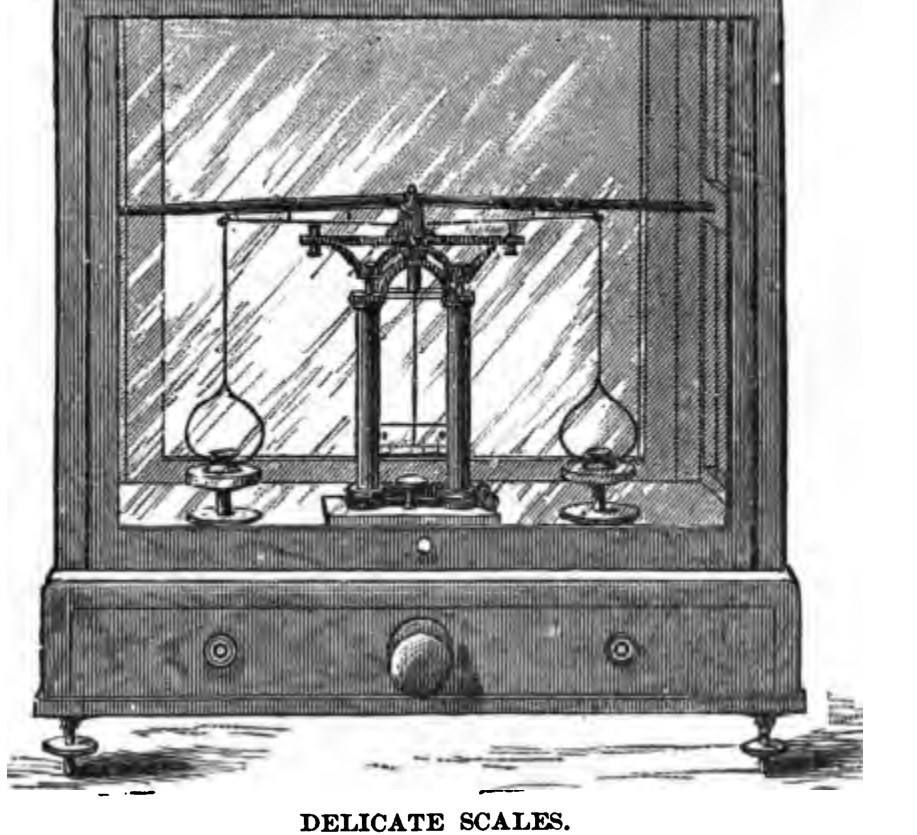
The Act of April 2, 1792 fixed the dollar at 371¼ grains of pure silver in 416 grains of standard silver, and the Mint went to the trouble of filing heavy planchets and plugging light ones to hit it. That makes weight a real diagnostic — and it is the diagnostic nineteenth-century numismatists reached for first, because it required nothing but a scale and an honest arithmetic.
It is also how the 1804 dollar's classes separate. The Mint's own plain-edge Class II piece weighs 381.5 grains, roughly 34 grains light, because it was never struck in a lettered-edge collar. That single fact is the physical proof that the Class III edges were lettered after striking rather than before.
Caveat worth stating: a circulated coin has lost metal, and an eighteenth-century planchet was adjusted by hand to a tolerance, not to a number. Weight rules coins out. It does not rule them in.
Weights on record
Standard dollar, by statute416 grains
Act of April 2, 1792 §9 — 371¼ grains pure in 416 grains standard
Stickney's Class I 1804415 grains
Weighed for Chapman's 1907 catalogue, with a written comparison from the Curator of the Mint Collection
The Mint Cabinet's Class I415.2 grains
Per Chapman, 1885
The Idler–Granberg Class III“411 and a fraction”
Per Haseltine, 1909 — his own figure, in a letter arguing the coin was an original
The Cohen Class I410¼ grains
Per Haseltine, 1909
The plain-edge Class II restrike381.5 grains
Per Evans, 1885 — roughly 34 grains light, because it was never struck in a lettered-edge collar
A working field guide from 1895
Telling a genuine 1794 from an altered 1795
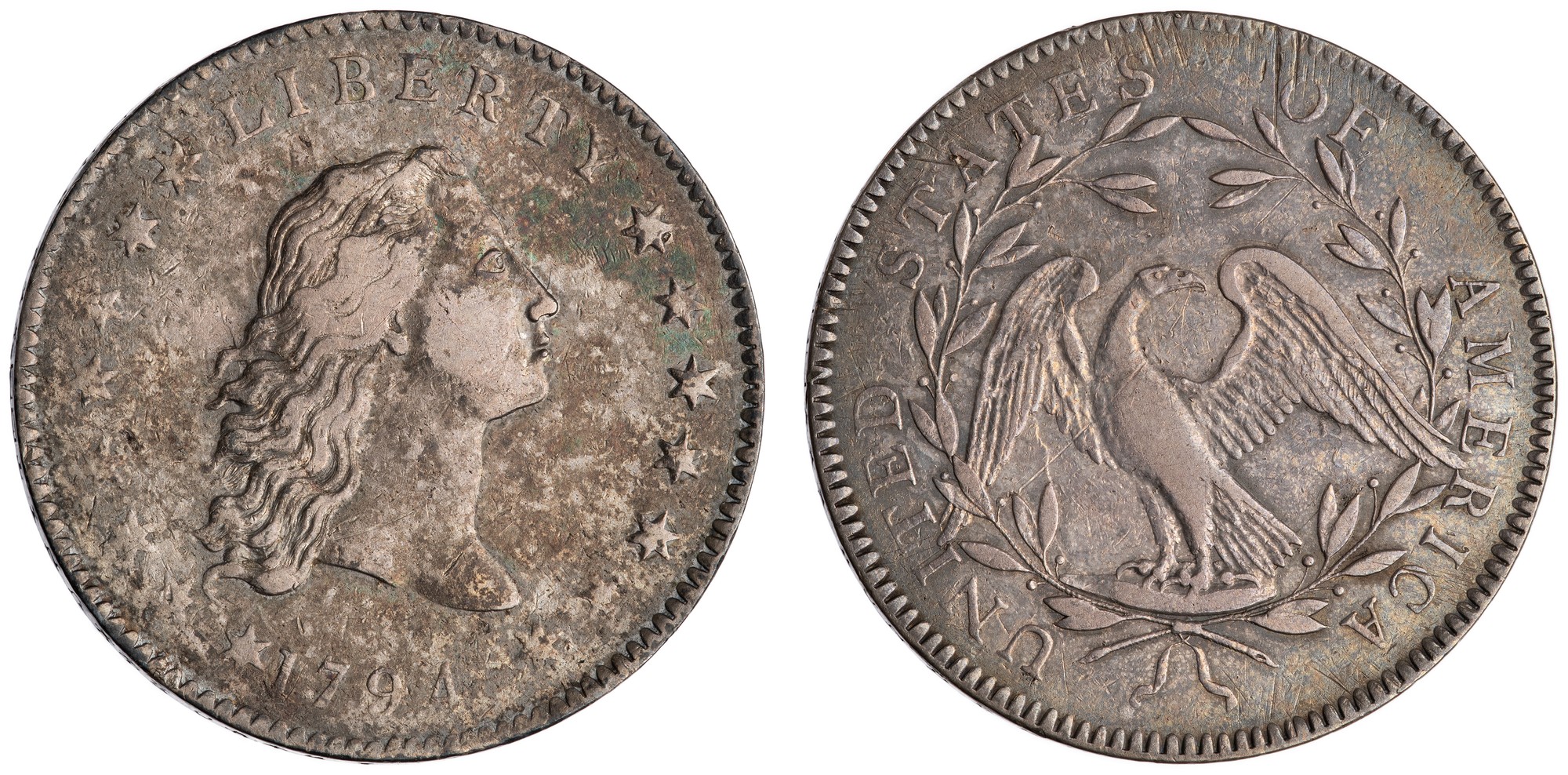
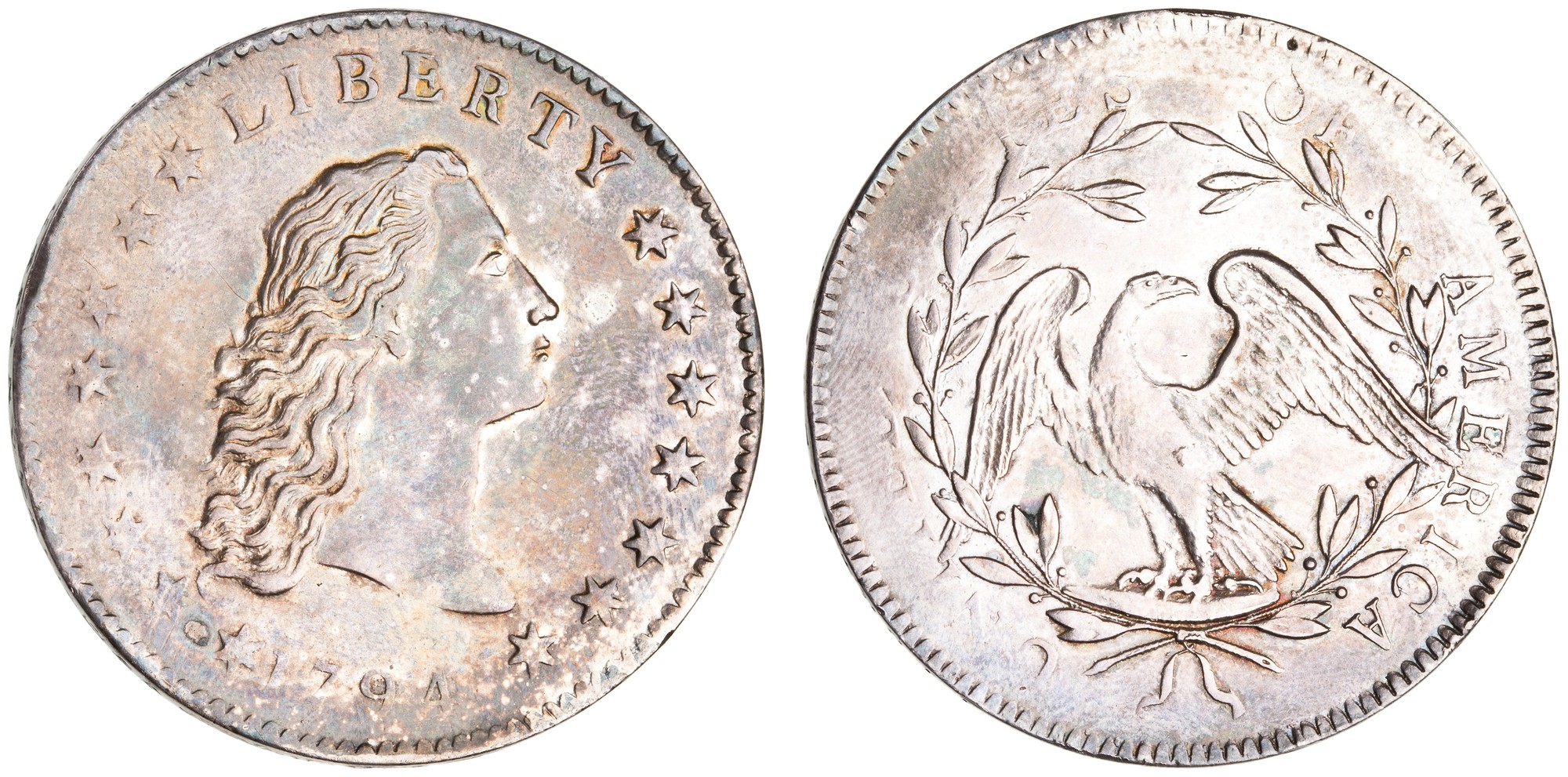
The commonest forgery in the series is a 1795 altered to a 1794, and the Archive holds a working field guide to it — a collector's letter printed in The Numismatist in 1895, two years before Nexsen published the border argument.
“The 1794 obverse shows two features I have not found on any die of 1795 I have seen. 1st, the curl of hair on left touches second star from bottom, while on the 1795 it either touches lowest star or is between the first two… The second point is the position or arrangement of the stars — you will see that on the 1794 the stars have each a single point presented to each other and following a curved line drawn through their centers on the right side only, while on the left two points of each star are presented to each other; the latter arrangement appears on both sides of 1795 and later dates, including 1804.”
The Numismatist, vol. 8 (1895), p. 255
The two tests, in order
- 1. The hair curl. On the 1794, the curl of hair on the left touches the second star from the bottom. On every 1795 the writer had seen, it either touches the lowest star or sits between the first two.
- 2. The star orientation. On the 1794, the stars on the right side each present a single point to their neighbour along a curve through their centres; on the left, two points of each star face each other. On 1795 and later — including 1804 — the two-point arrangement appears on both sides.
Why it works, and what it accidentally proves
The star-orientation test works because star punches were entered by hand at whatever rotation the workman chose — the exact fact that makes die marriages possible in the first place. And note what the writer says in passing: the 1804 dollar's star arrangement matches 1795-and-later. In 1895, two years before Nexsen published, somebody was already looking at the 1804's punch work and finding it in the wrong company.
Four independent checks
The 1804 diagnostics — and the trap in them
The border
Dollars of 1794–1803 show milling running to the edge of the piece. The 1804 shows beading with a plain rim outside — a style that begins with the 1836 dollar. This is Nexsen's 1897 argument, and it is dispositive: the die was cut between 1836 and 1842.
The edge lettering
Class I edges are cleanly lettered, rolled on before striking. Class III edges were lettered after striking with incomplete collar segments, so letters repeat and drop out. Look at the edge, not the faces.
The weight
416 grains by statute; 415 for Stickney's Class I; 381.5 for the Mint's plain-edge Class II. A coin thirty-four grains light was never struck in a collar.
The reverse die
“The A touches the eagle's claw, the OF much nearer of the end of eagle's wing than S in States (in the original it is equally spaced)” — Chapman, 1885, describing the difference between the two reverse dies.
The trap
Every one of those diagnostics has been observed correctly and pointed the wrong way. Henry Chapman used the beading itself as evidence for an 1804 striking — “Borders are beaded as are the dimes of this year” — ten years after Nexsen published. And Haseltine used the arrow count, thirteen rather than twelve, to argue that his father-in-law's coin was an original. Every observation in his letter is accurate; the conclusion is wrong and the interest was undisclosed.
The transferable lesson, and the reason this series is worth learning on: check the observations, then check the incentive. The full 1804 chapter →
Where the losses come from
Risk map
The altered dateSEVERE
The series' characteristic fraud, and it is not a counterfeit die — it is a genuine early dollar with its date changed. 1795 obverses become 1794s; 1803 dollars become 1804s. Woodward detected the first documented altered 1804 in August 1867 and the trade has been detecting them ever since.
The mis-attributed marriageMODERATE
Not fraud so much as optimism: a variety claimed on a coin that shows one matching feature out of several, or shows a diagnostic that belongs to a different die state. The remedy is the same either way — match every published marker, and buy the attribution on the holder when you are paying for it.
The “damage” that isn'tLOW
The inverse risk, and it costs collectors coins rather than money: reading adjustment marks or a silver plug as damage and walking away from a genuine, correctly-made early dollar. Both are Mint process. Both are original to the coin.
The pedigree claimMODERATE
Populations here are small enough that pedigree carries real money — which is exactly why pedigree claims need testing. The good news is that they CAN be tested: the great cabinets of this series were catalogued in print and several of those catalogues are public domain.
The general rule for this series is short: there is no purchase small enough to risk. Buy certified, verify the certification number against the grading service's own database, and treat a bargain as the thing it almost always is.
Two centuries of worked examples
The rejections are on record
Most series ask you to take counterfeit warnings on trust. This one does not. Because the coins are few and the literature is old and in the public domain, the rejections are named and dated: an altered 1803 offered to Woodward in 1867; three claimed 1804 dollars Nexsen judged “believed to be altered pieces” in 1891; one he examined in person on Canal Street and found “skilfully executed”; another sent to him from Chicago and “altered in a very bungling manner”; a coin in Lancaster, Ohio that had “been discovered annually for 15 or 20 years”; and a newspaper panic about 127 forgeries, refuted by a Mint officer with a fact from the mintage table.
Reading them is the fastest authentication education available in American numismatics, and it is free. The ghost census →
Sources
OBSERVED
39 sources
ESTIMATED
2 sources
DERIVED
2 sources
Sourced figures on this page trace to the ledger below. Editorial judgement is labelled as ours, and prices we have not sourced are not published.
View all sources & evidence methodology →Continue: die marriagesthe 1804 dollarcollecting pathwayskey dates & survival
The period grading ladder is quoted from Haseltine's Type Table catalogue of November 1881 (S14), held complete and in the public domain; the term counts are OunceDesk's tally across that catalogue and the modern equivalents are OunceDesk's editorial reading of his usage, not a published concordance (D1). Survival estimates by grade band are PCGS CoinFacts' (S31), observed 2026-08-23. The statutory weight is from the Coinage Laws (S30); the 1794/1795 diagnostics from The Numismatist, 1895 (S21); the coin weights from Chapman's 1907 Stickney catalogue (S23), Evans (S16) and Haseltine's 1909 letter (S25); the border argument from Nexsen, 1897 (S19), and Chapman's counter-reading from the 1907 catalogue (S23). The half-dollar-press explanation for 1794 weakness is trade tradition and is unsupported by any document in this Archive — it is published as tradition and flagged as such.