CoinsEarly DollarsThe First Mint
The First Mint
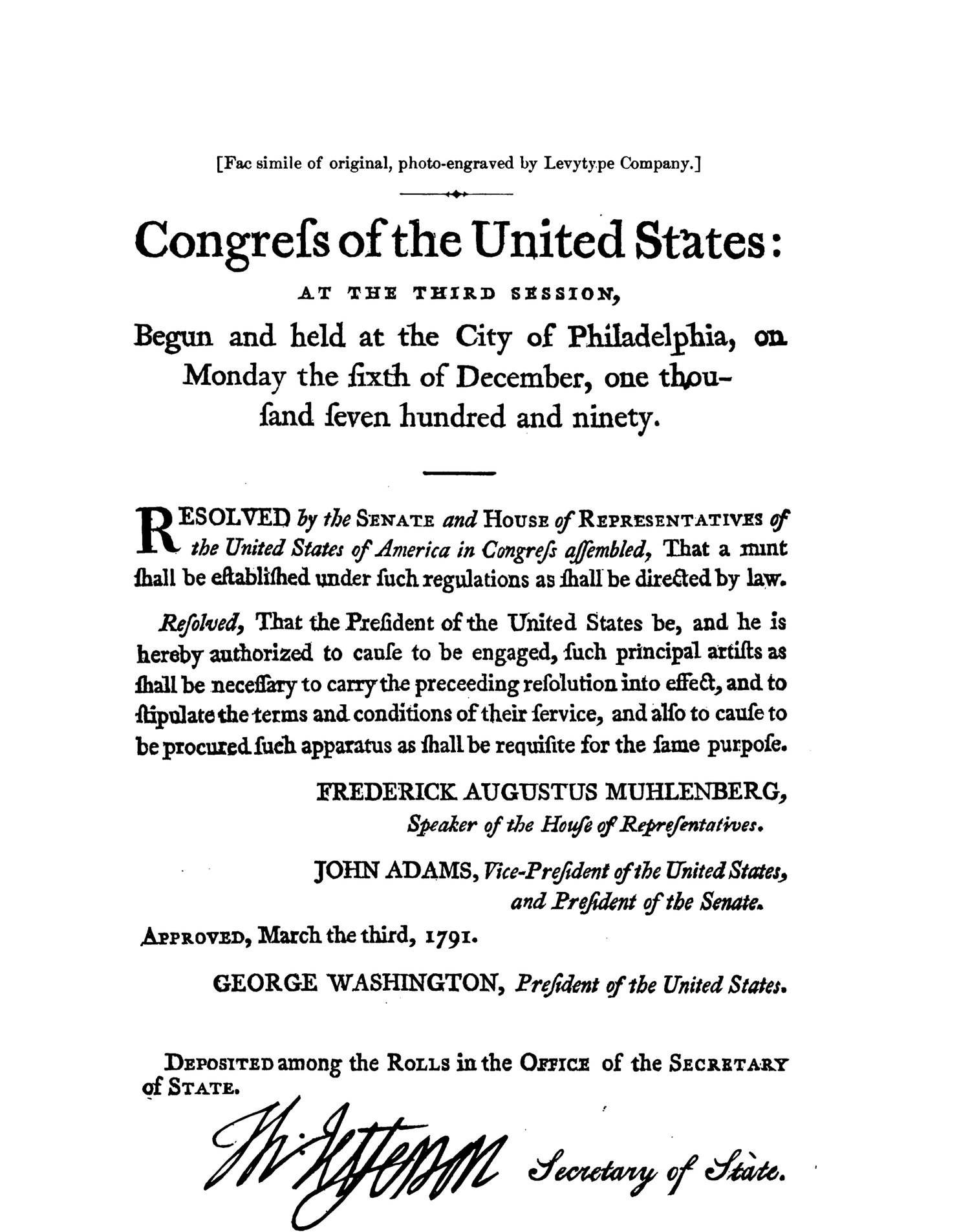
There is no mint-mark chapter in this series. Philadelphia was the only United States mint until 1838, so no early dollar carries a mark and there is nothing to tell apart. What there is instead is an institution — and it is a stranger one than most collectors imagine.
The short version
One mint, no mark, no question to ask
Every dollar in this series was struck in Philadelphia. Branch mints did not exist until 1838 — Charlotte, Dahlonega and New Orleans all opened that year, decades after the last early dollar left the press. If you are holding an early dollar with a mint mark, you are holding a problem, not a rarity.
That single fact removes an entire axis from this series' collecting. There is no “complete the mints” set, no frontier-mint romance, no premium attaching to a letter. What replaces it is the die marriage — which is why attribution carries more structural weight here than in any twentieth-century series.
- Mint
- Philadelphia
- Mint mark
- None — no branch mint existed
- Cornerstone
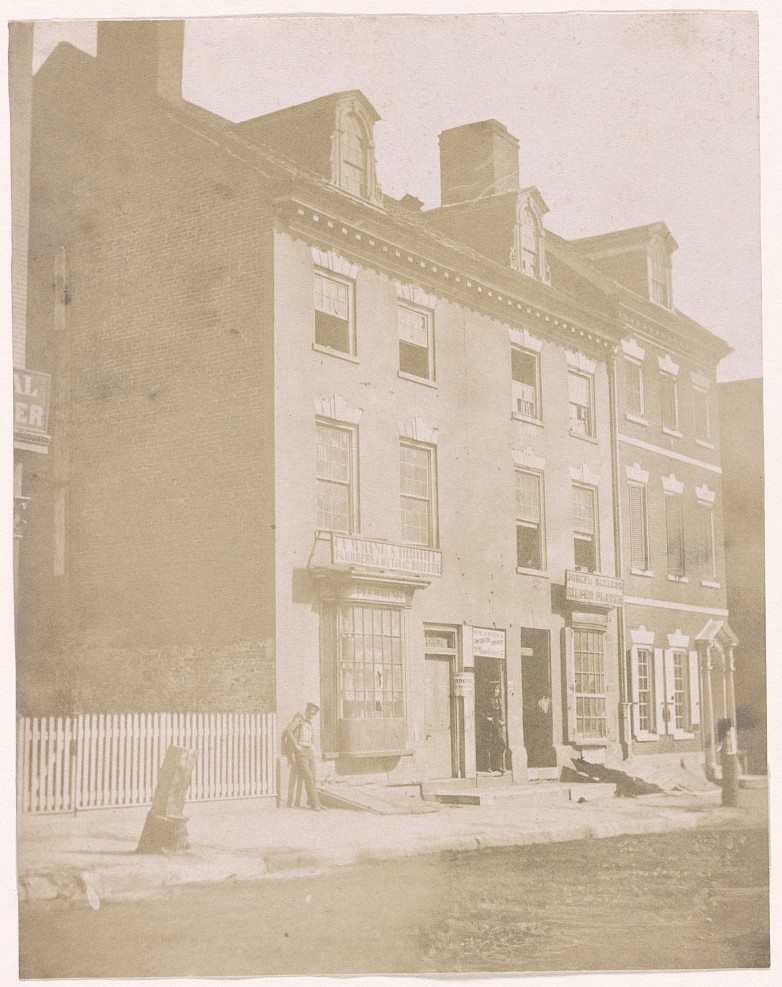
- July 31, 1792
- First silver deposit
- July 18, 1794
- First silver delivery
- October 15, 1794
- Dollars delivered, 1794–1805
- 1,439,517
- Dollar coinage suspended
- 1806
From the Director's own reports, 1802–1805
Two horses, a fever, and a statute about to expire
The institution that made the coins in this series was, in its own Director's account: powered by horses, nearly abolished by rumour from the seat of government, kept open through a yellow-fever epidemic by the workmen's own exertions, and about to lose its legal existence. These documents are four pages long, federal, public domain, and almost never quoted.
The Mint nearly closed by rumour
“He is happy to inform the President that the bullion, deposited in the mint during the past year, has far exceeded what was expected at the beginning of it, notwithstanding the considerable check given to deposites, for some time, by frequent reports from the seat of Government, during the last session of Congress, that the mint would be abolished.”
Boudinot on CY1802 · S1 p.1
One dollar lost in ten years — and a fever
“so that not a dollar has been lost, except in one solitary instance, when the culprit was detected by their assiduity and care, prosecuted and punished, and it was by their exertions that the mint was kept open during the late distress of the city, by the fever of last summer.”
Boudinot on his workmen, CY1802 · S1 p.2
The statute running out
In the same report Boudinot has to warn the President that the Mint's authorising law expires “on the 4th of March next, by its own limitation.” The institution that would later produce the King of Siam's presentation set was, in 1803, running out of statute — and asking for two more horses and $500 to power its machinery.
Boudinot on CY1802 · S1 pp.1–2
A good year, reported plainly
“Notwithstanding the dull prospect at the beginning of the year, coinage, of every kind, amounts… to the sum of three hundred and seventy thousand six hundred and ninety-eight dollars and fifty- three cents.”
Boudinot on CY1803, January 6, 1804 · S1 p.11
And the sentence that explains the whole series' disappearance
“the advantage of a public mint has been sensibly experienced, by the greatest part of the deposits being issued in small coin, which has been found very beneficial to the citizens at large, under the late scarcity of Spanish dollars, occasioned by the great exportation of them, for mercantile purposes.”
Boudinot on CY1804, transmitted by Jefferson on January 25, 1805 (S2 pp.5–6). The Director is describing a shortage of Spanish dollars caused by exportation — the same carousel that was, at that moment, carrying his own dollars out of the country. The export story →
A caution before you look
What the work looked like — ninety years later
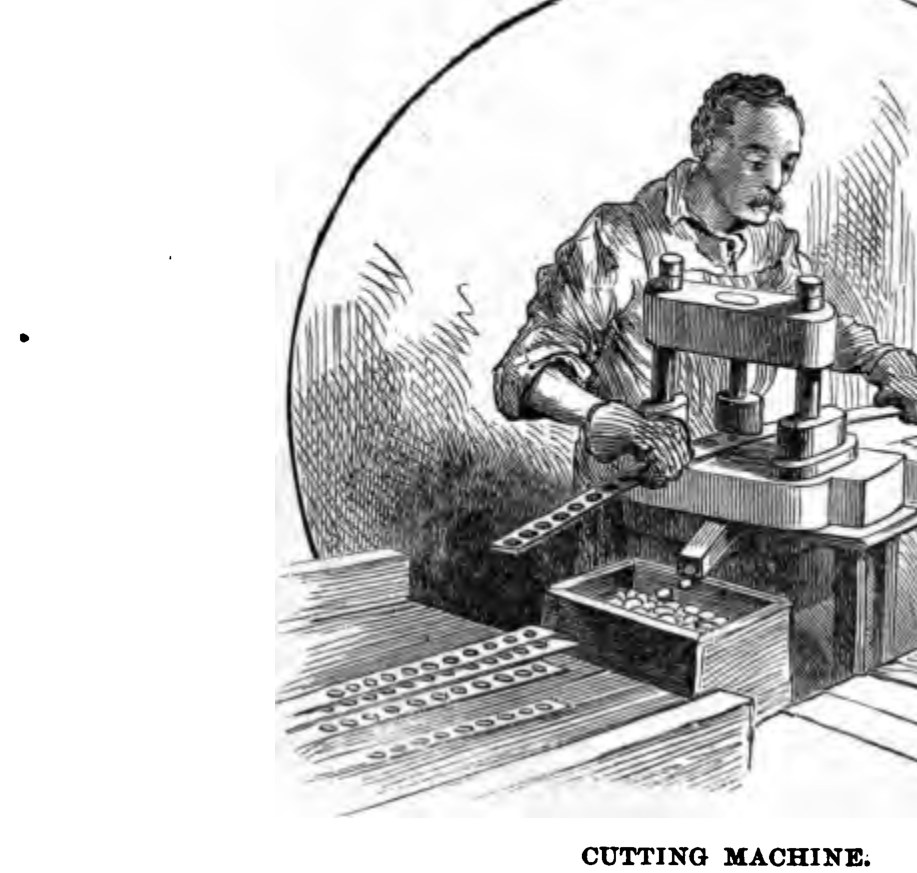
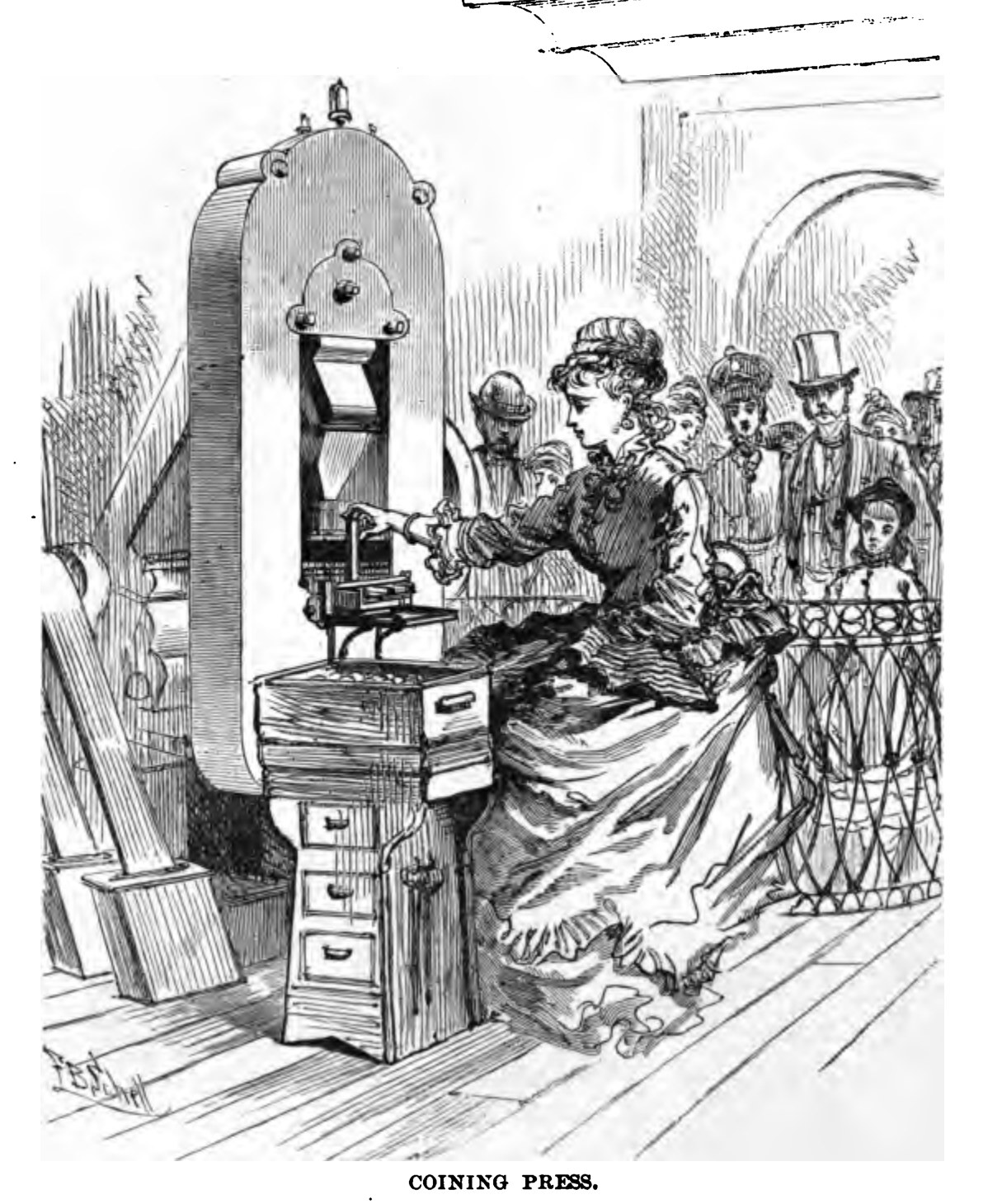
These two engravings are the clearest published pictures of Mint work the OunceDesk Archive holds, and they are not pictures of the Mint that struck these coins. They illustrate the Philadelphia Mint of the 1880s and 1890s: steam power, plate glass, a public gallery. The Mint of 1794–1804 was a converted lot on Seventh Street running on horse power, and Boudinot was writing to the President to ask for two more horses. We publish them because the operations — cutting planchets from a strip, weighing them, striking them — are the same operations in the same order, and because we would rather show you a dated picture with its date than nothing at all.
Eight names
Who was in the building
A small institution, and a small cast. Several of these men appear twice in this series' story — once making the coins, and once, thirty years later, making the coins dated 1804.
David Rittenhouse
Director, 1792–1795
Astronomer, instrument-maker and the Mint's first Director. Laid the cornerstone on July 31, 1792 — “the first building erected in the United States for public use, under the authority of the Federal Government.” He was gone before the great dollar years.
Elias Boudinot
Director, 1795–1805
The author of every annual report this series' data rests on, and a better writer than the office required. Every delivery figure on this site for 1798 through 1804 comes from a document Boudinot signed.
Robert Scot
Engraver, from November 23, 1793
Designer of both the Flowing Hair and the Draped Bust dollar. W. E. DuBois, writing from inside the Mint: “Wright must have made some of these earliest dies, but Robert Scot is the first officer of the line.”
Joseph Wright
Draughtsman and die-sinker
The might-have-been. Appointed to make the Mint's dies, and dead in the 1793 yellow-fever epidemic before the dollar existed.
Adam Eckfeldt
Chief Coiner
His name heads every Class I 1804 pedigree PCGS publishes, because the modern reconstruction has him striking the 1834 presentation coins. He is the hinge between the two halves of this series' story — and the OunceDesk Archive holds nothing of his in his own hand.
Benjamin Rush
Treasurer of the Mint
Signs the coinage abstracts that give us the delivery figures. Signed for him in 1802–03 by G. Ehrenzeller — which is how a clerk's initials end up load-bearing on a modern reference.
William E. DuBois
Assayer
Co-author of the 1842 Manual in which the 1804 dollar first appears in print — and the man who physically handed Matthew Stickney an 1804 dollar on May 9, 1843. The same officer published the coin and gave one away, and it does not appear to have occurred to anyone at the time that this was remarkable.
Joseph Saxton
Machinist
Inventor of the medal-ruling machine that engraved the 1842 plates, which he “first executed, in London, in 1829.” Every 1804 dollar in print for the next forty years descends from his machine tracing an electrotype of a Mint Cabinet coin.
The Mint's other role
The Cabinet — the only place early dollars were saved
From 1838 the Mint kept a cabinet of coins, which became the National Numismatic Collection. It is the only place in this series' history where early dollars were deliberately set aside rather than spent — and, as the 1804 story shows, it was also the place from which coins left the building in exchange for other coins.
Stickney's 1843 trade and the Parmelee coin's acquisition “from the Mint at face value” by an unnamed woman during Polk's administration are both cabinet outflows, and they are the reason three of the eight Class I 1804 dollars have a private pedigree at all.
Two Mint officers put facts about their own institution into the numismatic press rather than let the trade guess: E. L. Royal, Assistant Curator, who wrote to the American Journal of Numismatics in October 1887 to correct the public record on the Mint's holdings; and T. L. Comparette, Curator, who furnished the written comparison that accompanied the Stickney coin to auction in 1907.
Royal to the AJN, October 1887
“Now the fact is, we have but one dollar of 1804 in the Mint, and that has a lettered edge. The second piece, charged as being a dollar of that date, is only a re-strike, and is represented as such: it was struck from the original die, but is much lighter in weight, and intended merely to exhibit the reverse side of the coin.”
The Mint's own Assistant Curator, describing the unique Class II plain-edge piece seventy-five years before anyone had a name for the class — and, in the same letter, demolishing a newspaper panic about 127 counterfeit 1804 dollars with a fact from the mintage table: there were no dollars struck in 1806, so nobody was altering them.
The 1804 dollar in full →What this page cannot yet tell you
Everything above comes from printed Mint documents — the Director's annual reports and the compilations made from them. The underlying records, the Chief Coiner's delivery warrants and the bullion-deposit ledgers for 1794–1805, are in the National Archives (RG 104) and are not in the OunceDesk Archive. They would convert “the printed registry says” into “the warrant says,” and they would either confirm or destroy the reconstructed 1,758 figure for 1794 that every reference in the hobby now quotes.
The same gap applies to the 1834 diplomatic sets: no primary document for the State Department's order, Edmund Roberts' mission, or the Mint's execution of it is held here. That claim rests on Newman & Bressett and on PCGS's pedigree field, and it is carried as probable rather than as fact. We would rather say so than round it up.
Sources
OBSERVED
39 sources
ESTIMATED
2 sources
DERIVED
2 sources
Sourced figures on this page trace to the ledger below. Editorial judgement is labelled as ours, and prices we have not sourced are not published.
View all sources & evidence methodology →Continue: the complete historythe 1804 dollardie marriagesthe 1794 dollar
Every quotation on this page is from a United States federal publication or a nineteenth-century periodical in the public domain, held in the OunceDesk Archive: Boudinot's reports for CY1802–CY1804 (S1, S2), Evans' history of the Mint (S16), the American Journal of Numismatics (S15, S19) and Eckfeldt & DuBois (S7).