Skip to content
SILVER $69.11GOLD $4,604GOLD/SILVER 66.6PLATINUM $1,887PALLADIUM $1,371COPPER $6.47BTC $77,243SNAPSHOT○

CoinsEarly DollarsThe 1804 Dollar

The 1804 dollar

The series' crown chapter · sixteen coins, three classes, as of 2026

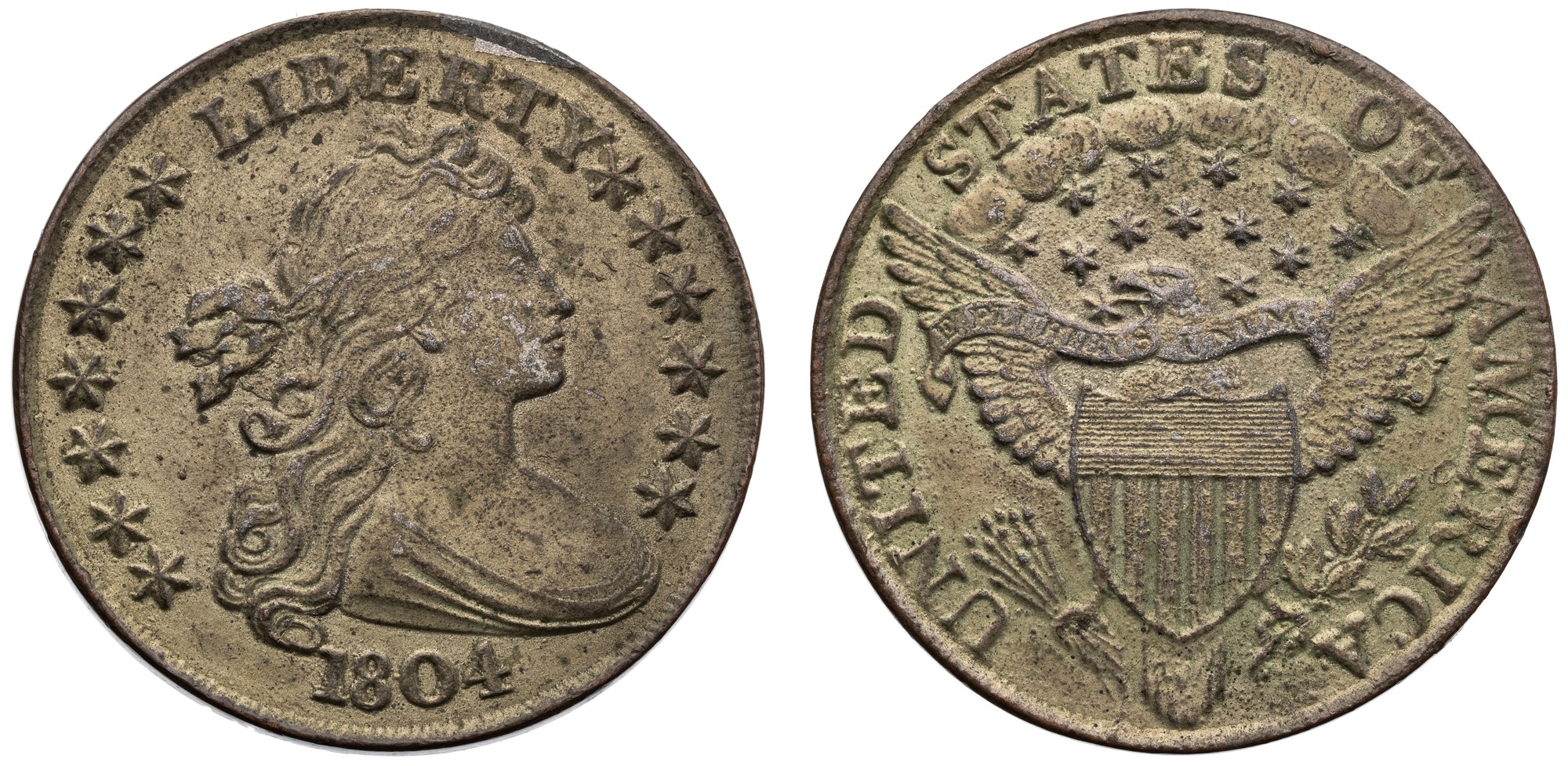
Zero dollars dated 1804 were struck in 1804. The coin exists because the Mint counted deliveries rather than dates, because the State Department needed diplomatic gifts in 1834, and because Mint employees in the 1850s made and sold things they had no authority to make. It is the most famous American coin, and almost everything the hobby believed about it for seventy years was wrong.

The taxonomy

Three classes, one date

The Class I / II / III framework is Newman and Bressett's, published in 1962. Before it, the hobby's categories were “original” and “restrike”, and the test being applied was whether a coin showed evidence of circulation — a reasonable test, and wrong.

Struck c. 1834–35

1804 Class I

Eight known

Made for diplomatic presentation sets, thirty years after the date they bear. One obverse die, one reverse die. Three of the eight are institutionally held and will never trade again.

The record for this class →

Struck c. 1858

1804 Class II

One known

The unique plain-edge piece, struck without a collar and retained by the Mint. 381.5 grains against 415–416 for a standard dollar — and the physical proof that the Class III edges were lettered afterwards.

The record for this class →

Struck c. 1858–60

1804 Class III

Seven known

Recut obverse, substitute reverse, edges lettered after striking with incomplete collar segments so letters repeat and drop out. Made at the Mint without authority and sold out of the building.

The record for this class →

“Original” is still a useful word if it means Class I, struck 1834–35 from a die made then — which is not what any nineteenth-century writer meant by it. This site publishes the word only with that definition attached.

Presents for kings

Why a coin dated 1804 exists at all

In 1834 the State Department needed diplomatic gifts for Edmund Roberts' mission to Siam and Muscat, and asked the Mint for complete sets of American coins. The Mint had no current dollar — none had been struck since 1804, by its own records — so it made dollars dated 1804.

Two of those coins went into cased presentation sets: one to Sayyid Sa'id bin-Sultan of Muscat, one to King Ph'ra Nang Klao of Siam. Neither man collected coins. One resurfaced in Liverpool in 1917 and sold in 2021 for $7,680,000; the other emerged in 1962 and was reported sold privately in 2005.

The rarest and most famous American coin was created as a diplomatic courtesy and given away to people who had no idea what it was — and the reason the Mint chose 1804 is the same bookkeeping convention that runs through this entire series. The register said the last dollar coinage was 1804. It was wrong about the date, and the Mint believed it.

Where this claim stands

The 1834 origin is the modern consensus, established by Newman and Bressett in 1962 and carried in PCGS's own pedigree field, which names “U.S. Department of State, c/o Edmund Roberts” for the two finest Class I coins.

The OunceDesk Archive holds no primary document for it. No State Department instruction, no Mint correspondence, no Roberts paper. It is the weakest-sourced load-bearing statement on this page and it is carried as PROBABLE, not as fact.

The human spine

The man who solved it sixty-five years early

Between 1887 and 1905 a Brooklyn collector named John A. Nexsen ran a private census of the 1804 dollar out of his own house. He corresponded with owners. He kept a file of press impressions — physical rubbings — to compare against claimed specimens. He published four censuses in the American Journal of Numismatics, and his stated purpose was as plain as it could be: “In order that there might be a record of the 1804 Dollars.”

In April 1891 he formalised the categories the hobby had been using loosely: “The term Original is applied to pieces which were struck from the original dies in the year of their date… the first two are universally conceded to be ORIGINAL, being the only ones reclaimed from circulation, and without doubt were coined in 1804.” The test he was applying was evidence of circulation. It was a reasonable test. It was also wrong, and six years later he found out why.

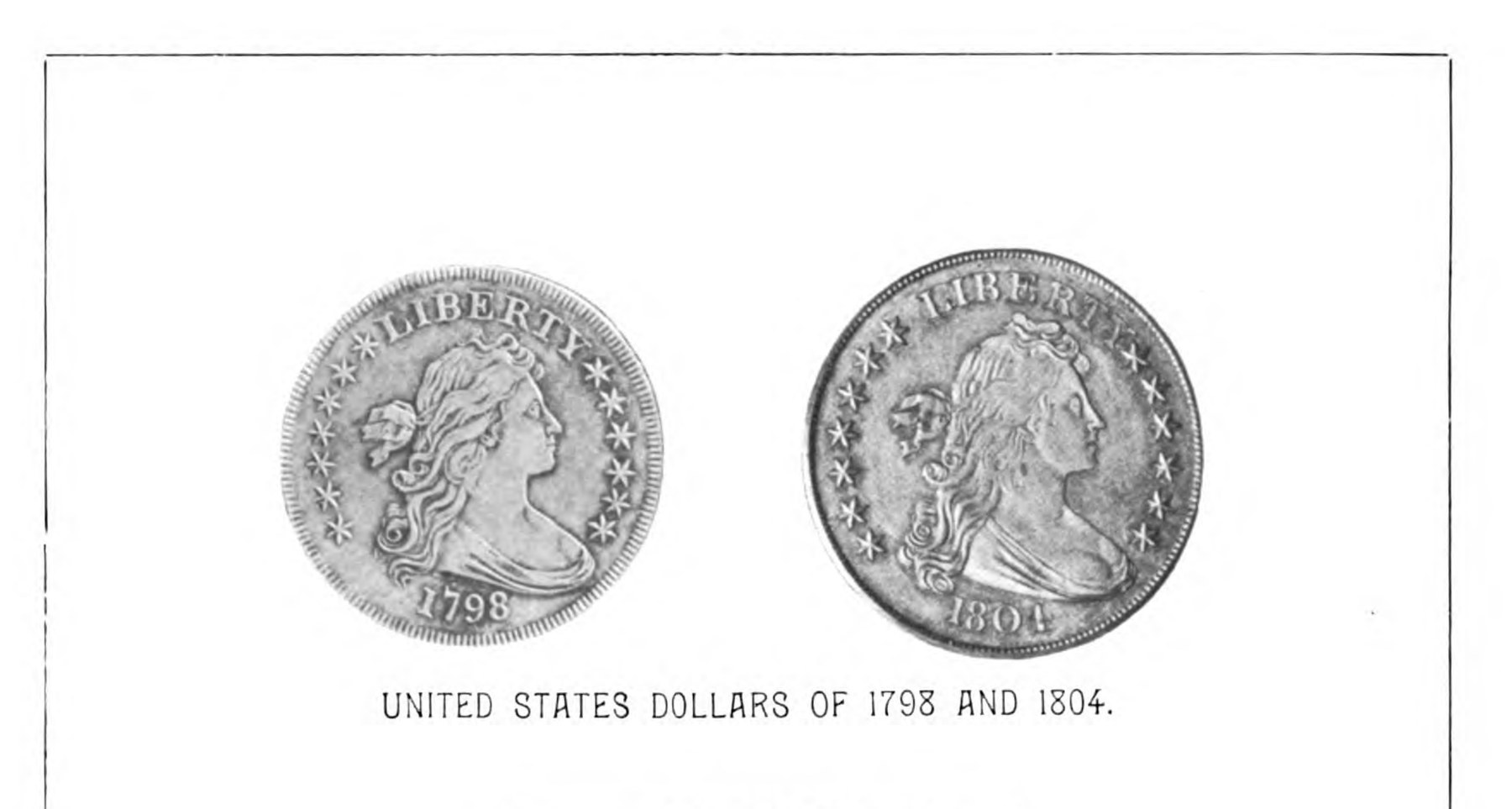
In July 1897 he printed a plate comparing the border of a 1798 dollar with an 1804, and wrote the sentence that ends the argument:

“The plate represents a 1798 Dollar, showing milling or lines extending to the edge of the piece, as on all Dollars coined from 1794 to 1803 inclusive. The other cut is from a photograph of one of the existing 1804 Dollars, and shows a beading with plain rim outside. This style of beading commenced with the 1836 Dollar and has been continued from that time… what inference can be drawn other than that the die was cut between the year 1836 and 1842?”
Two early United States silver dollars side by side, dated 1798 and 1804, from John A. Nexsen's 1897 comparison plate
The plate itself. Nexsen's comparison as it was printed in the American Journal of Numismatics, July 1897. The 1798, on the left, carries milling that runs out to the edge of the piece. The 1804, on the right, has a beaded border with a plain rim outside it — the border style of the 1836 dollar and everything after. It is on the page, in 1897, sixty-five years before The Fantastic 1804 Dollar. American Journal of Numismatics, July 1897 · public domain · digitised from the Cornell University copy, HathiTrust CC0

Eight years later, in April 1905, he published a retraction of his own life's position:

“No one now believes that they were coined in 1804. I must therefore repudiate all that I said in these articles about originals and restrikes.”

That is the central conclusion of The Fantastic 1804 Dollar— reached, printed and signed sixty-five years before Newman and Bressett published it, by a man the hobby has forgotten. He built a working comparison archive, ran a census for eighteen years, changed his mind on the evidence, and said so in public.

Nexsen's four censuses

  • April 1887 — six pieces, owners named
  • April 1891 — twelve, with ORIGINAL and RE-STRIKE as formal categories
  • March 1894 — thirteen; two claimed 1804s rejected as alterations
  • April 1905 — thirteen, and the recantation

All four are held complete in the OunceDesk Archive, public domain and quotable without limit.

The dissent, preserved

S. S. Crosby, 1891 — author of The Early Coins of America, and not a man to dismiss — argued the other way from the same physical facts, and reported seeing “a dollar of 1804 which I believe to be genuine, struck from a die altered from 1803, with both figures plainly showing.”

Henry Chapman, 1907 — used the beading itself as evidence FOR 1804: “Borders are beaded as are the dimes of this year.” Same feature, opposite conclusion, ten years after Nexsen.

Registered as a contradiction rather than reconciled. Crosby was wrong about the 1804 dollar and right about almost everything else — including the methodological point that outlived the dispute, since he is also the man who printed the Mint's own delivery-versus-date NOTE.

1858–1869

The Mint as its own counterfeiter

Between about 1858 and 1869 the Philadelphia Mint produced, without authority, coins dated 1804 — the Class II and Class III pieces — and proof “restrikes” of 1801, 1802 and 1803 dollars. They were sold out of the building.

One went to Henry R. Linderman: clerk in the Director's office 1853–65, later Director of the Mint, later Superintendent of all mints and assay offices. Nexsen recorded in 1888 that the coin “passed directly from the U. S. Mint” to him. When Linderman's collection was sold that February the Government claimed much of it as its own property. The Mint's most senior officer is in the census.

The official account was that the plain-edge pieces had all been recovered and destroyed but one. Seven Class III coins say otherwise.

Everything above is documented. The motive is not, and is not asserted here.

The official story, as Nexsen received it

“About the year 1858 several Dollars were struck in the Mint from the 1804 dies, without the collar, with plain edges. One was sold for $75, and others were offered for sale. It is said that these were returned to the Mint, and that all were destroyed but one, which is the specimen now in its collection with a plain edge.”

American Journal of Numismatics, April 1891, p. 333

And the dealer's own admission, 1909

“Forty years ago I knew that Mr. Idler had an 1804 Dollar and he bound me to secrecy in reference to it, as he made his electrotypes from it.”

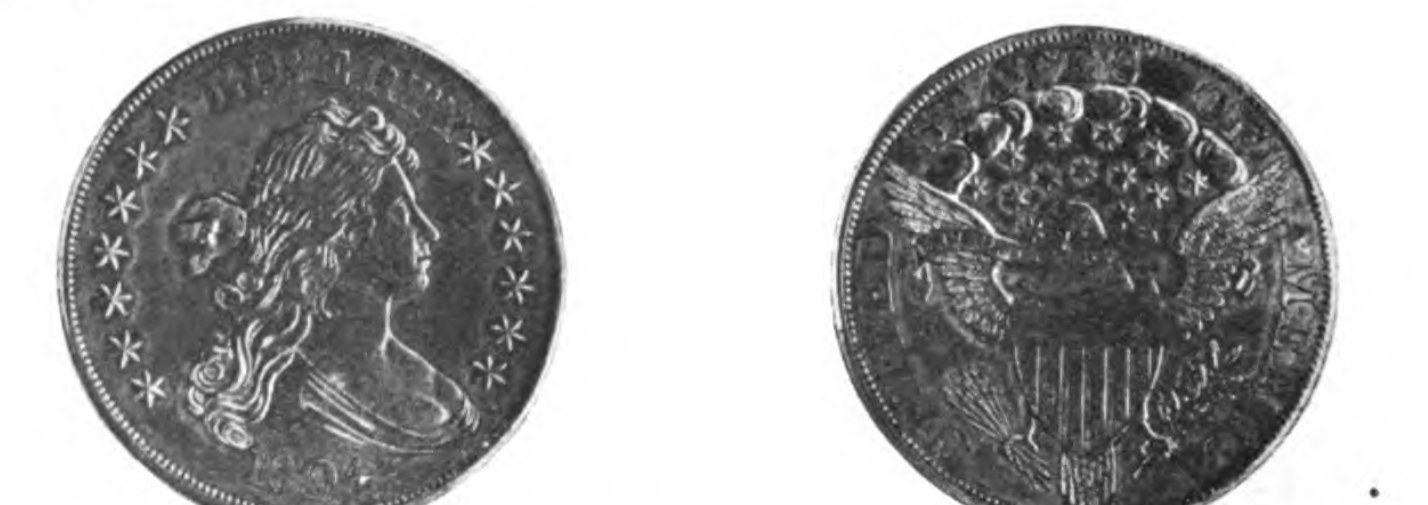
Capt. John W. Haseltine, defending his father-in-law's coin as an original — with a page of impeccable observation, a fatally compromised conclusion, and an undisclosed interest. Modern attribution places the Idler–Granberg coin among the Class III restrikes.

Obverse and reverse of the Idler-Granberg 1804 silver dollar, from a 1909 photograph
The coin in question, photographed for the article that announced it. Haseltine's affirmative arguments were drawn from exactly this image — thirteen arrows in the eagle's claw rather than twelve, edge lettering intact, the stars clear of the clouds. Every observation correct; the conclusion wrong. The Numismatist, April 1909 · public domain

Sixteen coins, individually identified, as of 2026

The full census

Populations here are small enough that a complete census is achievable, so this is one. Every coin below is a distinct physical specimen in the OunceDesk specimen graph with a documented custody chain; the last recorded price is the most recent realized sale in the sources we hold, and “—” means no price is recorded rather than that the coin is unsold.

1804 Class I — eight known

The issue record →
SpecimenGradeWhere it is nowLast recorded price
The Watters–Childs specimenOD-SP-ED-0001PCGS PR68Private, since Aug 2021$7,680,000 · Aug 2021
The King of Siam specimenOD-SP-ED-0002PCGS PR67The Tyrant Collection$3,190,000 · May 1990
The Stickney specimenOD-SP-ED-0003PCGS PR65Private, since Dec 2020$3,360,000 · Dec 2020
The Dexter specimenOD-SP-ED-0004PCGS PR65Bruce Morelan$3,290,000 · Mar 2017
The Parmelee / Byron Reed specimenOD-SP-ED-0005est. PR64The Durham Museum$570 · Jun 1890
The Mickley specimenOD-SP-ED-0006PCGS PR62Dell Loy Hansen$2,640,000 · Jun 2018
The Mint Cabinet specimenOD-SP-ED-0007est. PR58National Numismatic Collection—
The Cohen specimenOD-SP-ED-0008est. PR30ANA Money Museum$2,500 · May 1921

ESTIMATED All eight Class I coins are individually identified, and OunceDesk carries a documented custody chain for each. Three are institutionally held and will not trade again: the Mint Cabinet coin at the Smithsonian, the Parmelee coin at the Durham Museum in Omaha, and the Cohen coin at the ANA Money Museum. Site-wide rule: every census figure ships with its class and its date. Sixteen 1804 dollars are known across three classes as of 2026 — eight Class I, one Class II and seven Class III.

1804 Class II — one known

The issue record →
SpecimenGradeWhere it is nowLast recorded price
The unique Class II — the plain-edge pieceOD-SP-ED-0009—National Numismatic Collection—

OBSERVED The unique plain-edge piece, in the National Numismatic Collection. It has no market and never will; it exists in the census to make the count come out right. Site-wide rule: every census figure ships with its class and its date. Sixteen 1804 dollars are known across three classes as of 2026 — eight Class I, one Class II and seven Class III.

1804 Class III — seven known

The issue record →
SpecimenGradeWhere it is nowLast recorded price
The James A. Stack specimenOD-SP-ED-0010est. PR65A private collection$6,000,000 · Dec 2025
The Linderman specimenOD-SP-ED-0011est. PR63National Numismatic Collection$470 · Feb 1888
The Idler–Granberg specimenOD-SP-ED-0012est. PR60ANA Money Museum$308,000 · Jan 1985
The Presidio specimenOD-SP-ED-0013PCGS PR58Private, since Jan 2026$3,538,000 · Jan 2026
The O. H. Berg specimenOD-SP-ED-0014PCGS PR55A private collection$1,440,000 · Mar 2020
The R. Coulton Davis specimenOD-SP-ED-0015est. PR40McConnell$36,000 · May 1963
The Rosenthal specimenOD-SP-ED-0016est. PR40American Numismatic Society—

ESTIMATED Seven known — a number that changed in living memory. From 1962 to 2025 the standing count was six; the James A. Stack coin was unpublished until 2025 and sold in December of that year. Two of the seven are institutionally held (the Smithsonian and the ANA Money Museum) and one is at the American Numismatic Society. Site-wide rule: every census figure ships with its class and its date. Sixteen 1804 dollars are known across three classes as of 2026 — eight Class I, one Class II and seven Class III.

The count changed in December 2025

From 1962 to 2025 the standing count was six Class III coins, giving 8 + 1 + 6 = fifteen 1804 dollars. The James A. Stack specimen was “unpublished until 2025” and had been in one collection since before its owner's death in 1951; it sold on December 9, 2025. That makes sixteen. Any source published before 2026 saying fifteen is not wrong — it is superseded. This is why every census figure on this site carries its class and its date.

Never usually compiled — and it should be

The ghost census: every 1804 dollar that wasn't

For every genuine 1804 dollar there are several that were offered as one. Every entry below is a named, dated rejection by a competent contemporary, and all of it is public domain.

An altered 1803, offered for sale, 1867

W. Elliot Woodward: “a comparison of which with the genuine Dollar in my possession at once revealed the fact that the new ‘1804’ is simply an alteration… made from an 1803.” He had offered $750–$1,000 sight-unseen if it were genuine.

C. A. Walters, Liverpool

Nexsen, 1891: “believed to be altered pieces.”

F. W. Furman, Providence

Nexsen, 1891: the same verdict.

Dr. E. Walther, St. Paul

Nexsen, 1891: the same verdict.

Hugh Rodens, Canal Street, New York

Nexsen examined it in person: “it was an altered coin; the alteration was skilfully executed.”

J. S. Smith, Chicago

Sent to Nexsen for examination. “It also was altered, and in a very bungling manner.”

The Lancaster, Ohio coin, 1921

Announced by the Cleveland Plain Dealer as “the eighth 1804 dollar.” An ANA member's reply: “This dollar of 1804 has been discovered annually for 15 or 20 years… It is nothing but an altered date.” The owner “knows his dollar is an altered date, but he gets good advertising out of it at intervals. I am told he is an ex-saloon keeper.” A second altered-date 1804 was known in the same town.

“127 of the dollars of 1804”, 1887

A Boston newspaper, crediting the late Capt. Hall of the Secret Service, reported 127 fakes allegedly made by altering 1806 dollars. E. L. Royal of the Mint Cabinet, in print: “It should be unnecessary to inform you there were no dollars struck in 1806, and the fright occasioned the numismatists was quite unnecessary.” A myth refuted by a fact from the mintage table — which is what mintage tables are for.

A white metal 1804 dollar catalogued as a forgery by the American Numismatic Society
A ghost you can look at. The American Numismatic Society's own catalogue entry reads “White Metal Dollar, United States, 1804” and describes it in one word: Forgery. It weighs 27.91 grams against roughly 26.96 for a struck dollar, and it is not silver at all. OunceDesk makes no claim that this is any particular coin named in the nineteenth-century censuses above. It is published for what it plainly is: a documented 1804 forgery, in a national collection, catalogued as one.American Numismatic Society, accession 0000.999.55590 · public domain

Two ghosts that are not so easily dismissed — I

The Spiers piece

Obtained in Philadelphia c. 1846 by Charles Spiers, M.D., given to the Society of California Pioneers and lodged for safekeeping at the San Francisco Mint. Nexsen, 1905: “The piece has a plain edge, and weighs 46 grains less than the proper weight of the early American Dollars. Its composition is a combination of tin and copper, the former largely predominating, and it is plated with silver.” He nonetheless kept it in his census and called it “a trial-piece, and probably the first impression from the die.” It appears in no modern census. Where is it? The Society of California Pioneers still exists.

Two ghosts that are not so easily dismissed — II

The Haigh dollar

Bought by John Haigh of Somerville, Massachusetts, for $10 from a Boston dealer who assumed it was altered. Crosby, 1891: “only very recently has Mr. Haigh had much faith in its genuineness; but upon careful examination, some peculiarities are discovered which render it impossible for me to consider it other than a genuine original dollar of 1804.” Crosby also reported a second coin “struck from a die altered from 1803, with both figures plainly showing.” Both are untraced. Whatever they were, somebody should look for them.

Tradition against the documents

Six things people say about the 1804 dollar

“19,570 silver dollars were struck in 1804”REJECTED

What is true: 19,570 dollars were delivered by the Chief Coiner during calendar 1804. The figure is in the Director's own abstract, printed in a Northampton newspaper on March 5, 1805, and in every Mint compilation since. What is false: that any of them was dated 1804.

The error has a traceable chain. In 1859 Dickeson turned the delivery into a dated mintage and attached a variety count to it: “The designs the same, with one type and but one variety, and the number coined was 19,570.” The hobby press repeated it without qualification for forty years. In 1891 Crosby published the refutation — the Mint's own NOTE — while arguing the other side. In 1910 Edgar H. Adams generalised it: “it is extremely doubtful if a single piece bearing the date of 1804 was struck in that year at the mint and possibly the issue mentioned should be credited to 1803.”

And it is still living, in the 1803 mintage figure the trade uses. The Mint recorded 66,064 for 1803; the standard compilations carry 85,634; the difference is 19,570 exactly. The 1804 delivery has been silently reassigned to 1803. That reassignment is probably physically right and documentarily unsupported — and it should be published as an interpretation, not as a record. The 1803 dollar →

“The whole 1804 mintage went down with a ship bound for China”LEGEND

Its earliest instance in the Archive is George G. Evans, 1885: “It is said that the scarcity of this dollar was owing to the sinking of a China-bound vessel having on board almost the entire mintage of the 1804 dollars in lieu of the Spanish milled dollars.” By 1899 the story had acquired an iron chest, a United States frigate, a typhoon and four “test pieces” in the Treasury vaults:

“The whole lot, just as it came from the stamping presses, was dumped into an iron chest and put on board a merchantman bound for China… The merchantman ran into a Chinese typhoon and went to the bottom, where to the best of my information, she still remains, iron chest and all.”

The hobby did not believe it even then. The Numismatist, the same year: “This explanation, however, is not credited by expert numismatists, who ridicule it as a story without foundation.” The best part is that the legend is a true mechanism attached to the wrong coins: American dollars really were being shipped abroad by the crate — to the West Indies, for profit, not to China by accident. The 1899 telling even preserves the tell, sending them “in lieu of the Spanish milled dollars.”

No documentary trace of any such shipment has been found — and it is not clear anyone has searched the custom-house records. The legend took hold because this series genuinely has no hoard and no melt event, and the vacuum where an explanation should be attracted one.

“Some 1804 dollars are originals and the rest are restrikes”REJECTED— as a description of the coins

Confirmed, though, as a description of what serious people believed for seventy years — and demolished by the man who built it. See Nexsen, above. The residue worth keeping: “original” means Class I, struck 1834–35 from a die made then, and nothing else.

“The 1858 restrikes were all recovered and destroyed but one”REJECTED

Seven Class III dollars exist. They are plain-edge restrikes with lettering applied afterwards. The Mint said the pieces were destroyed; the Mint kept one; and pieces from the same episode reached the market through a Philadelphia dealer and a Mint Director's private cabinet. Whatever happened in 1858–60, the official account is not what happened.

“The 1804 dollar is the rarest American coin”DISPUTED as a fact · CONFIRMED as a title

As a fact it is false and always was: sixteen 1804 dollars exist across three classes, while several United States coins are unique. What the 1804 dollar is, is the most famous rarity — and the reason is that it is the rarity with the best story.

The title, by contrast, is documented and datable. Farran Zerbe, reporting the Stickney sale in 1907: “The 1804 dollar has been restored as the ‘King of American Rarities,’ and the price commanded was the greatest ever paid for a coin of the United States series.” Zerbe's word restored is the tell — the title was understood to be contested and transferable, and it had just been won back from the Brasher doubloon, which outsold the 1804 dollar in the same sale at $6,200 against $3,600.

Editorial rule on this site: “King of American Rarities” is published as a title, with Zerbe's attribution and its 1907 date. Never as a rarity ranking.

“There are only [n] 1804 dollars”UNRESOLVED, permanently

The count keeps moving, and it moves for reasons that have nothing to do with coins appearing or disappearing: 4 · 6 · 7 or 8 · 12 · 13 · 6 “originals” · “twelve to fifteen” · 15 · 16. Two rules for publication, and they are now site-wide: always say which class is being counted, and always date the count.

The counterpart myth is the periodic panic that the census is swamped with fakes — and its best refutation is the one E. L. Royal of the Mint Cabinet delivered in 1887, when a Boston newspaper reported 127 forgeries allegedly made from 1806 dollars: there were no dollars struck in 1806.
Honest gaps

What would settle what

  • The 1834 order. State Department instructions and correspondence for the Roberts mission, 1832–36, and Mint correspondence for 1834–35. Edmund Roberts published his own account of the embassy in 1837 — the participant's narrative, public domain, and not yet acquired.
  • The 1842 plate — asked, and answered “not from this copy”. Eckfeldt & DuBois' Plate II is captioned by type rather than by date, and its entry 3 reads “Dollar, 1797–1805”. That the coin ruled for it was an 1804 has always rested on later testimony. We went and looked. The plate is present in the Archive's copy and the printed description confirms entry 3 exactly — and the engraving itself is not legible: the medal-ruling machine's line work did not survive digitisation, and the coins render as blank discs at any contrast. The claim stays PROBABLE on its chain of testimony. Settling it needs a better scan, or the physical book.
  • Nexsen's press impressions. He kept a physical comparison file of rubbings of several 1804 dollars and used it to authenticate one coin and reject two others. A nineteenth-century authentication archive for the most disputed coin in America. Its fate is unknown.
  • Did anything actually sink? The shipwreck legend has never been tested, only ridiculed. Philadelphia and New York custom-house outward manifests for 1804–06 would either produce a candidate vessel or convert LEGEND into REJECTED with evidence rather than by common sense.

Sources

OBSERVED

39 sources

ESTIMATED

2 sources

DERIVED

2 sources

Sourced figures on this page trace to the ledger below. Editorial judgement is labelled as ours, and prices we have not sourced are not published.

View all sources & evidence methodology →

Continue: the 1804 Class I recordthe 1803 dollarkey dates & survivalthe first mint

Nexsen's censuses and his 1897 and 1905 articles are held complete and in the public domain (S15, S17, S18, S19, S20), as are Crosby's dissent (S17), Chapman's 1907 catalogue (S23, S32), Zerbe's sale report (S24), Haseltine's 1909 letter (S25), Woodward's 1867 catalogue (S11, S12), Evans (S16), the 1899 shipwreck telling (S22) and the 1922 Lancaster report (S27). Modern grades, pedigree chains and realized prices are PCGS CoinFacts' (S31), observed 2026-08-23. The Class I/II/III taxonomy and the 1834 origin are Newman & Bressett's (S39), which this Archive does not hold and does not quote.

OunceDeskPrecious Metals IntelligenceIndependent research, market data, tools and coin intelligence for people who take hard assets seriously.