The First Silver
A shop with horses, a statute about to expire, and 1,758 coins on an October afternoon — where every early dollar comes from.
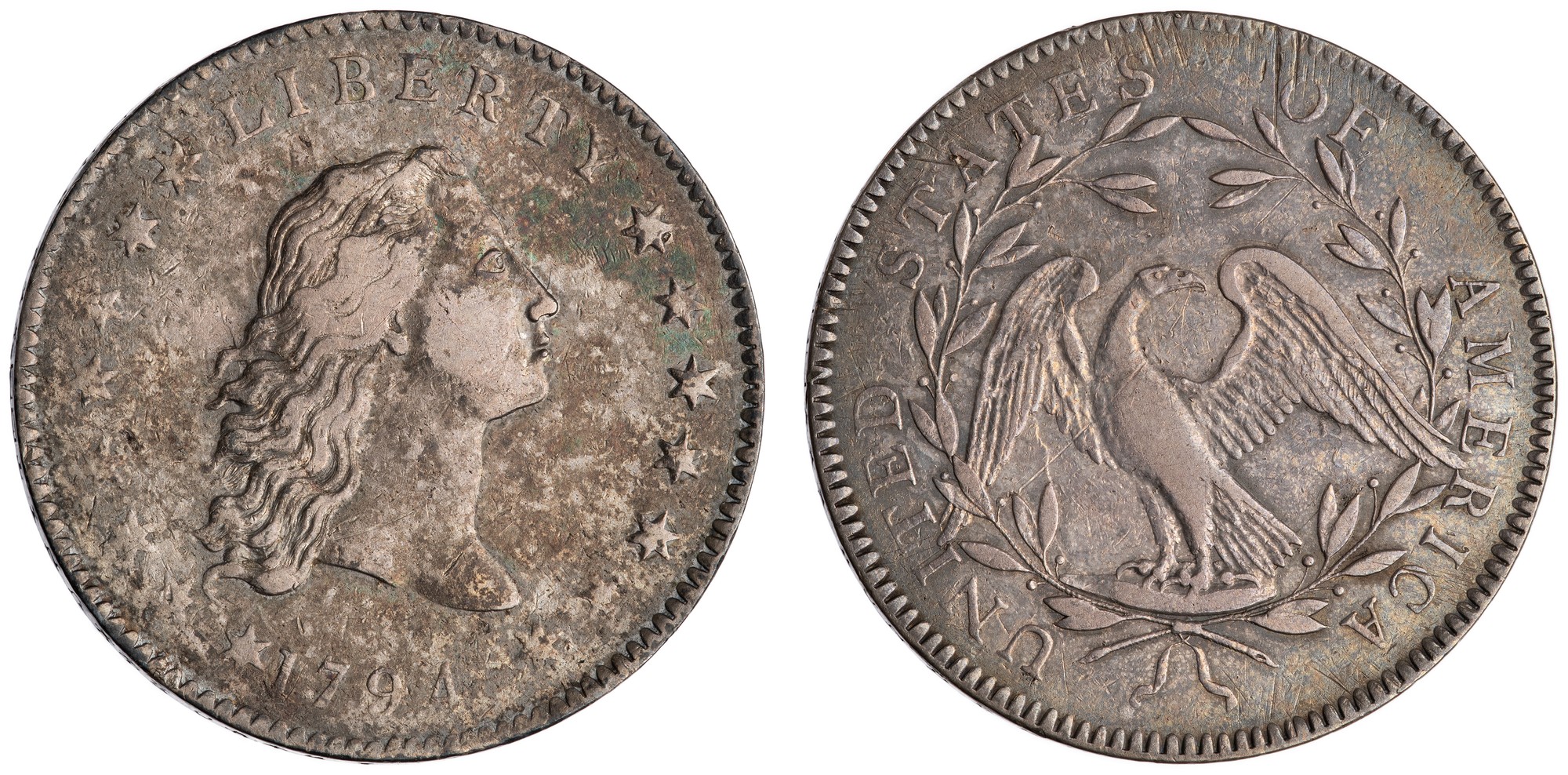
Pick up any early dollar — a worn 1798, say, the kind a patient collector can actually own — and the first thing to understand is that nobody who made it ever saw another one exactly like it. The stars were punched into the die by hand, one at a time, at whatever spacing the workman's eye settled on; the letters the same; the date the same.1 Every die was a one-off, and the coin in your hand is a print from a pairing of two of them. That is the whole secret of this series, and the rest of this book is what follows from it.
Where the series begins
Where the series begins is written down. On July 18, 1794, the Bank of Maryland deposited the Mint's first silver — French coins, $80,715.73½ — and on October 15, 1794, the Chief Coiner made the first return of silver dollars to the Treasurer.2 The standard figure for that delivery is 1,758 pieces3, and it is worth knowing, right at the start, what kind of figure that is: a reconstruction. The Mint's registry combines 1794 and 1795 into one line — 204,791 dollars4 — and the split was worked out by arithmetic in 1927, from a source its own author could not fully name.5 This series will ask you to hold numbers that way constantly: firmly enough to use, loosely enough to say where they came from. Collectors who can do that are proof against most of what will be tried on them, as the last chapters of this book will show.
The law behind the coin is blunter than you would guess. The dollar of 1794 was defined as the equal of "a Spanish milled dollar as the same is now current" — 371¼ grains of pure silver, 416 grains standard6 — because the money Americans actually used was Spanish, and the new coin had to slot into a pocket that already jingled. The Mint that struck it was two years old and had spent those years unable to legally touch precious metal: the Act of 1792 demanded bonds from the chief coiner and assayer so large the men could not raise them, and silver waited until Congress cut the sums by the corrective act of March 3, 1794.6 The first building the federal government ever erected for public use — cornerstone laid by Director David Rittenhouse, July 31, 17922 — spent its first two years coining copper and waiting on paperwork.
The workshop on the coin
Now look at the coin again, because the workshop left its fingerprints. Those parallel scratches across Liberty's cheek on so many 1794s and 1795s are not a cleaning; they are adjustment marks, where a heavy planchet was filed down to legal weight before striking. And if you ever see an early dollar with a round disturbance at its very center, look closer before you call it a hole: the Mint brought light planchets up to standard by driving in a silver plug and striking over it.2 One mark means the blank was heavy, the other means it was light, and both mean a person weighed your coin, by hand, in 1794. PCGS recognizes the plugged 1794 and 1795 dollars as distinct issues, and the most expensive American dollar ever sold — $10,016,875, in January 2013 — is a 1794 with the plug.7 The market did not pay that in spite of the "flaw." It paid it, in part, for the evidence.
There is one more thing tradition says about the 1794 dollars, and this book will always tell you when it is tradition talking. The characteristic weakness at the lower left of a 1794 — flat stars, a soft date — is conventionally explained by the story that the dollars were struck on a press sized for the half dollar. It may be true. No document in the Archive this book is built on supports it: it is not in the Mint's reports, not in the early histories, not in the hobby press gathered for this series.8 Numismatic tradition holds it; the paper, so far, does not. You will meet this distinction again.
Boudinot's Mint
The institution itself is best seen through the reports of its longest-serving early Director, Elias Boudinot, who ran the Mint from 1795 to 1805 and wrote its annual reports like a man who expected to be believed. His report on 1802 informs the President that deposits had exceeded expectation "notwithstanding the considerable check given to deposites, for some time, by frequent reports from the seat of Government, during the last session of Congress, that the mint would be abolished."9 In the same document he asks for two more horses and five hundred dollars — the rolling mills ran on literal horsepower — and pauses to defend his workmen in a sentence that deserves to outlive every mintage table in this book:
"so that not a dollar has been lost, except in one solitary instance, when the culprit was detected by their assiduity and care, prosecuted and punished, and it was by their exertions that the mint was kept open during the late distress of the city, by the fever of last summer."10
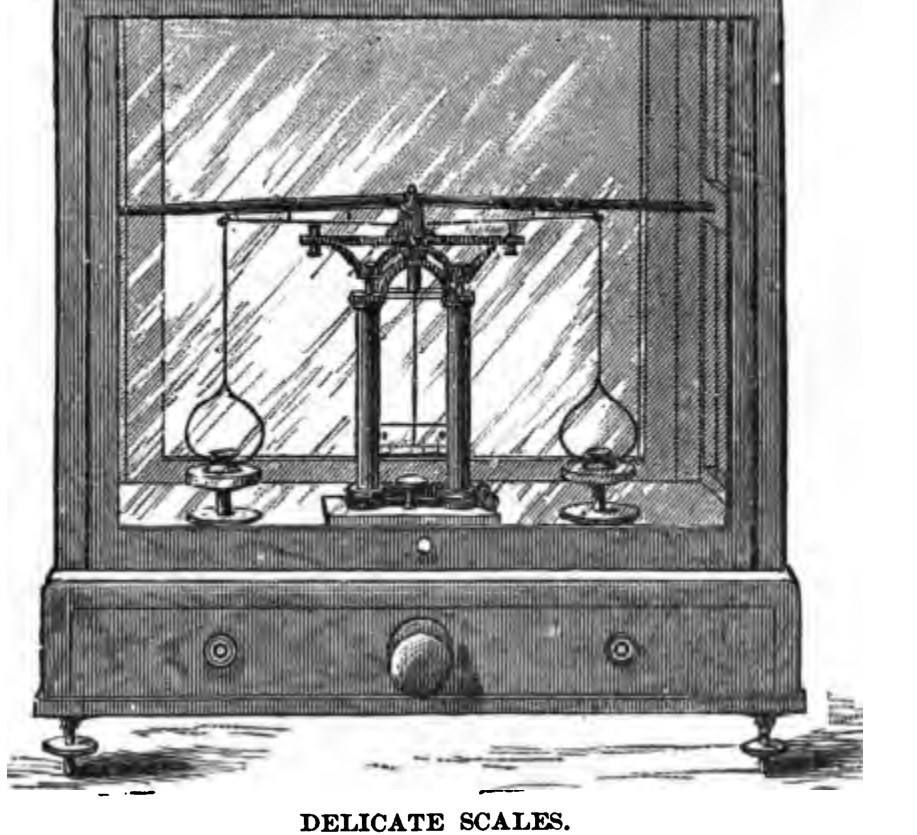
The adjusting room's balance, as the Mint's souvenir history drew it — decades later, but the same work: every planchet weighed by hand.
Yellow fever emptied Philadelphia more than once in the Mint's first decade — it had already killed Joseph Wright, the Mint's first draughtsman and die-sinker, in 1793, before the dollar existed11 — and the men who stayed to keep the coining rooms open are the reason the series in this book has its middle years at all. Robert Scot, appointed the Mint's first Engraver on November 23, 1793, designed both faces this series wears: the streaming-haired Liberty of 1794–95 and the draped portrait that followed. W. E. DuBois, writing from inside the Mint decades later, put the succession plainly: "Wright must have made some of these earliest dies, but Robert Scot is the first officer of the line."11
Boudinot's reports also carry the anxiety of an institution that was never certain it would be allowed to continue. His report for 1802 warns that the Mint's authorizing law expires "on the 4th of March next, by its own limitation"10; his report for 1803 opens against "the dull prospect at the beginning of the year" and closes proud that coinage of every kind had reached $370,698.53.12 Congress renewed the statute; the horses were bought; the fever passed. The Mint of this series is not the granite institution of the later chapters of American coinage. It is a shop — bonded, rented, horse-powered, periodically abandoned to an epidemic — doing precision work to a sixteenth of a grain.
The souvenir impulse
People saved these coins from the first day. An English traveller named William Strickland toured the United States in 1794–95 and went home to Yorkshire with two brand-new dollars among his souvenirs; they passed by sale in 1834 to Charles Winn and stayed with the Winn family at Nostell Priory until Christie's sold them in October 1964, and one of them is today the finest known business-strike 1794 dollar.7 It survived in that condition precisely because it left — out of the tills, off the ships, away from everything the next chapter describes. The first dollars were souvenirs before they were money. In a sense this book is about how they became souvenirs again.
A 1794 dollar, Bolender 1 — the series' single opening marriage, photographed by the museum that holds it.
Because the ones that stayed home went to work, and the work was fatal. The same reports that count Boudinot's horses count the deliveries: hundreds of thousands of dollars a year by 1798, the series' peak at 423,515 delivered in 179913, and then, within seven years, nothing — a denomination stopped dead by presidential order. What happened to the early dollars is not a mystery, and it is not a shipwreck. It is arithmetic, and the Mint's own Director wrote it down as it happened.
- Every die was cut by hand, so the coin in your hand is a print from one particular pairing of two particular dies. That is the unit of study.
- Hold a number firmly enough to use and loosely enough to say where it came from. The chapter's own instruction, and the reason every figure on this site carries its class.
- Mint process is not damage. Adjustment marks and silver plugs are the workshop showing its working.
ARCHIVE13 notes · 7 documents
Notes
- 1
- 2
- 3
American Numismatic Association, The Numismatist, March 1927 (1927)
1,758 silver dollars were delivered in 1794, the balance of the Mint's combined 1794-1795 figure of 204,791 belonging to 1795. PROBABLE
- 4
- 5
- 6
- 7
- 8
1794 half dollar press NUMISMATIC TRADITION
- 9
- 10
- 11
- 12
- 13