The Carousel
Accepted by count, exported by the crate: the banker's habit that consumed ninety-seven percent of the series.
The document that explains why you cannot easily buy an early dollar is not a shipwreck report or a melt order. It is a banker's habit, described by the Director of the Mint in his own annual report. Boudinot, reporting on 1802, explains what happened to the coins the moment they existed:
"All these deposites were private property, the certificates for which were sold, generally, as soon as given, to the banks in this city, at a fourth and a half per cent. discount for the delay of coinage. The banks are fond of keeping the coin in their vaults, as part of their capitals, on account of the ease with which they are counted, without the trouble of weighing."1
"Without the trouble of weighing" is the whole problem in five words. A coin that passes by count rather than by weight will be arbitraged the moment its weight and its count disagree — and the American dollar was born with exactly that disagreement built in.
The mechanism
The Mint Act pegged the new dollar to "a Spanish milled dollar as the same is now current"2, but the American piece came out slightly lighter than a full-weight Spanish one. In the West Indies, both passed by tale — counted, not weighed. A. Barton Hepburn, the standard historian of American coinage, states the consequence with the economy of a man describing a machine:
"Although somewhat less in weight than the Spanish pieces, the American dollars were accepted by tale throughout the West Indies and were exported for that reason. Spanish and Mexican pieces were imported, and those of full weight, or nearly so, were recoined into dollars at the mint, the depositors reaping the profit."3
Follow the loop. Deposit heavy Spanish dollars at the Mint. Receive slightly lighter American dollars — more pieces from the same silver. Ship the American pieces to the Caribbean, where they count the same as the heavy coin. Buy more Spanish dollars. Repeat. Every turn of the carousel put freshly struck United States dollars on a boat, and no turn ever brought one back. The Mint was operating, in effect, a free re-coining service for exporters, and it was doing so at precisely the moment its dollar output peaked — 327,536 delivered in 1798, 423,515 in 1799, 220,920 in 1800.4
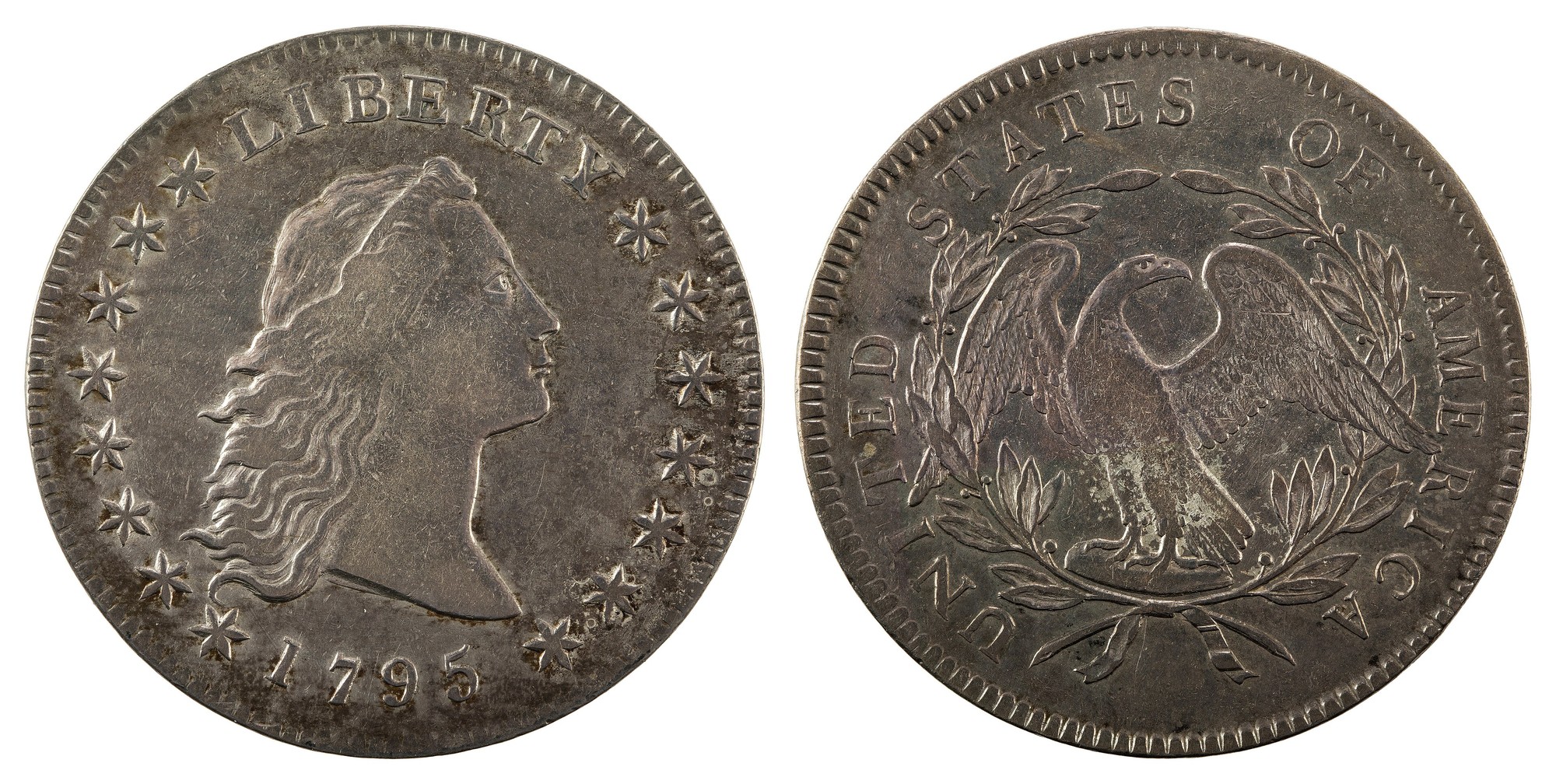
A 1795 Flowing Hair dollar — struck in the series' first six-figure year, and exactly the kind of coin the carousel exported.
The mispricing underneath was widening as the coins were struck. The Act of 1792 had fixed silver to gold at fifteen to one; the 1876 Monetary Commission, looking back, noted that "silver immediately began to decline in price, and before 1800 it had reached the ratio of 15.42," and described the fate of the full-weight fractional coins in the same breath: "Vainly did the United States Mint issue American fractional coins of full weight and value, as these were soon melted up, and the bullion sold at a high profit."5 Boudinot himself watched the drain in real time. His report on 1804 notes that most deposits were being paid out "in small coin, which has been found very beneficial to the citizens at large, under the late scarcity of Spanish dollars, occasioned by the great exportation of them, for mercantile purposes."6 Even the Spanish coin was leaving. The dollars — Spanish and American alike — were a commodity that happened to be legal tender.
The stop order
The government's response, when it came, was not a reform of the ratio. It was a switch thrown by the President. Hepburn again:
"President Jefferson undertook to check this business in 1806 by directing that the mint suspend the coinage of the dollar pieces. This suspension continued until after the legislation of 1834."3
And from inside the building, Eckfeldt and DuBois — the Mint's own assayers — recorded the result as a bare line in their 1842 statistics: "No dollars from 1806 to 1838, except 1000 in 1836."7 The series ends there. The last substantial delivery was the 19,570 pieces of calendar 1804; the final 321 dollars were delivered in 1805; and then the denomination itself went dark for a generation. What those 1804 and 1805 deliveries were actually dated is the business of Chapter 5, and the strangest story in American numismatics hangs on the answer.
What did not happen
Because the early dollars have no hoard, stories have grown to fill the space, and a collector should know the three events that did not touch this series. The Pittman Act of 1918 melted over 270 million silver dollars — the Director's report for 1919 notes the surge of metal "due to the melting of silver dollars"8 — but those were Morgan dollars in Treasury vaults; by 1918 no meaningful quantity of early dollars was in government hands. The recoinage legislation of 1834 changed the gold standard, not the silver. And the 1804 shipment that supposedly sank on the way to China is a legend, told in full in Chapter 8, where it belongs — among the fakes and the stories.9 No recall, no redemption, no official melt ever touched the coins of 1794–1803. They were consumed by commerce, one profitable shipment at a time, over about thirty years.
The arithmetic of survival
That slow, uniform consumption shows up in the numbers, and it is worth doing the arithmetic openly — noting, per this book's standing rule, that survival estimates belong to the party who made them, and that the rates computed from them are this book's own analysis, not a published authority's. Roughly 1.44 million dollars were delivered between 1794 and 1805 by the Mint's registry.10 PCGS's survival estimates for the series, observed in August 2026, total in the low tens of thousands.11 Set the two against each other, year by year, and the big delivery years — 1798, 1799, 1800 — cluster tightly at a survival rate of two to three percent. That tight cluster is the signature of a slow, uniform drain: no single catastrophe, no lucky surviving bag, just export and melt working evenly across every year's output.
Two years break the pattern, in opposite directions, and both breaks are informative. The 1794 rate is high — around eight percent on PCGS's estimate of 150 survivors11 against the reconstructed 1,758 — for the obvious reason: the first dollars were saved as curiosities from the beginning, and Strickland's souvenirs prove the impulse was immediate. And 1797, with the lowest delivery figure of any year in the series — 7,776 pieces10 — shows thousands of survivors, an implied survival rate near forty percent, which no one believes. The economical explanation is not that 1797 dollars were uniquely treasured. It is that the 7,776 figure does not describe the coins dated 1797 — that the delivery ledger and the dates on the coins are two different things.12
Hold that thought through the next three chapters. It is the crack through which this series' greatest story enters.
ARCHIVE12 notes · 8 documents
Notes
- 1
- 2
- 3
- 4
- 5
- 6
- 7
- 8
- 9
1804 china shipwreck NUMISMATIC TRADITION
- 10
- 11
- 12
The ratio of estimated surviving 1797-dated dollars to the Mint's 1797 delivery figure of 7,776 is roughly an order of magnitude higher than the equivalent ratio for 1798-1803, which is better explained by the delivery figure not matching the dated output than by exceptional preservation. PROBABLE