The Way
of Seeing
No two dies were ever alike. An 1881 auction catalogue taught the hobby to read them — and the skill has never stopped paying.
The founding document of early-dollar collecting is not a book. It is an auction catalogue — Philadelphia, November 1881 — and its author tells you, in his own preface, that he is publishing a numbering system for a book he may never write:
"The following Dollars, Half Dollars and Quarter Dollars comprise the type table of John W. Haseltine, having been collected from many specimens, during the past five years, with the view of publishing a work upon the subject. Whether that will be done is not yet fully determined… The numbers of the pieces in the type table are the same as will appear in the book referred to above if it should be published."1
The book was never written. Sixty-nine years later M. H. Bolender wrote it for him2, and Haseltine's numbers are still visible underneath, the way an older street grid shows through a modern city. This chapter is about what Haseltine was actually doing when he numbered those coins — because it is the single skill that separates a collector of this series from a buyer of it.
Why no two dies match
Between 1794 and 1804 the Mint had no way to make two identical dies. The portrait came from a punch, and from 1798 the eagle did too — but the stars, the letters, the numerals of the date, and the berries of the wreath were entered by hand, one punch at a time, at whatever spacing and rotation the workman's hand produced.3 Every die therefore carries a unique fingerprint. And because dies were expensive and steel was unpredictable, a die was used until it failed — then re-paired with whatever survived on the other side of the press. The unit of study is therefore not the die but the marriage: a specific obverse used with a specific reverse. A single 1798 obverse might strike coins with two, three, five different reverses across its working life. Haseltine counted the wreckage of that year himself, and quoted his own count decades later: "in 1798 there were 30 different obverses of the dollar, with 17 reverses. No. 10 has 2 reverses; No. 18 has 3; No. 22 has 2; No. 14 has 2; and No. 26 has 5."4
There is a third variable, easy to forget because it lives on the part of the coin you cannot see in a photograph. The edge — HUNDRED CENTS ONE DOLLAR OR UNIT — was lettered before striking, by a Castaing machine that rolled the blank between two bars. An edge that can be lettered before striking can also, with the right tooling, be lettered after.5 File that fact away. It is the loose thread the 1804 dollar hangs on, and Chapter 7 pulls it.
Reading the workman's hand
What Haseltine understood in 1881 is that these accidents of hand-work are not noise. They are an alphabet. His descriptions read like field notes, and they are perfectly usable at the bench today:
"1795; No. 1; flowing hair; wide date; 1 point of lower star touches the curl; the hair flows back ending in 5 decided points including the curl; rev., delicate wreath; 10 berries on right and 9 on left; barely circulated."1
"1795; No. 5; wide date; the lower curl is more perfect than in any of the preceding and is not near the stars, but above them… rev., heavy wreath; 6 berries on right and 7 on left; there are 3 leaves under each wing of the eagle (there being only 2 in any of the preceding)."6
That second entry — three leaves under the wing where earlier dies show two — is the 2 Leaves / 3 Leaves distinction that PCGS still recognizes as a major variety of the 1795 dollar, printed on holders and in auction titles today.7 A Philadelphia dealer described it, numbered it, and priced it in 1881. When you learn to attribute this series you are not learning a modern grading-service taxonomy; you are joining a chain of looking that is a century and a half old.
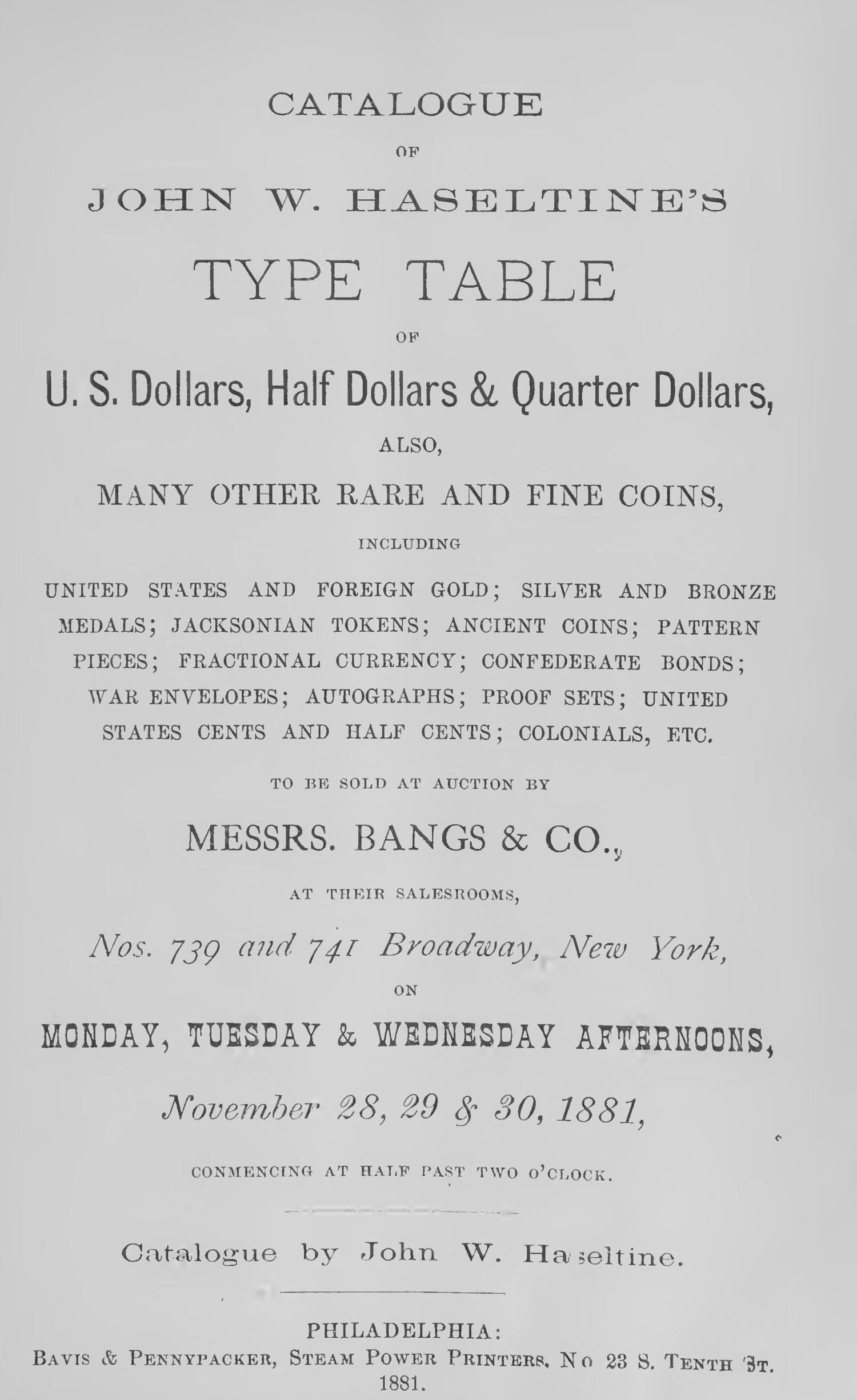
The founding text of American die-variety collecting is an auction catalogue: Haseltine's Type Table, Philadelphia, November 1881.
Haseltine also tells you, in the catalogue's NOTICE, what his numbers meant to him — and what rarity meant before population reports:
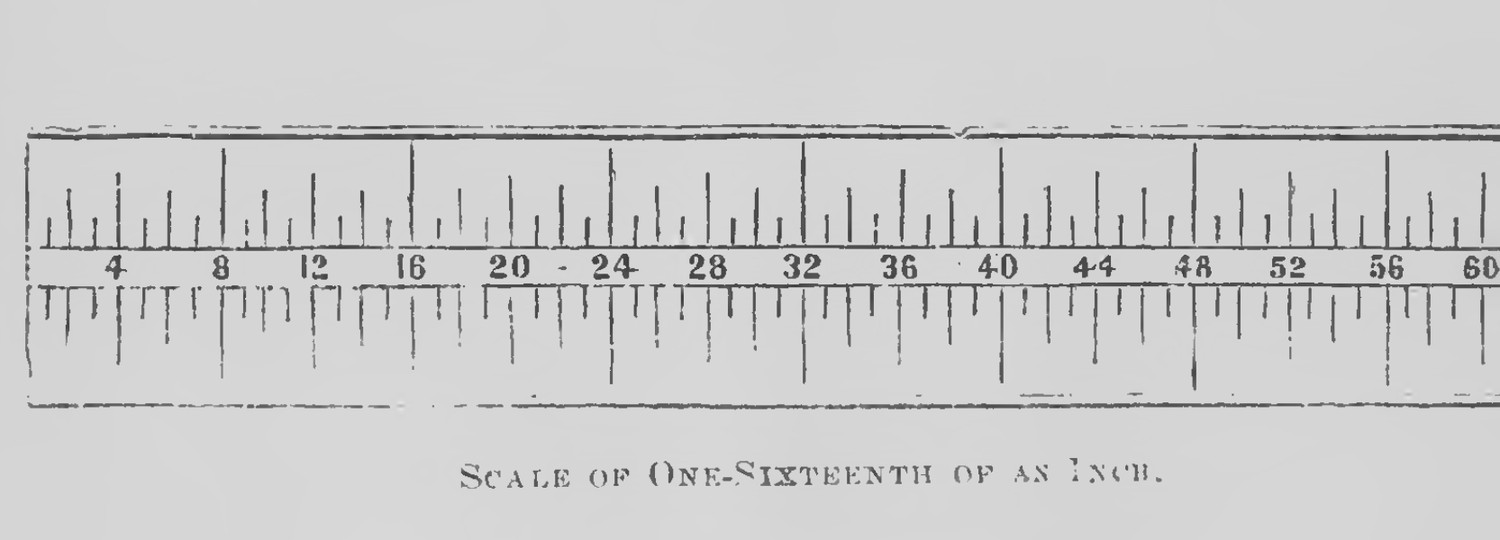
The catalogue's engraved scale — one-sixteenth of an inch, numbered to 60 — printed so buyers could measure the diagnostics themselves.
"In many of the varieties in the Type Table, I have met with but a single specimen, and in that case they are termed excessively rare. Particular attention has been directed to the varieties of the early dates…"8
One man, five years, "many specimens": that was the census. Keep it in mind in Chapter 9 when we talk about what survival estimates are and who owns them.
Four systems, one series
The attribution systems for this series arrived in four waves, and knowing the sequence keeps old catalogues readable. Montroville W. Dickeson's 1859 manual described varieties in prose — berry counts, star positions — date by date; influential, frequently wrong, and cited in this book only as evidence of what was once believed.9 Haseltine's 1881 Type Table assigned the H-numbers.1 Bolender's 1950 book assigned B-numbers that restart at 1 for each date — which is why a bare "B-15" means nothing without its year2 — and Bowers and Borckardt's 1993 encyclopedia assigned the BB-numbers in use today: one continuous sequence across the whole series, obverse dies numbered, reverse dies lettered, the BB number naming the pairing.10
The BB sequence is also, quietly, the strongest single argument for the way this book is organized. A numbering scheme that runs unbroken from the unique 1794 marriage straight through the 1795 change of portrait, the 1798 change of eagle, and on into the 1804 dies is a statement by the two people who knew the series best that the design boundaries are not the collecting boundaries. The checklist a collector completes is one run. Bolender's per-date restart makes the same point in negative: nobody needed a date-blind number until the whole run was treated as one thing.
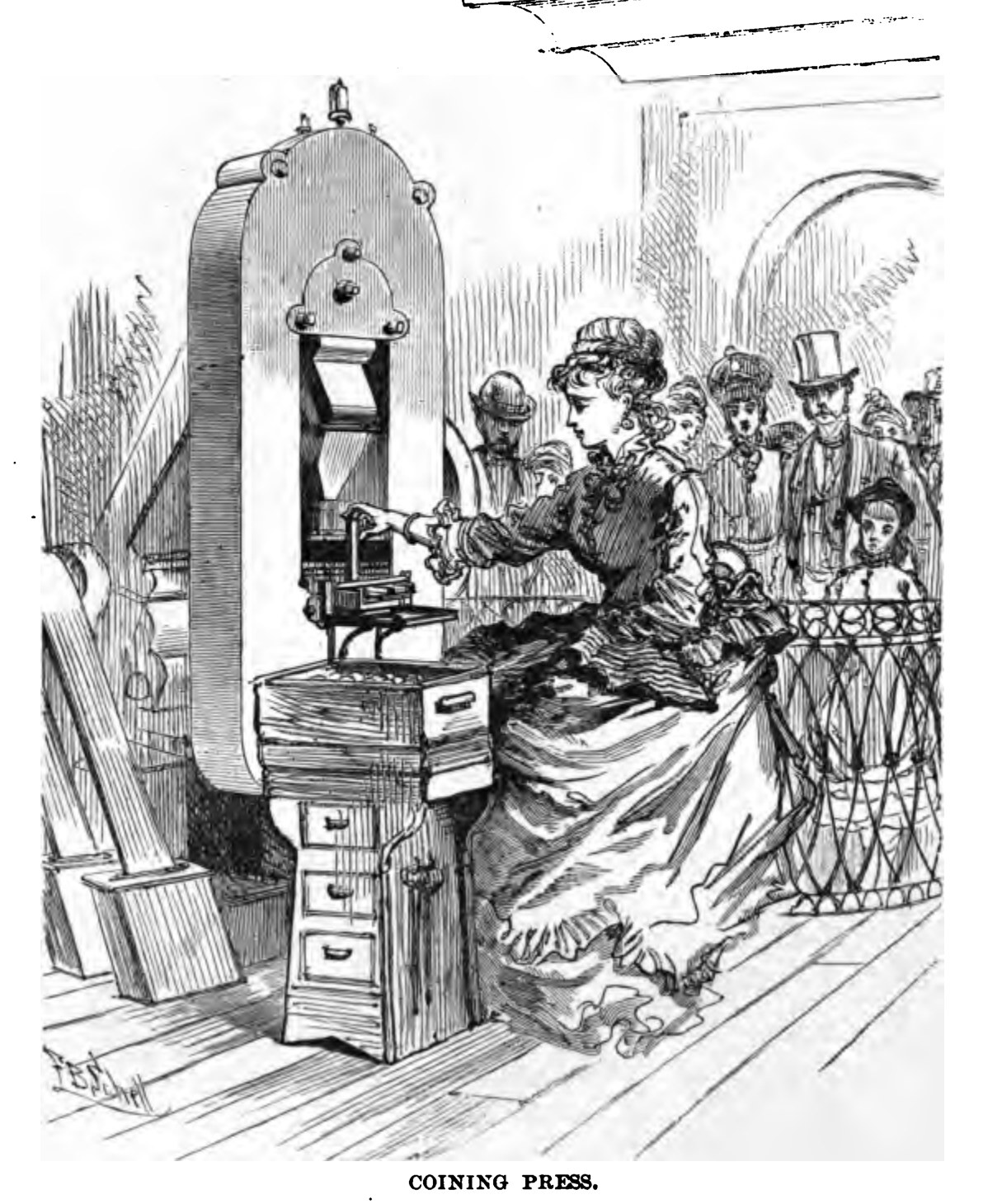
The coining press, as Evans illustrated it — the machine at the center of every marriage in this book.
This book's convention, wherever a marriage is named: BB-number first, B-number second — 1798 BB-xx (B-xx) — with the PCGS variety name in quotes when one exists, because that is what appears on holders. Never trust a bare B-number without its date, including from this book.
What the skill is for
It would be easy to mistake all this for stamp-collecting at the margins — berries and curls, an inch scale printed in an auction catalogue so buyers could measure diagnostics for themselves.3 It is the opposite. Die-marriage attribution is the only instrument this series has ever had for answering its hardest questions. It is how an anonymous collector in 1895 could tell a genuine 1794 from an altered 1795 by the rotation of the star punches.11 It is how the whole nineteenth century's argument about the 1804 dollar was finally settled — not by a document, but by a border. And it is how you, at a bench, with a loupe, can check claims that were being argued over before your great-grandparents were born.
The next chapter puts the instrument in your hands: twelve marriages, chosen not for price but for what each one teaches. Attribute those twelve and you can attribute the series.
ARCHIVE11 notes · 5 documents
Notes
- 1
- 2
The United States Early Silver Dollars from 1794 to 1803 (1950)
- 3
- 4
- 5
- 6
- 7
- 8
- 9
- 10
The Encyclopedia of United States Silver Dollars 1794–1804 (1993)
- 11