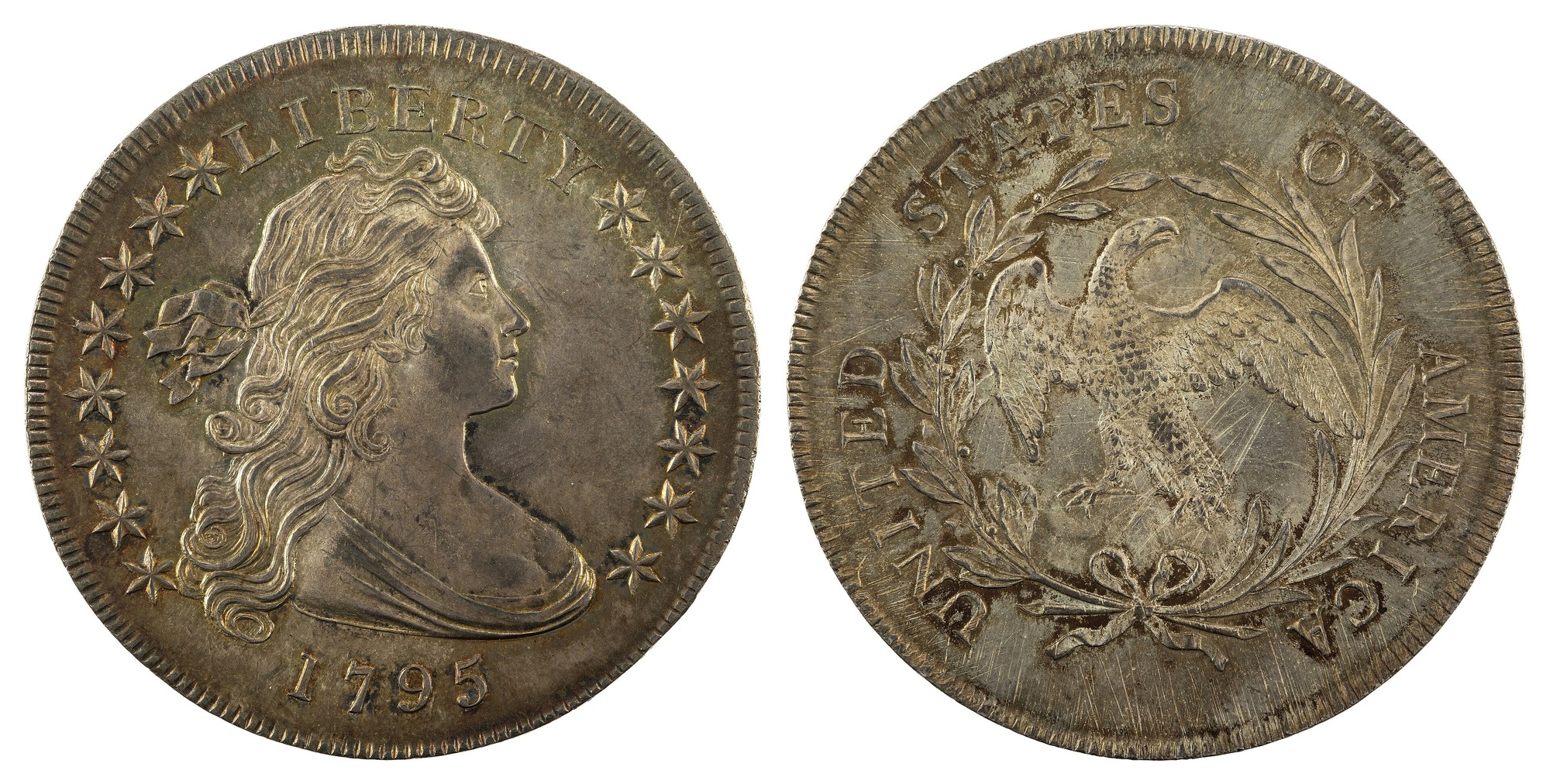
Twelve Marriages
A teaching set, ranked by lesson rather than price: attribute these twelve and you can attribute the series.
A teaching set is not a want list. The twelve marriages and varieties below are ranked by what each one teaches, not by price or rarity; several are obtainable, a few are museum pieces, and the last one decided a two-century argument. A student who can attribute these twelve can attribute the series. Survival and rarity figures in this chapter are PCGS CoinFacts estimates, observed August 2026, and belong to PCGS.1
1 · 1794, BB-1 (B-1) — the marriage that is also the date
One obverse, one reverse, one marriage. Every 1794 dollar in existence came from the same pair of dies, which makes this the cleanest possible introduction to the vocabulary: this is an obverse die, this is a reverse die, this is what it means that they were married. It also introduces the workshop evidence from Chapter 1 — the finest known example carries adjustment marks — and the trade tradition about the undersized press, which this book carries as tradition, not record.2 There is no 1794 variety set to complete. There is only condition, and history.
2 · 1795 Flowing Hair, 2 Leaves vs. 3 Leaves — count the leaves
The single best first attribution exercise in American numismatics: one feature, two states, both common enough that you can put them side by side at a coin show. Under each wing of the eagle, two leaves or three. Haseltine described the difference in 18813; PCGS carries both as major varieties today, with the 3 Leaves the commoner of the two.1 Five minutes with these two coins and you understand, physically, what a reverse die is.
3 · 1795 Flowing Hair, Silver Plug — process is not damage
The Mint corrected underweight planchets by punching a hole at the center, driving in a silver plug, and striking over it.4 PCGS estimates about 250 survivors and treats the plug as a distinct issue.1 The lesson pairs with the adjustment marks of entry 1: one mark means the blank was heavy, the other means it was light. A round disturbance at the center of an early dollar may be the most valuable thing about it — the eight-figure 1794 is a plug coin. Learn to see Mint process before you learn to see problems.
4 · 1795 Draped Bust, Centered vs. Off-Center — where the head sits
When the new portrait arrived late in 1795, Haseltine caught something subtle: "No. 14; fillet head; the head not well centered, being too far to the left" against "No. 15; fillet head; head well centered."3 The lesson: the placement of a punched device, not just its shape, is a diagnostic. A modern PCGS designation — Centered, Off-Center — is being read straight out of an 1881 catalogue.1
The new portrait, late 1795: a Draped Bust, Small Eagle dollar — Haseltine's “fillet head.”
5 · 1796 Small/Large Date × Small/Large Letters — the punch matrix
Date punches came in two sizes that year; so did the reverse letter punches; the combinations are a coordinate grid, and three of the four cells exist as catalogued varieties.1 The lesson is that obverse and reverse vary independently — a variety name is often a coordinate pair, not a single feature. When an auction title says "1796 Small Date, Large Letters," it is giving you two readings, and you should check both.
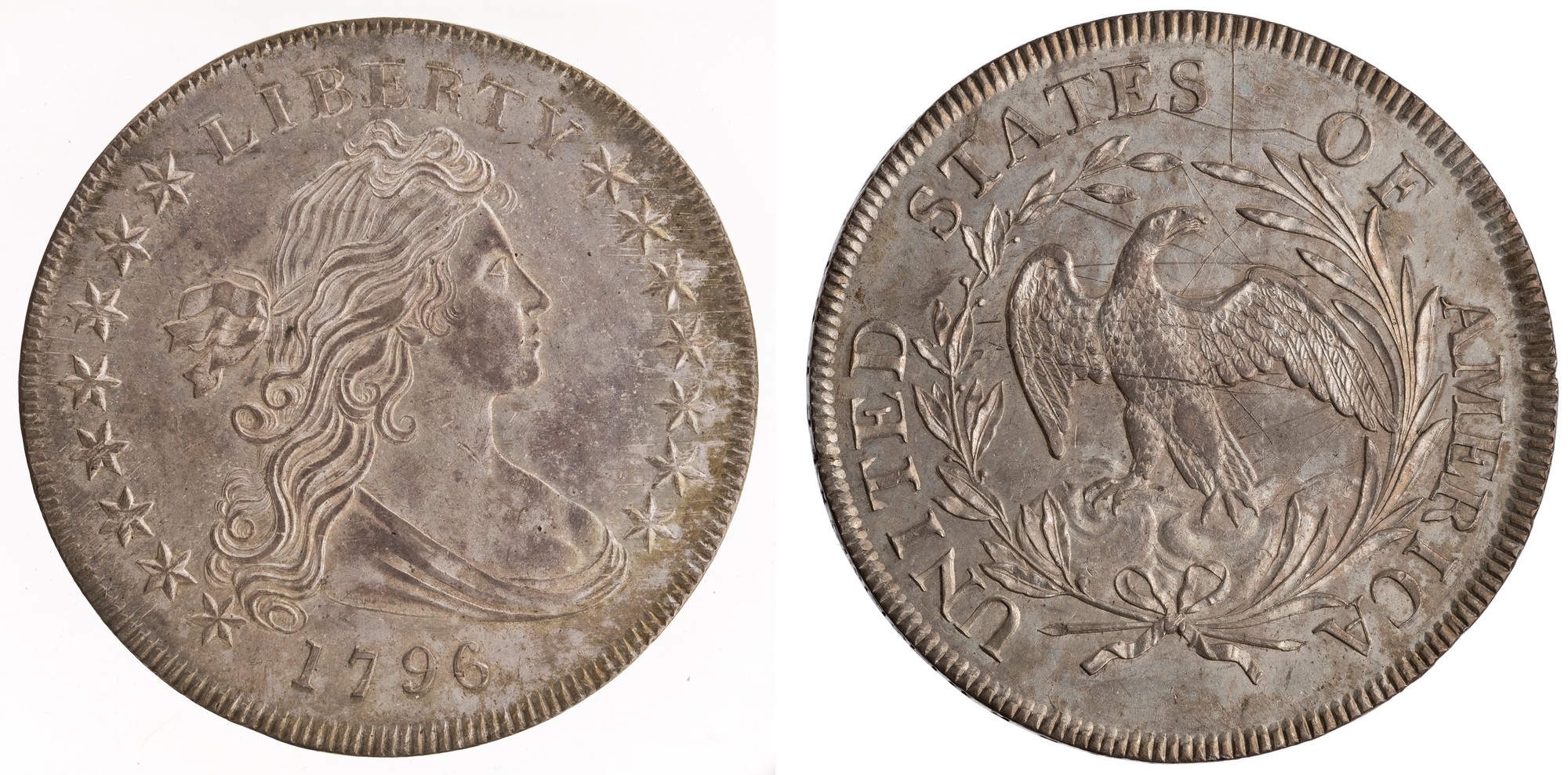
A 1796 dollar (ANS attribution B-4) — the punch-matrix year: date size and letter size vary independently.
6 · 1797 9x7 Stars vs. 10x6 Stars — count, then count again
The same stars, distributed two ways around the same portrait — nine facing seven, or ten facing six — and the only way to know which coin you are holding is to count. That is the whole lesson, and it never stops applying: count them yourself, every time, because the punches were placed by hand and the catalogues were written by people who counted. The 9x7 arrangement splits again by reverse letter size into varieties of very different rarity.1 The 1797 dollars also carry the series' strangest delivery figure — 7,776 for the whole year5 — and the survival anomaly from Chapter 2 that the figure cannot explain.6
7 · 1798 Small Eagle, 13 Stars vs. 15 Stars — a type change inside one date
1798 carries both the outgoing small eagle and the incoming heraldic eagle — a design transition happening mid-year, mid-delivery. "Type" and "date" are independent axes, and the small-eagle 1798s are the last of their kind. The trade's allocation of the year's 327,536 delivered pieces across the three kinds is judgment, not record — the Mint counted deliveries, not designs.7
8 · 1798, the die chaos — why marriages exist at all
No single coin here; the lesson is the count. Thirty obverses, seventeen reverses, dies re-paired as they failed — Haseltine's own census of the year, quoted in Chapter 3.8 Stand in front of a dealer's case of 1798 dollars and know that the chaos was the system. And note who is deploying the fact, and where: Haseltine used the combinatorics of 1798 as an argument in the 1804-dollar controversy. Variety knowledge, in this series, has never been neutral.
9 · 1799/8 — the overdate
The series' most collected overdate: a 1798 die re-dated rather than discarded, the 8 still visible under the 9, with a 15-star reverse variant as a further split.1 The lesson is reading an undertype — steel was too valuable to waste, and the dies tell you so. 1799 is also the series' high-water mark, 423,515 delivered9, which makes it the natural date for a first purchase and this list's natural anchor.
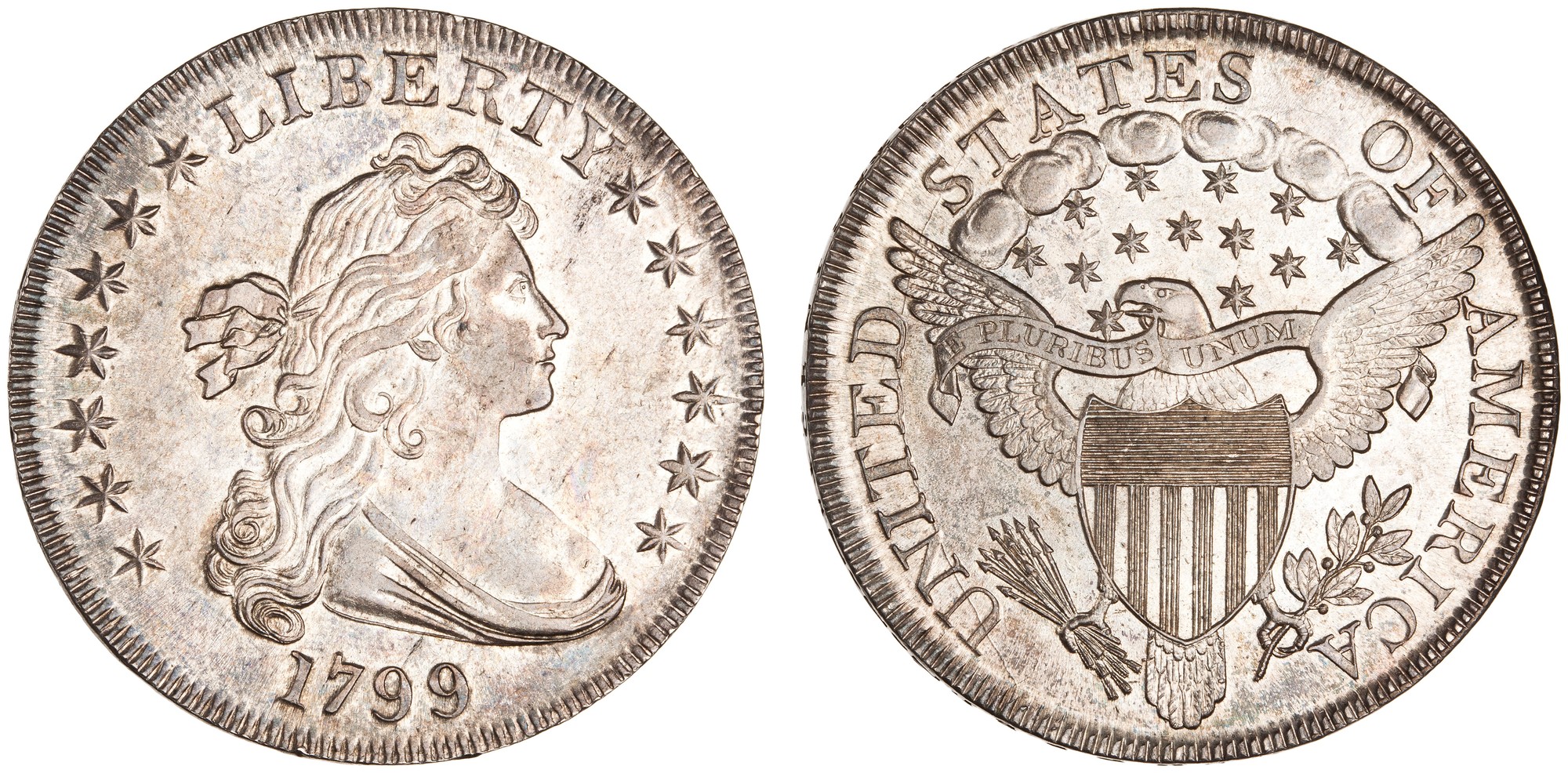
A 1799 dollar — the series' high-water mark and its natural first purchase.
10 · 1800 AMERICAI — a die break is not an engraving error
At the end of AMERICA, what reads as an extra letter I is a break in the die — metal flowed into the crack and printed as a raised line. Its stablemate, the 1800 "Dotted Date," is the same lesson in miniature: flakes out of the die, not dots punched in.1 This is the most common beginner's confusion in the series — distinguishing what the engraver punched from what the steel did later — and the 1800s teach it cheaply.
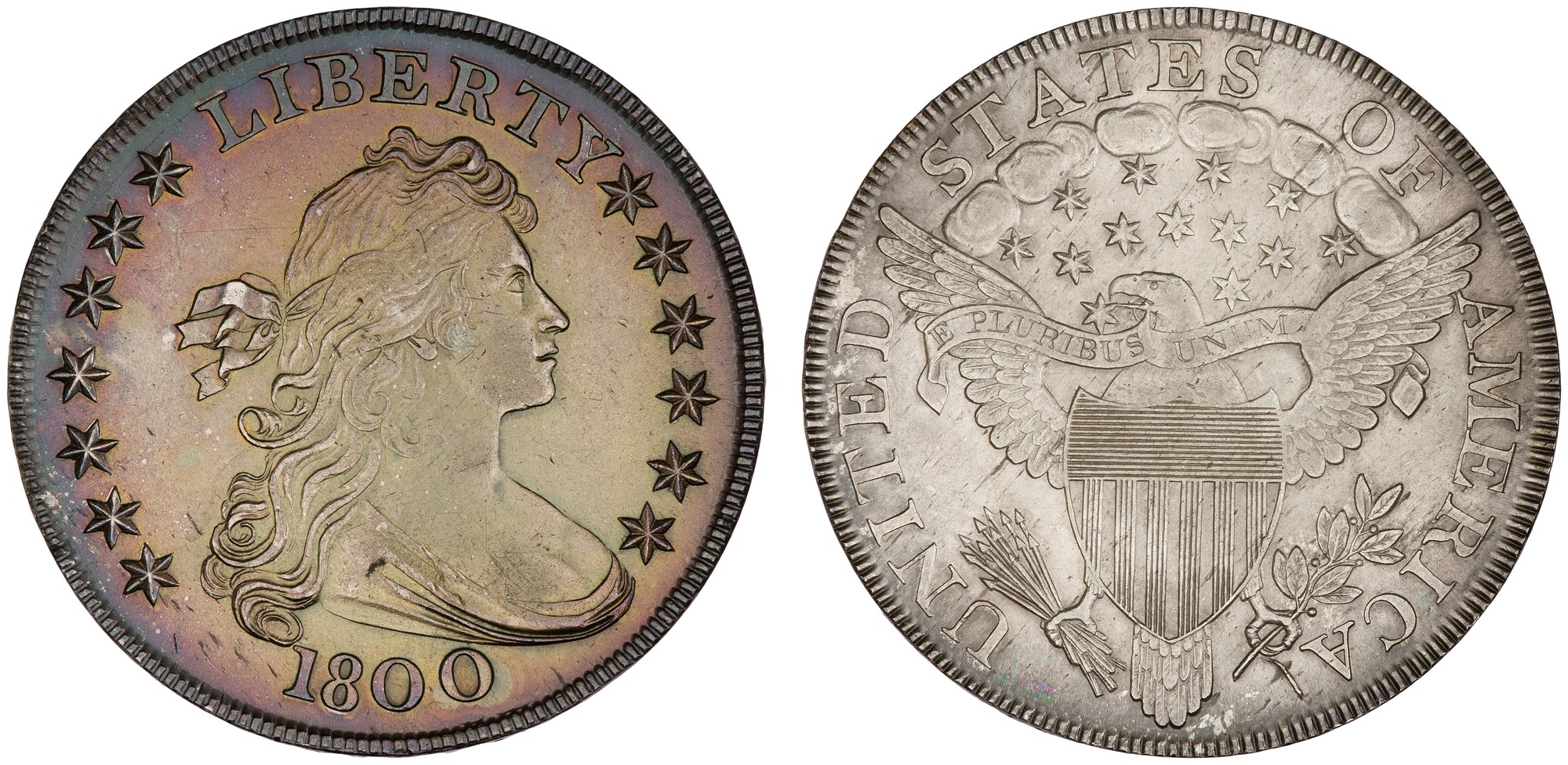
An 1800 dollar (ANS attribution B-19) — the date whose die breaks teach the difference between the engraver and the steel.
11 · 1802/1 Narrow Date and Wide Date — two variables at once
An overdate that exists in two date-spacings, so attribution requires sequenced readings: first identify the overdate, then measure the spacing. Chapman's 1907 Stickney catalogue describes the 1802/1 lots exactly this way — star-to-Y distance, reverse leaf position — which is worth knowing because it means the method you are learning is the method the great cataloguers used.10
12 · 1804, Class I vs. Class III — the capstone
The attribution that decided a two-century argument, checkable by any student with good photographs. Four independent diagnostics:
The border. Dollars of 1794–1803 show milling — raised lines — running to the edge of the piece. The 1804 dollars show beading with a plain rim outside, a style that begins with the Gobrecht dollar of 1836. This is Nexsen's 1897 argument, and it is dispositive: "what inference can be drawn other than that the die was cut between the year 1836 and 1842?"11
The edge. Class I edges are cleanly lettered. Class III edges were lettered after striking, with incomplete collar segments that repeat some letters and drop others.4 The Castaing thread from Chapter 3, pulled.
The weight. The legal standard was 416 grains12; the Mint's plain-edge restrike weighs 381.54; the Stickney Class I weighed 415 on Chapman's scale13; Haseltine reported the Cohen coin at 410¼ and the Idler coin at "411 and a fraction."8
The reverse die. Chapman, 1885, on the restrike reverse: "The A touches the eagle's claw, the OF much nearer of the end of eagle's wing than S in States (in the original it is equally spaced)."4
And one deliberate trap, because a teaching set should contain one: Haseltine used a correctly observed diagnostic — thirteen arrows in the Idler coin's eagle's claw against twelve on the others — to argue the opposite case, that his father-in-law's coin was an original.8 The observation was right. The conclusion was wrong, and the interest was undisclosed. Chapter 8 returns to him.
The field guide, 1895
One more document belongs in this chapter, because it shows the method working a real case a century and a quarter ago. The commonest forgery in this series has always been the 1794 made from an 1795 by altering the date. In 1895 a collector published the tell, in The Numismatist, as a working field guide: on a genuine 1794 the lowest curl touches the second star from the bottom, and the stars along the right side present single points to each other along the curve — an arrangement no 1795 die shows.14
Two things to notice. First, the star-orientation test works because star punches were entered by hand at whatever rotation the workman chose — the exact fact that makes die marriages possible at all. The forger can copy a date; he cannot re-derive a workman's wrist. Second, the 1895 writer observes in passing that the 1804 dollar's star arrangement matches 1795-and-later. Two years before Nexsen published the border argument, someone was already looking at the 1804's punch work and finding it in the wrong company. The instrument was in the hobby's hands before the hobby knew what it had measured.
ARCHIVE14 notes · 9 documents
Notes
- 1
- 2
1794 half dollar press NUMISMATIC TRADITION
- 3
- 4
- 5
- 6
The ratio of estimated surviving 1797-dated dollars to the Mint's 1797 delivery figure of 7,776 is roughly an order of magnitude higher than the equivalent ratio for 1798-1803, which is better explained by the delivery figure not matching the dated output than by exceptional preservation. PROBABLE
- 7
- 8
- 9
- 10
- 11
- 12
- 13
- 14