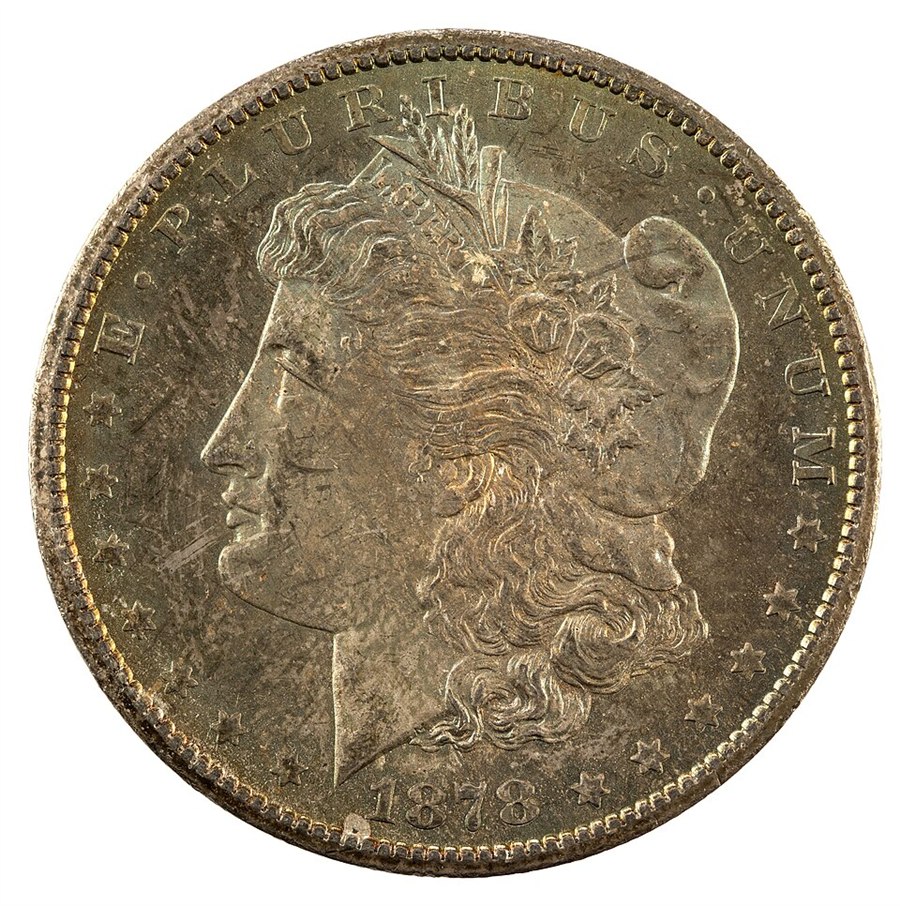
Morgan grading is its own discipline because the population is strange: millions of uncirculated survivors mean the real game is played inside Mint State, where one point can multiply the price. Learn the circulated ladder once; learn the Mint State variables forever.
12
1 Hair above the ear — highest point, first to wear. 2 The cheek — the open surface where bag marks hurt most. On the reverse: the eagle's breast. Educational markers, not a grading tool.
Before anything else
The two-second triage
Tilt the coin under one light. Rotating cartwheel luster plus flat spots = weak strike (common on New Orleans coins, not wear). Broken, dull luster on the hair above the ear and the cheek = wear — the coin is circulated, whatever the seller says. Uniform dead shine = someone polished it, and the value went with the surfaces. Everything else in Morgan grading is refinement of those three cases.
AG-3 → MS-67
The circulated ladder, Morgan-style
Standard grades expressed in this coin's anatomy. Grades between the listed steps interpolate.
AG-3Rims worn into the design; date and mint mark readable — the coin is silver with an identity.
G-4Design outlines complete; Liberty's hair a smooth sweep; eagle's breast flat; rims full.
VG-8Major hair contours return above the forehead and ear; a few breast feathers hint at edges.
F-12Hairlines distinct over the ear and forehead; wreath details clear; breast still smooth.
VF-20Two-thirds of hair detail sharp; cotton bolls defined; breast feathers begin to show.
XF-40All hair strands defined with light flatness only on the highest waves; breast feathers clear but worn at center.
AU-50/58Trace friction on the cheek and hair above the ear only; luster survives in protected areas — the grade where 'sliders' pretend to be mint state.
MS-60/62No wear at all — but marks, sometimes heavy. Baggy, dull or scuffed; genuinely uncirculated nonetheless.
MS-63The collector baseline: scattered marks, decent luster, nothing disqualifying on the cheek.
MS-64Close — one grade and often several multiples of price from gem; usually a cheek or field issue away.
MS-65Gem: clean cheek, clean fields, full luster; small marks only in protected areas.
MS-66/67Superb: nearly mark-free with exceptional luster and eye appeal. Price cliffs live here — census coins, registry money.
The Mint State game
Above MS-60 nothing is worn — so what separates an ordinary uncirculated coin from one worth a hundred times as much? Four variables:
Marks. Thousand-coin canvas bags made "bag marks" the series' signature affliction. Location matters more than count: the cheek is the market's obsession because it's the largest open surface. MS-63 tolerates scatter; MS-65 demands a clean cheek and fields.
Luster. Frosty, satin or semi-prooflike — but always rotating under light. Luster broken by friction can't come back; luster stripped by dipping leaves coins bright and dead.
Strike. Full breast feathers and sharp hair over the ear vary by mint and date (see the mints). Weak strike caps eye appeal, not the technical grade — but the market pays for both.
Eye appeal. The tiebreaker that isn't tie-sized: at equal grade, the pretty coin can bring multiples. Toning, cameo contrast and clean focal areas all live here.
PL and DMPL
Freshly polished dies struck some business coins with mirror fields. Grading services designate PL (Prooflike) and DMPL (Deep Mirror Prooflike) by the depth of field reflectivity per their published standards — DMPL mirrors read clearly at several times PL's distance. Frosted devices over deep mirrors ("black and white" cameo) make common dates spectacular and expensive. Mirrors magnify every hairline, so DMPL grading is merciless — and raw "deep mirror" coins on auction sites deserve suspicion by default.
Proofs are a different animal
Philadelphia's small annual proof runs (typically several hundred to roughly a thousand) have mirror fields by design, struck from prepared dies on prepared planchets. Rim, edge and strike character differ from DMPLs; attribution belongs with the grading services. Proof grading runs its own ladder where hairlines dominate — the ~880-proof 1895 being the stakes at maximum.
Cleaning, damage, and "details"
The value-killers, in rough order: harsh cleaning (parallel hairlines, unnatural brightness), whizzing (wire-brushed fake luster), polishing, heavy scratches, rim knocks, tooling, and artificial toning. Certified coins with these problems come back in "details" holders at deep discounts. Original surfaces — even dark ones — are the asset. Never clean a coin; our inherited-coins guide explains why in blunter terms.
When to insist on certification
Self-grading gets you to "roughly XF" and "probably cleaned." It does not get you to MS-64 vs MS-65, PL vs DMPL, or genuine vs excellent fake. For key dates, for anything over a few hundred dollars, and for every raw "bargain" — PCGS or NGC certification, with the certification number verified against the service's own database (faked holders exist). The key-dates reference flags per-issue risk.
Worked example
One issue, five real coins, five grades
Everything above is a description of surfaces. The 1893-S issue page carries the grade explorer: a set of individually certified 1893-S dollars — an uncertified circulated example at one end, a census-grade mint-state coin at the other — each with its own certification linked, so you can step through the grades on real coins of a single issue instead of on generic illustrations.
Use it as a reading exercise, not a rulebook: one photograph never defines a grade, and the copy on that page says so. What it does show honestly is how much of the difference between grades on one issue is surface and luster rather than detail.
A full photographic grade ladder — the same wear points shown at every step from Good to Gem — is not published here yet. The photography that would make it good is not ours to publish, and the rights position is an open decision. We would rather say that than illustrate grades with coins that don't hold them.
Sources
OBSERVED
13 sources
ESTIMATED
6 sources
DERIVED
1 source
Sourced figures on this page trace to the ledger below. Editorial judgement is labelled as ours, and prices we have not sourced are not published.