A coin is a policy you can hold. The Morgan dollar's story runs through four decades of silver politics, one world war, and a half-century of government vaults — and none of its strangeness makes sense without the politics that struck it.
1873 – 1980
The arc at a glance
1873Coinage Act ends the standard silver dollar — the 'Crime of ’73'
1876George T. Morgan arrives at the Philadelphia Mint (Oct 9)
1878Bland–Allison passes over veto (Feb 28); first Morgans in March; 8TF→7TF
1885Carson City coinage suspended
1889Carson City reopens
1890Sherman Silver Purchase Act doubles the silver intake
1893Panic; Sherman repeal (Nov); Carson City strikes its last coin
1904Silver stocks exhausted — Morgan production halts
1918Pittman Act: 270,232,722 dollars melted
1921Morgan revival at three mints; Peace dollar takes over in December
1962–64Treasury vaults empty at face value
1972–80GSA sells the 2.8M-coin Carson City hoard
Silver, the war, and the "Crime of '73"
After the Civil War the United States ran on paper greenbacks and a political argument about what should back them. Silver men wanted bimetallism — free coinage of silver at the old 16-to-1 ratio with gold; hard-money men wanted gold alone. The Coinage Act of 1873 settled it quietly: in a general recodification of the mint laws, the standard silver dollar simply disappeared from the list of coins anyone could have silver struck into. Few noticed at the time. Then the Comstock Lode poured out metal, Germany demonetized silver, the price slid — and suddenly the 1873 act had a nickname, the "Crime of '73," and silver had a political movement. Whether crime or housekeeping remains argued; what matters for this story is that by 1877 the mining states wanted the government buying silver again, loudly.
Bland–Allison: a dollar by statute
Richard Bland's House bill wanted free silver coinage; William Allison's Senate blunted it into a purchase program: the Treasury would buy $2–4 million of silver every month and coin it into standard dollars. President Hayes vetoed it; Congress overrode him on February 28, 1878, and the Mint was striking the new dollar within days. The Morgan dollar was, above all, a product of silver-purchase legislation rather than commercial demand — the law said the silver had to become something.
Morgan, Williams, and a very fast design
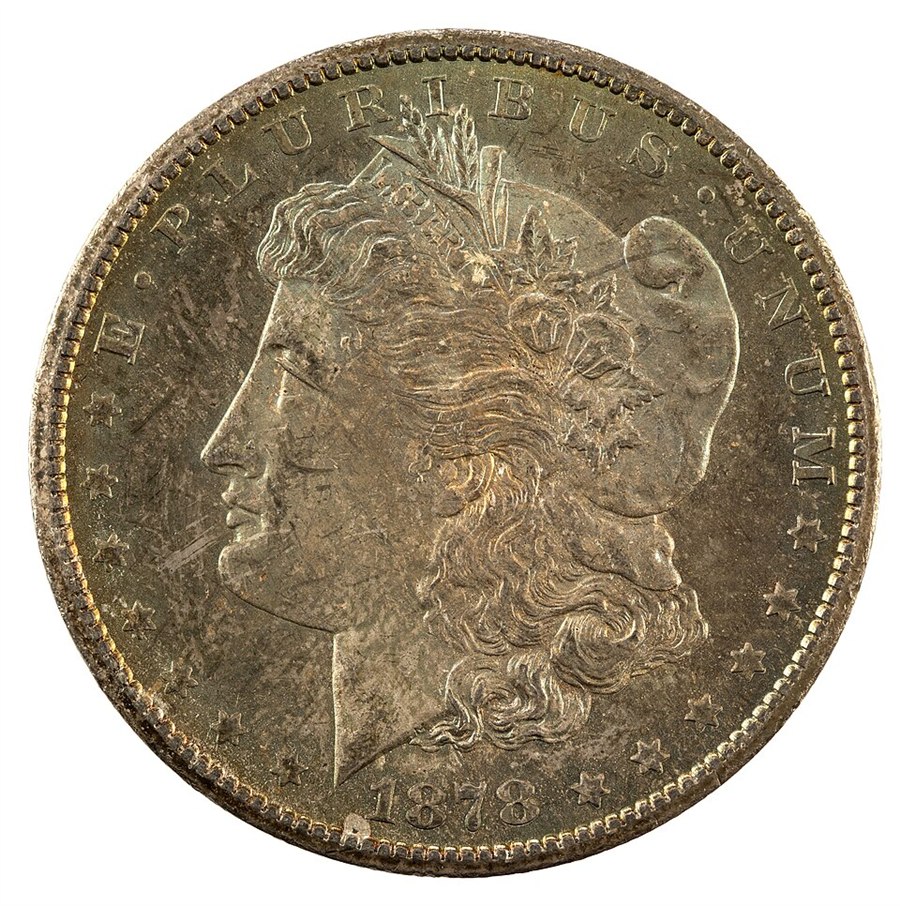
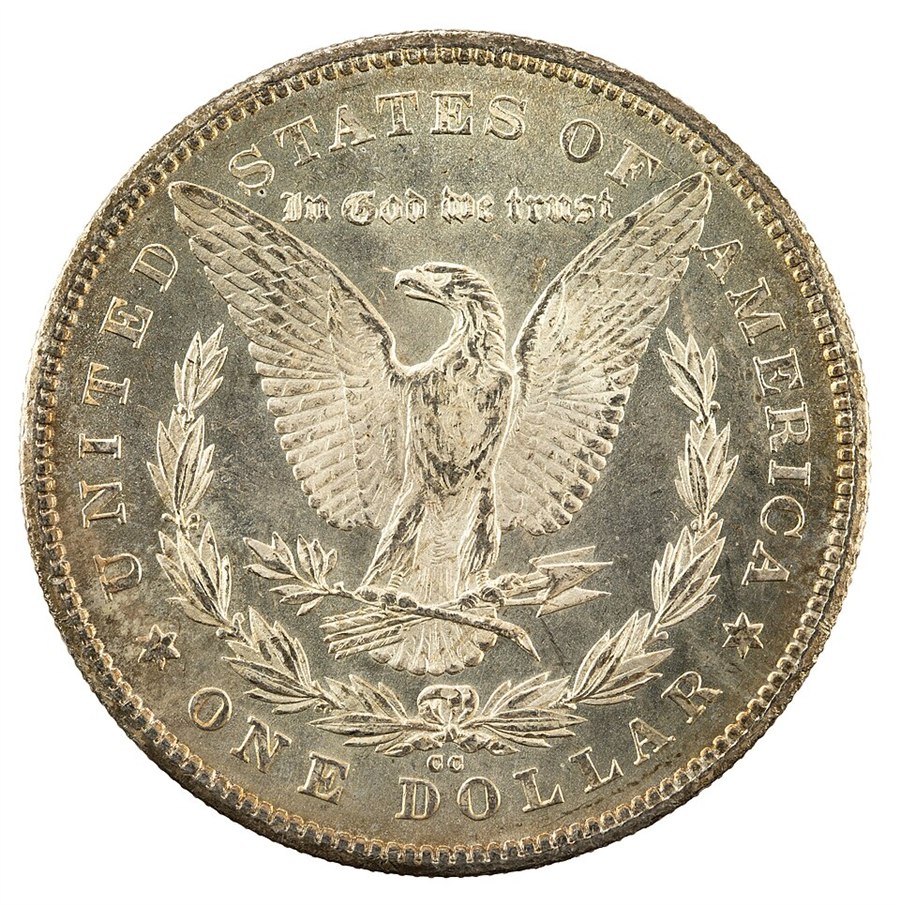
The design was already waiting. George T. Morgan — recruited from England in October 1876 as Assistant Engraver, partly to break the Barber series' grip on the engravership — had spent 1877 preparing half-dollar patterns that became the dollar's blueprint. His Liberty was a living American: Anna Willess Williams, a Philadelphia teacher who sat five times (a story the period press told with relish and she spent years trying to escape; the outlines are well documented even where the embroidery isn't). Morgan signed the truncation of the neck and the reverse ribbon with a tiny M — the first US coin bearing its designer's initial on both sides. Production speed showed anyway: the first reverse gave the eagle eight tail feathers, heraldic tradition demanded an odd count, and within about two weeks the Mint re-hubbed to seven — creating the 8TF, 7/8TF and 7TF varieties in the series' opening months. The 1878 8TF issue page tells that story coin-first.
Anatomy of the design
Obverse
Liberty — Anna Williams' profile, facing left. The cheek and the hair above the ear are the coin's highest points.
Phrygian cap — the classical badge of freedom, soft behind the LIBERTY headband.
Crown of wheat & cotton — Northern grain, Southern fiber: a deliberate post-Reconstruction union gesture.
13 stars & E PLURIBUS UNUM — ringing the portrait above the date.
Date — with the mint mark opposite, one of the two facts that set an issue's identity.
The initial M — at the truncation of the neck. Morgan signed both sides — a first on a US coin.
Reverse
Bald eagle — wings spread; the breast feathers wear first and strike weakest — the grader's puzzle.
Arrows & olive branch — war and peace in the talons; seven tail feathers after March 1878.
IN GOD WE TRUST — in Gothic script; UNITED STATES OF AMERICA and ONE DOLLAR ring the rim.
Laurel wreath — encircling the eagle, tied in a bow at the base.
The second M — on the left loop of that ribbon bow.
Mint mark — below the bow, above the DO of DOLLAR: the most valuable millimeter on the coin.
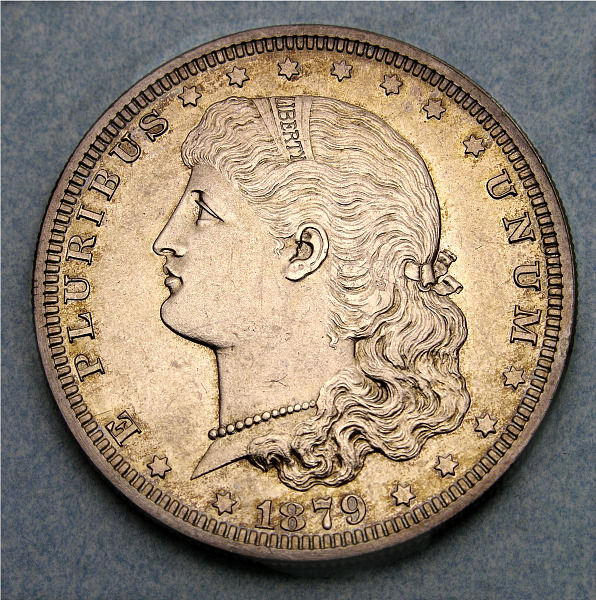
1879 "Schoolgirl" pattern. National Numismatic Collection.
Did you know?
The dollar you know wasn't the limit of Morgan's ambition — his unadopted 1879 Schoolgirl pattern is widely considered one of the most beautiful designs in American coinage. Patterns like it are why specialists speak of Morgan the artist, not just Morgan the dollar.
1878–1890: striking into the vault
Four mints carried the load — Philadelphia and San Francisco from 1878, Carson City beside its Comstock ore, New Orleans from 1879. Commerce east of the Mississippi mostly preferred paper; the big coins circulated hardest in the West and South. The purchase law didn't care: dollars were struck at statutory pace and flowed into Treasury vaults in canvas bags of a thousand, millions of coins that never touched a pocket. That accident — mass production plus mass storage — is the demographic fact behind everything collectors later found strange about this series: gem survivors by the bag for some dates, near-total wear for others. Our key-dates reference is largely a study of which side of the vault door an issue landed on.
Sherman, panic, and the end of the program
In 1890 the silver bloc traded votes for a bigger program: the Sherman Silver Purchase Act obliged the Treasury to buy 4.5 million ounces a month — nearly the whole US mine output — paid for with notes redeemable in gold. It was a machine for draining the gold reserve, and in 1893 the machine met a crash: railroad failures, bank runs, the worst depression the country had seen. President Cleveland forced repeal of the purchase clauses that November 1893. The same year closed the Carson City Mint for good and produced, at San Francisco, the 100,000-coin 1893-S. Coinage limped on from remaining bullion until the purchased silver ran out in 1904, and the Morgan stopped — apparently for good. Philadelphia's dies were destroyed in 1910.
The Pittman Act: the great melt
The war brought silver back. In 1918, with wartime Britain facing a silver crisis in India, the Pittman Act (40 Stat. 535) authorized melting up to 350 million of the vault dollars for sale to Britain at a dollar an ounce. The Treasury ultimately melted 270,232,722 — with 11.1 million of them recoined into dimes, quarters and halves. Bags were pulled with no regard for date or mint: which issues burned was essentially arbitrary, and from that point mintage alone stopped being enough to predict modern rarity. The act also required replacing the melted dollars with new ones from American silver — which is why, in 1921, the Morgan returned for one colossal encore: 86.7 million coins at Philadelphia, Denver (its only Morgans) and San Francisco, struck from entirely new master dies in shallower relief, until the Peace dollar superseded the design that December. The 1921 issue page covers the revival coin-first.
The vaults open: 1962–1980
Then the story went quiet for forty years — dollars sat in vaults, redeemable at face, largely ignored. In November 1962 a sealed bag paid out against a silver certificate turned up rare New Orleans dates; word spread, and a polite national bank run followed. By March 1964 the Treasury's hundreds of millions of stored dollars were gone at face value, and celebrated rarities — most famously the 1903-O — collapsed in price as bag after bag surfaced. When the dust settled the government held one last treasure: slightly more than 2.8 million Carson City dollars, which the General Services Administration sold in seven mail-bid sales from 1972 to 1980 for about $107 million, mostly in the black plastic holders collectors now hunt in their own right.
The other warehouses
The private hoards
Government vaults weren't the only stockpiles. The documented private hoards kept rewriting availability for decades:
The Treasury releases
1962–1964
Millions of Morgan and Peace dollars paid out at face value after sealed vault bags were opened; prices of several 'rarities' collapsed overnight
Effect: Rewrote the series' rarity map — most famously turning the 1903-O from celebrated rarity to available coin
The GSA Carson City sales
1972–1980
2.8+ million CC dollars sold in seven government mail-bid sales for ~$107M, most in the now-iconic black GSA holders
Effect: Made uncirculated Carson City dollars broadly collectible; GSA holders became collectibles themselves
The Redfield Hoard
found 1974, sold 1976
~407,000 silver dollars hoarded in a Reno basement by LaVere Redfield; bought by A-Mark for $7.3 million
Effect: Flooded specific S-mint dates in mint state; 'Redfield' pedigree holders still circulate
The Continental-Illinois Bank hoard
early 1980s
Roughly 1.5 million silver dollars (~1,500 bags) liquidated by the Chicago bank through dealer Rarcoa
Effect: One more reminder that thousand-coin bags kept surfacing a century after striking
What the history means for a collector
Every practical Morgan question routes back through this story. Why is a 228,000-mintage coin easy to buy uncirculated and a 1.2-million-mintage coin nearly impossible? Vault door. Why do gem 1880s dollars exist by the thousand with scuffed cheeks? Canvas bags. Why does 1921 look different? New dies after 1910. Why does a CC mint mark carry a premium beyond scarcity? Because the GSA sales turned a closed frontier mint into a collectible brand. History isn't background here — it's the mechanism.
Sources
OBSERVED
13 sources
ESTIMATED
6 sources
DERIVED
1 source
Sourced figures on this page trace to the ledger below. Editorial judgement is labelled as ours, and prices we have not sourced are not published.