Every important figure in this piece is classed OBSERVED (primary source), DERIVED (arithmetic we show), ESTIMATED (defensible assumption), or SPECULATIVE — and the evidence ledger behind it is published. Prices dated August 2026. Critic-gate reviewed.
In 1964, the federal minimum wage was $1.25 an hour — five quarters. If you spent them, they’re gone. If you kept them, those five 1964 quarters contain 0.904 troy ounces of silver, worth about $63 at today’s spot price.
The paper minimum wage is $7.25.
Same five coins. Same hour of work. The metal kept its promise; the paper kept 11% of it. That gap — between what money is and what money says — has a history. It is one of the oldest continuous stories civilization tells, and it always runs the same way: a government under pressure discovers it can quietly take a little silver out of the coin, or a little value out of the note, and pay its bills with the difference.
The Romans did it with a furnace. Henry VIII did it with copper. We do it with a keyboard. The mechanics change; the arithmetic never does.
This is that story, told through the numbers — ending with the ones printing right now.
Part I — Rome: the original slow debasement
When Augustus reorganized Rome’s coinage, the denarius — the empire’s daily wage, its tax unit, its soldier’s pay — was struck at roughly 98% silver (OBSERVED; the series above follows the NGC/Harl compilation; modern core-drilling analyses by Butcher & Ponting show the rot ran even deeper than the classic surface tests suggested).
Then came the bills.
Nero, AD 64. Rome burns; rebuilding is expensive. Nero’s mint quietly cuts the denarius to ~93% silver and trims its weight 12.5%. The template is set: shave the coin, mint the difference, tell no one.
Septimius Severus, 194. Doubling down on army pay — the military was the majority of the budget — Severus takes the coin to roughly half silver. His deathbed advice to his sons, as tradition via the historian Cassius Dio has it: enrich the soldiers, scorn everyone else.
Caracalla, 215. A genuine innovation: the antoninianus, a coin tariffed at two denarii that contained about one and a half denarii worth of silver. Not just debasement — denomination fraud. An early large-scale token overvaluation by the state itself.
The collapse, 250–270. Plague, civil war, an emperor captured alive by Persia. With no bond market, the mint was the empire’s only lender. By Gallienus’s last years the “silver” coin was 2.5–5% silver — a copper slug with a silver wash that wore off in your purse.
From 98% to under 5% in 250 years, with half the collapse packed into the fifty years after 218 (DERIVED). Romans noticed. Hoard archaeology shows old high-silver denarii vanishing from circulation as fast as the new junk appeared — Gresham’s law in action, fourteen centuries before Gresham. The state noticed too: under Trajan, the mint itself melted down the remaining good old denarii.
The endgame was Diocletian’s Edict on Maximum Prices (301 AD): over a thousand goods price-capped, death penalty for the seller — and the buyer. The preamble blames “the limitless and furious avarice” of merchants; it does not mention that the men issuing it had multiplied the money. The chronicler Lactantius records how it ended: blood shed over cheap goods, wares vanishing from the markets, the law quietly set aside. Price controls did not repeal arithmetic in 301, and they haven’t since.
Part II — Clipping, Coppernose, and Isaac Newton, cop
Shear a sliver of silver off a coin’s rim, spend the coin at face value, melt the clippings — do it to thousands of coins and you are running a private mint. For the thousand years that Europe’s coins were hammered by hand, every edge irregular and no two alike, clipping was retail-scale debasement available to anyone with shears and nerve. By the 1690s the average English shilling in circulation had lost roughly half its silver to clippers, the crisis behind the Great Recoinage of 1696 (OBSERVED).
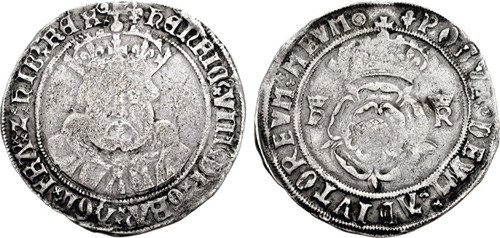
Kings were not morally superior to clippers; they were simply bigger. Henry VIII, broke from French wars, took English coinage from sterling (92.5% fine) down to 25% between 1544 and 1551 — the episode historians literally call the Great Debasement; we borrowed our title from him. The new shillings were base metal with a thin silver blanch — and on the highest point of the design, the king’s protruding nose, the silver wore off first, exposing copper. His subjects called him “Old Coppernose”: monetary policy you could see with your own eyes, on the face of the man responsible. Elizabeth I spent 1560–61 calling in the junk and recoining at full sterling — and the standard then held for some 360 years, until 1920.
The clipping problem got a technological fix and a famous enforcer. From 1662 England struck coins by machine with reeded and lettered edges — any clip instantly visible. The large coins carried the edge inscription DECUS ET TUTAMEN: “an ornament and a safeguard.” (Run your thumbnail down the edge of any quarter in your pocket. Those ridges are a 360-year-old anti-fraud device, faithfully reproduced on coins that no longer contain anything worth stealing.) And when clipping persisted anyway, the Royal Mint’s new Warden — one Isaac Newton, yes, that one — built an informant network across eleven counties, personally took some two hundred depositions, and prosecuted twenty-eight coiners and clippers, most of whom hanged. Debasement was for states; freelancing it was high treason.
America’s founders read this history. The Coinage Act of 1792, Section 19, prescribed one penalty for a Mint officer who debased the coinage for profit: “shall be deemed guilty of felony, and shall suffer death” (OBSERVED — the statute’s actual text). That was the founding position of the United States on making money worth less.
Part III — The American arc: 1792 → 3 cents
The dollar began as a defined object: 371.25 grains of pure silver (Coinage Act, 1792). What followed, in compressed form:
- 1834–1900: gold at $20.67/oz, a price that held so long it looked like a law of nature.
- 1933–34: Executive Order 6102 orders citizens to surrender their gold ($10,000 fine, ten years); the Gold Reserve Act then revalues gold to $35. The dollar’s gold content is cut 41% overnight — after the gold was collected. The state didn’t just debase; it front-ran its own debasement.
- 1965: silver leaves the dime and quarter. President Johnson, signing the act, addresses the stackers of the future directly:
“If anybody has any idea of hoarding our silver coins, let me say this… There will be no profit in holding them out of circulation for the value of their silver content.” — Lyndon B. Johnson, July 23, 1965 (OBSERVED)
Every clause aged badly. Within a few years the silver coins had vanished from circulation. The melt value of the quarters he was discussing is now roughly fifty times face — the live number is on our melt table.
- August 15, 1971: Nixon: “I have directed Secretary Connally to suspend temporarily the convertibility of the dollar into gold.” That suspension has now run 55 years — the longest “temporarily” in monetary history.
Since the CPI series began in 1913, the dollar has lost roughly 97% of its purchasing power — a 1913 dollar buys about 3 cents of 1913 goods today (DERIVED from OBSERVED BLS index levels: 9.9 then, 333.9 in July 2026). The money supply that backs it: M2 was $287 billion in 1959; it is $23.2 trillion as of June 2026 (OBSERVED, FRED) — an eighty-fold expansion, including a +40% burst in the two pandemic years alone. And the ledger behind the ledger: the national debt crossed $40 trillion on August 18, 2026, having doubled in under a decade; it is currently growing at about $91,000 per second (OBSERVED, Treasury/JEC).
No silver was removed from any coin to do this. That’s the modern refinement: there is no coin to shave. The denarius took 250 years to lose 95% of its metal. The dollar took 113 years to lose 97% of its purchasing power — politely, electronically, and with excellent documentation.
Part IV — When it goes fast: the fiat failure reel
The dollar’s decline has been slow enough to feel like weather. The same policy, run without brakes:
| Episode | Peak of the madness | The cure |
|---|---|---|
| Germany 1923 | 4.2 marks/$ (1914) → 4.2 trillion/$; prices doubling every ~28 hours; bread >200 billion marks | Rentenmark, Nov 1923 — capped issuance; stabilized in days |
| Hungary 1946 | The world record: prices doubling every ~15 hours; the largest note ever printed (100 quintillion pengő) worth ~20 US cents | New forint, Aug 1946 |
| Yugoslavia 1994 | 313 million percent per month | Pegging to the Deutsche Mark — sometimes the refuge is just someone else’s harder paper |
| Zimbabwe 2008 | 89.7 sextillion percent/yr (Hanke’s estimate; the central bank stopped counting) | Dollarization, 2009 |
| Venezuela 2018 | 1.7 million % (National Assembly) or ~80,000% (Hanke) — when estimates span two orders of magnitude, measurement itself has collapsed | 14 zeros dropped across three redenominations |
| Argentina, 1969–present | Thirteen zeros across four redenominations and five currency names | Ongoing: under Milei’s chainsaw experiment, inflation is down to 33.8%/yr (July 2026) — and it’s called victory |
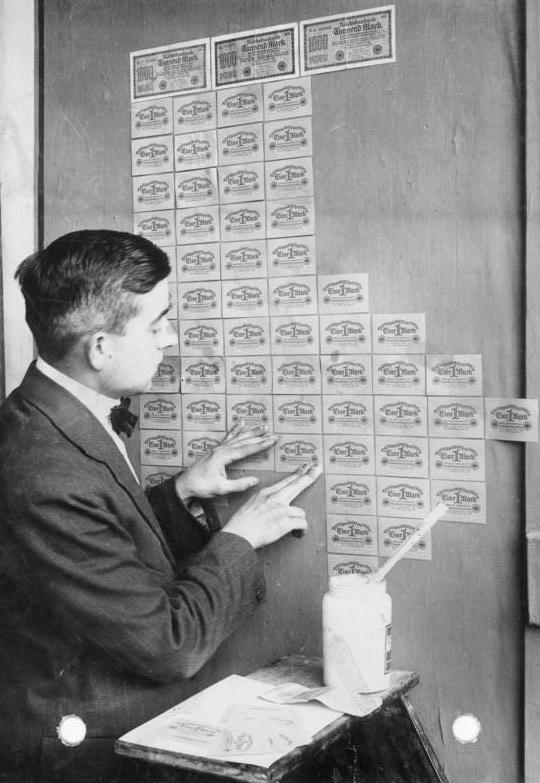
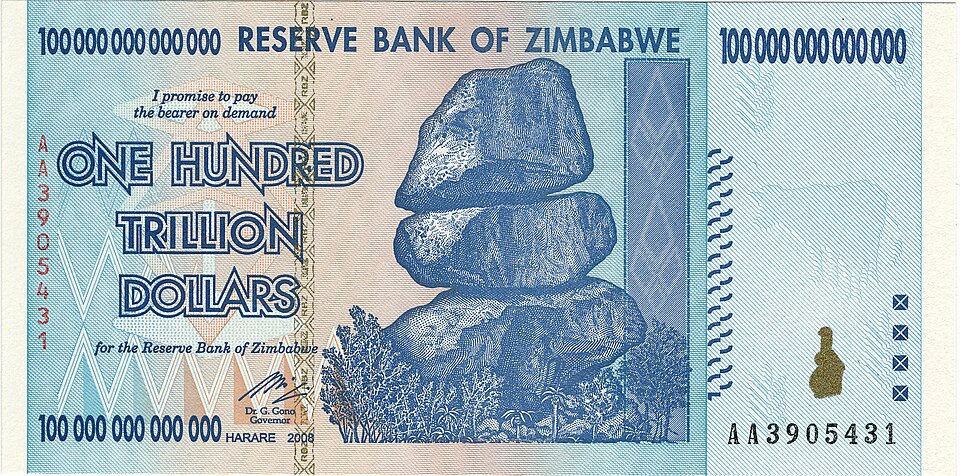
The Weimar color is the genre’s archive: workers paid twice daily with shopping breaks before the afternoon repricing (DOCUMENTED); banknotes as wallpaper and kindling (photographed, above). The most famous story of all — the stolen wheelbarrow, dumped money left behind — is the era’s favorite joke about itself: told everywhere, documented nowhere. We label it accordingly.
What did metal do through all this? A German holding a gold 20-mark coin came out of 1923 with more than he went in with — by loaf-count, the coin’s peak paper value bought roughly five times the bread it had in 1914 (DERIVED). In Venezuela’s mining towns, Bloomberg found hotels charging half a gram of gold a night — spontaneous re-metallization, at gunpoint-level risk. The pattern in every episode: cash and bond holders financed the whole thing; holders of metal — or any harder money — came through with purchasing power intact.
And one honest asterisk, which most gold essays omit: holding worked, but it wasn’t riskless. In 1933 the United States confiscated citizen gold at $20.67 and revalued it to $35 afterward — the state captured the upside. France in 1936 imposed declaration requirements and a 50% windfall tax on devaluation profits. In Venezuela’s gold towns, armed syndicates were the tax authority. The full historical lesson is two-sided: debasement is reliable, and so is the state’s interest in your hedge, after it works.
Part V — The slow version, live
Nobody is wallpapering with dollars. That is not the claim. The claim is arithmetic:
| Since January 2020 (6.5 years) | Change | Class |
|---|---|---|
| Consumer prices (CPI) | +29% — a 2020 dollar buys 77 cents of 2020 goods | OBSERVED (BLS) |
| M2 money supply | +50% ($15.4T → $23.2T) | OBSERVED (FRED) |
| Median existing home | ~+49% ($440,600 all-time high, June 2026) | OBSERVED (NAR); 2020 base ESTIMATED |
| New car (avg. transaction) | ~+30% ($49,855) | OBSERVED (KBB); 2020 base ESTIMATED |
| Gold | +200% ($1,520 → ~$4,600) | OBSERVED |
| Silver | +287% ($18 → ~$70; touched $121.67 in January’s squeeze before a ~42% retrace — this hedge is not a sedative; see The Silver Bottleneck) | OBSERVED |
| Federal debt | $40.05 trillion, crossed Aug 18, 2026 | OBSERVED |
Same arc as every chapter above — run at a thousandth of the speed, with better public relations.
The 1964 quarter is the most honest economist in America: it has no press office. It just sits there, being 0.1808 ounces of silver, quoting you the running total. Its current quote is on our melt table, updating live.
Part VI — The case against this article
The counter-case is real, and we publish it:
- Leaving gold ended the Great Depression. The scholarship is genuinely one-sided: countries that abandoned gold earliest recovered fastest (Eichengreen & Sachs; Bernanke & James: “To an overwhelming degree, the evidence shows that countries that left the gold standard recovered… more quickly”). The 1934 devaluation this article just called a 41% haircut was arguably the single most effective recovery policy of the decade. Hard money has a deflation problem, and 1929–33 — prices down 25% while debts stayed nominal — was that problem killing people.
- Debasement of the unit ≠ impoverishment of the people. The dollar lost 97% of its purchasing power since 1913; real output per American rose roughly eight-fold anyway. Nobody actually held one bill for 113 years — savings earned interest, and compounded cash handily beat a mattress.
- The silver tables flatter silver. Our five-quarters-of-minimum-wage table pays “$63/hour” at $70 silver — but it paid $12.66 at the 2015 low. Run across the full range, the honest claim is that 90% silver coinage preserved purchasing power across decades, on average, with violent variance — not that it’s a paycheck.
- CPI-since-1913 comparisons overstate the felt loss. A 2026 car is not a 1913 car; quality adjustment cuts both ways.
What survives the counter-case is narrower and harder: fiat regimes have a one-way ratchet. No fiat currency has ever, over a long horizon, gained purchasing power; every long-lived one has lost most of it; and the tail outcomes — the reel in Part IV — only ever point one direction. Gold-standard economies had recessions and deflations; fiat economies have only ever resolved their arithmetic one way. You don’t hold hard money because collapse is imminent. You hold some because the drift is structural and two thousand years old — and because five quarters from 1964 are still worth a full day’s work at the paper minimum wage.
Companion pieces: our live US Coin Melt Values table (what the debasement of 1965 left in your change), and The Silver Bottleneck (what happens when the hedge itself gets crowded).