Skip to content
OUNCEDESK
SILVER$69.11GOLD$4,604GOLD/SILVER66.6PLATINUM$1,887PALLADIUM$1,371COPPER$6.47BTC$77,243

Coins /Morgan Dollars / 1892-S

1892-S Morgan Dollar

San Francisco Mint · Semi-key

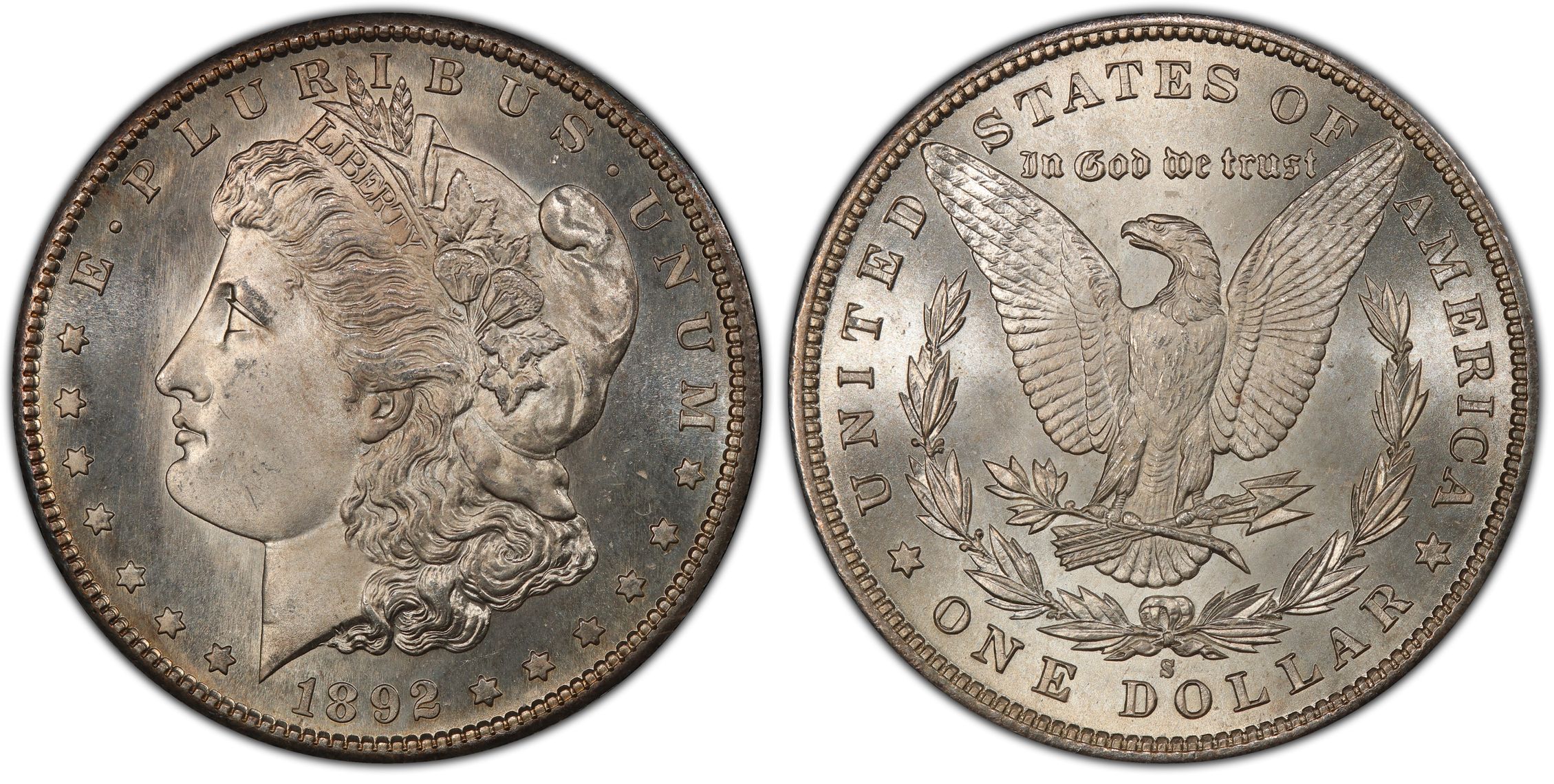
Morgan dollar obverse (series reference coin)Morgan dollar reverse (series reference coin)

Series reference coin (1878-CC, National Numismatic Collection) — shown for design reference, not an example of this issue.

Melt value$53.40

SNAPSHOT ·0.77344 oz silver — the floor, not the price. This issue's collector value stands far above its metal.

Year
1892
Mint
San Francisco (S)
Mintage
1,200,000
Strike
Business strike
Composition
90% silver, 10% copper
Weight
26.73 g
Silver
0.77344 ozt
Diameter
38.1 mm
Edge
Reeded
Designer
George T. Morgan

The great conditional rarity

Why this issue matters

The purest conditional rarity in the series — and its most dangerous grade boundary. 1.2 million struck at San Francisco, five times the 1889-CC's mintage; nearly every coin went into circulation and stayed there. No sealed bags of 1892-S surfaced in the Treasury releases. The result is a coin that's ordinary money in Very Fine and a legend in Mint State.

Rarity & survival

PCGS-cited estimates put true mint-state survivors at roughly 135–270 coins in total — MS60–62: 75–150; MS63: 25–50; MS64: 10–20; MS65 or better: 25–50 — with a famously strange shape: the population splits between coins barely into Mint State and outright gems, with almost no middle ground. (The gems that exist are usually well struck and beautiful; a few bags' worth of coins apparently escaped early and were preserved with care.) Meanwhile AU examples — coins with the faintest cabinet friction — are comparatively plentiful, which is exactly what makes this issue treacherous.

Collector values

We don't publish a price table for this issue yet — numismatic values require sourced market observations with provenance, and we won't invent them. The realized-market architecture (per-grade medians, ranges and trends from authorized sale data) is built and waiting on data; see methodology. Until then: the melt value above is the floor, and the rarity discussion tells you which side of "far above melt" this issue lives on.

Grading this issue

The whole game is the AU58/MS60 boundary, one of the steepest value cliffs in American numismatics. Learn the slider tells: luster broken on the cheek's crest and the hair above the ear, faint gray friction where the cartwheel should roll through. Then assume worse: 'uncirculated' raw 1892-S dollars are AU sliders until a grading service says otherwise, and doctored sliders — whizzed, polished, or artificially toned to hide friction — are the standard merchandise.

Authentication

The threat is grade fraud more than counterfeiting: doctored AU coins offered as Mint State outnumber outright fakes many times over, though added-S alterations exist too. For any example offered above circulated money: certified only, cert number verified. There is no bargain 1892-S in mint state; there are only mispriced sliders.

History

San Francisco struck its 1.2 million in the last ordinary year before the storm — the Sherman Act still running, the Panic months away. The coins went to work in a cash-hungry West and simply never stopped working. By the time collectors came looking for uncirculated examples, there was nowhere to look: no vault bags, no hoards, no second chance. The 1892-S is what every Morgan would have been without the Treasury's warehouses.

The conditional-rarity archetype

1892-S is why the CONDITIONAL classification exists. Its mintage says 'common'; its circulated population agrees; its mint-state population is rarer than the 1893-S's. One coin, three different answers, depending entirely on grade — the concept every Morgan collector must internalize before spending serious money.

Related issues:1893-S1885-CC1881-S· Full series guide· Checklist

Sources: mintage and production history per the series source ledger (S1–S8); rarity characterizations are standard numismatic consensus (DERIVED).