Nothing in this series is common. The largest year — 1,952,000 pieces in 1835 — has a survival estimate of 5,250, about 0.27%. Read every tier below as relative, and read every survival figure as what it is: a PCGS estimate, observed 2026-08-24.
Read this before the tables
Here, condition beats rarity
The series' record price — $1,740,000 — belongs to a Gem example of its most-saved coin, the 1796, with an estimated 650 survivors and 90 in Mint State. Its rarest circulating coin, the 1823/2 with thirty-three known and none Uncirculated, has never made half that. The whole market logic of this series is in those two numbers: preservation sets the top, census sets the floor, and the two famous coins sit at opposite corners.
$1,740,000
a 1796 in MS66 — 650 survive
$246,750
the finest-sold 1823/2 — 33 survive
0
Uncirculated 1823/2s estimated to exist
Prices are PCGS auction-record and condition-census fields, observed 2026-08-24; survival figures are PCGS estimates of the same date. The pattern is old: in 1915 The Numismatist described a collection's summits as "a brilliant proof 1796; one of the best 1823 and a proof of 1827" — the same three coins, a century ago.
Tier one
The coins that define the series
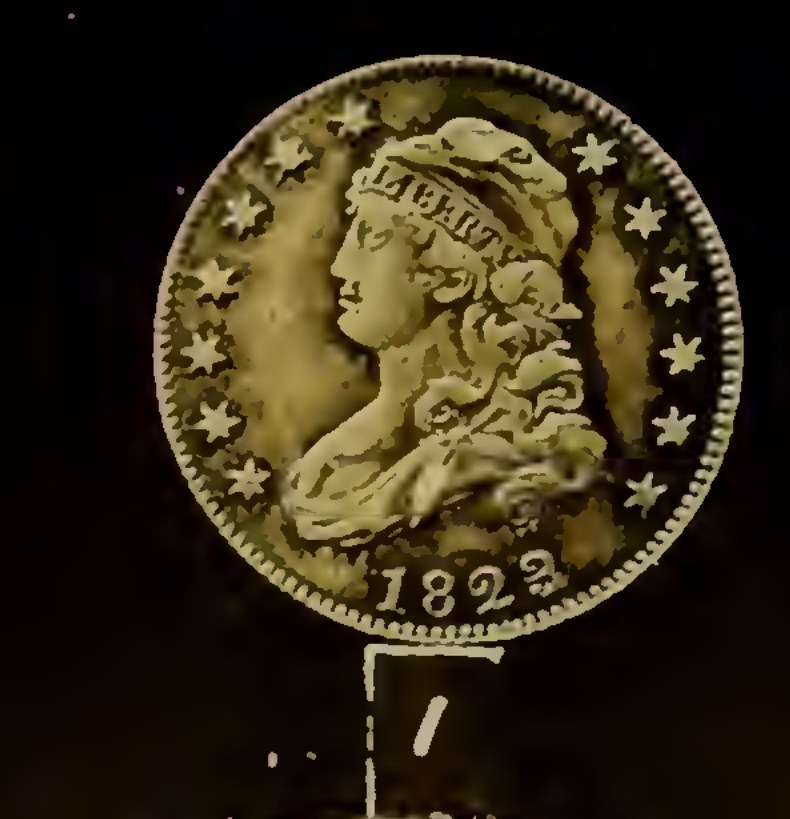
1823/2 — Browning plate figure · reference example · Browning 1925, public domain — a 1925 halftone, not a graded coin
THE RECORD RARITY · 17,800 — and honest
1823/2
The rarest circulating coin in the series, from the one delivery figure where record and trade agree exactly: 17,800 in calendar 1823, all from a single obverse die overdated from 1822. PCGS estimates 33 survivors and none Uncirculated — roughly 0.19% of the delivery, the lowest rate in the series, and a rate this reference cannot explain: at the series average near 1% the date would have left about 180 coins. The received explanation, Browning's melting hypothesis, rests on a mintage figure that is wrong by a factor of 6.6. And a census of this coin was being kept by letter in December 1867 — twenty years before the famous 1804-dollar census — per a PCGS note that is single-source and flagged as such. Auction record $246,750, AU58, Stack's Bowers, May 2015.
PCGS estimate as of 2026-08-24: 33 all grades · 2 at MS60+ · 0 at MS65+ · R-8.8
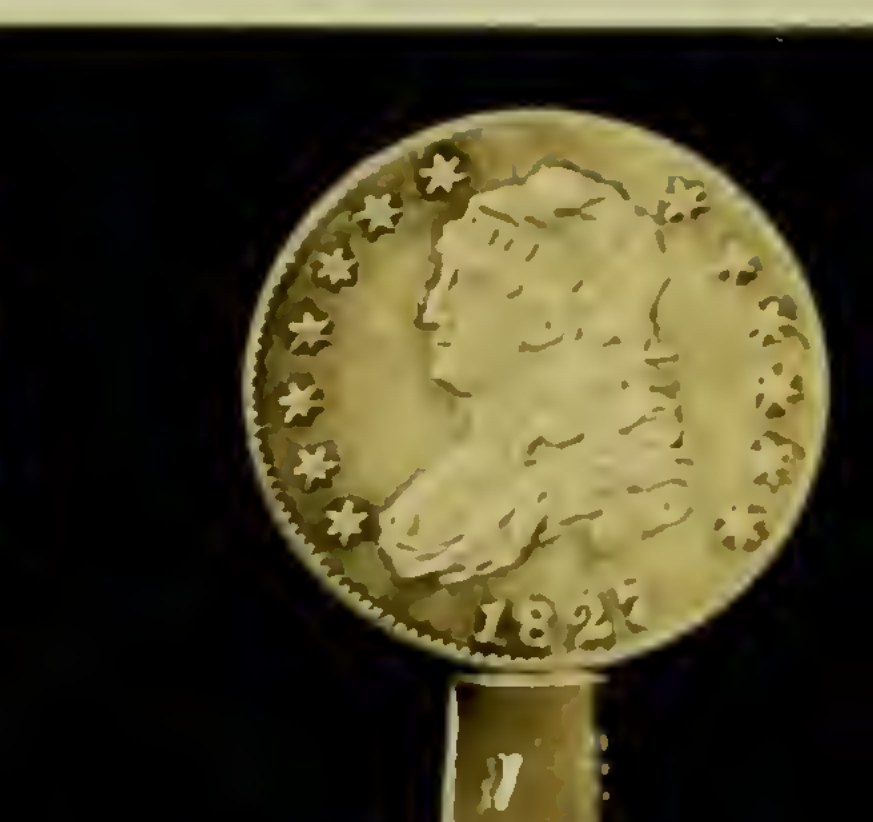
1827/3 Original — Browning plate figure · reference example · Browning 1925, public domain — a 1925 halftone, not a graded coin
THE OTHER RAREST DATE · PCGS proof mintage field: 12
1827/3 Original
The record delivers 4,000 quarters in 1827 and no circulating 1827 quarter is known — the only 1827-dated pieces are two proof strikings. The Original, eight known, is the coin whose finest example sold for $227 in March 1864, in the middle of the Civil War, when the Mickley 1804 dollar would bring $750 three years later; the same coin made $705,000 in the Pogue sale of 2015. Browning's own plate coin of this issue is plate-matched into the modern census, and the plate is reproduced on this site. Auction-record field $444,000 PR65 (January 2019); the census field carries the higher Pogue figure — the two PCGS fields disagree and are cited separately.
PCGS estimate as of 2026-08-24: 8 all grades · 5 at PR60+ · 2 at PR65+ · R-9.6
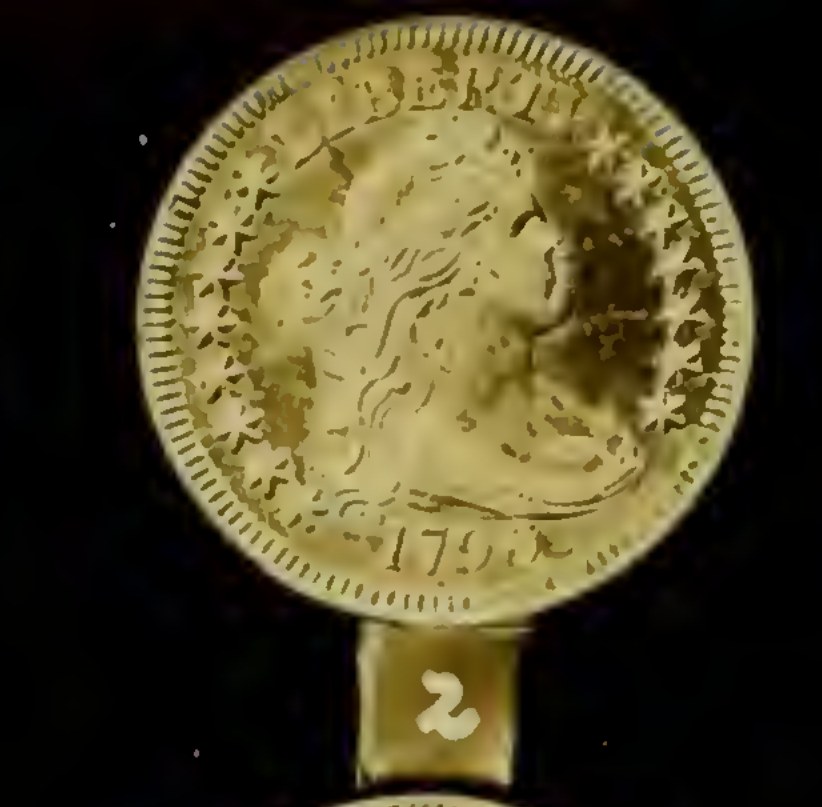
1796 — Browning plate figure · reference example · Browning 1925, public domain — a 1925 halftone, not a graded coin
THE MOST SAVED COIN IN EARLY AMERICAN SILVER · 5,894 + 252 (merged as 6,146)
1796
A one-year type with no statement of value anywhere on it, and the most-saved coin in early US silver: of roughly 6,100 pieces attributed to the date, PCGS estimates 650 survive and 90 of them in Mint State — about 10.6% overall, with 14% of survivors Uncirculated, rates nothing else in the series approaches. It was saved as a novelty from the day it appeared, and Browning supplies the mechanism: "Specimen coins or proofs, were apparently struck from this reverse with both obverses." A Gem sold for $1,740,000 in January 2022 — the series record. Set it against the 1823/2 and the whole market logic of this series is on one page: here, condition beats rarity.
PCGS estimate as of 2026-08-24: 650 all grades · 90 at MS60+ · 5 at MS65+ · R-5.7
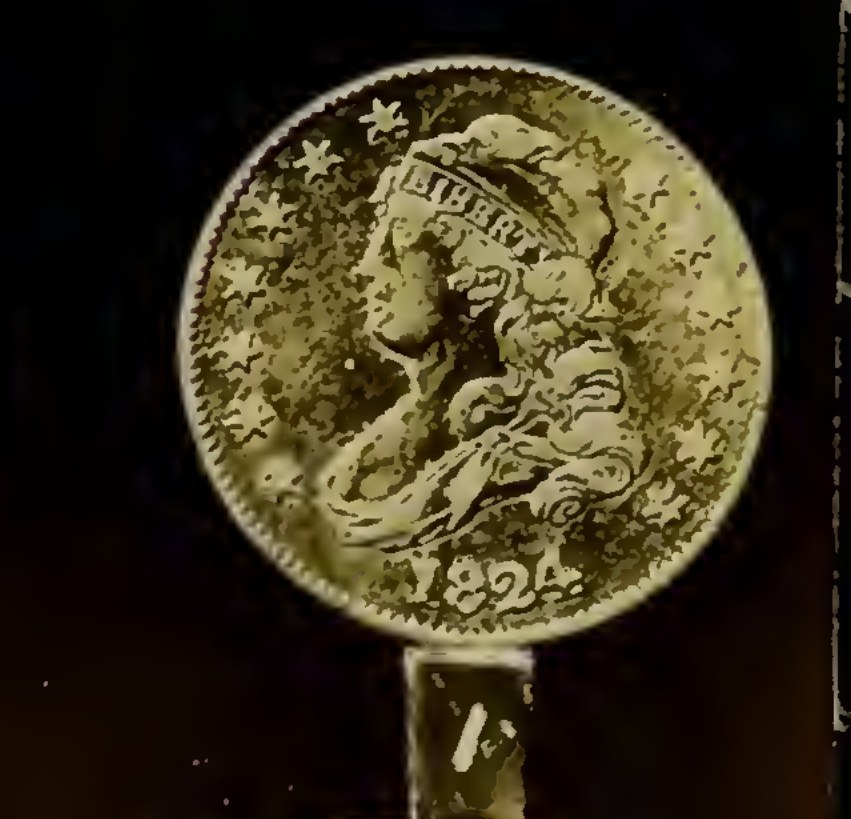
1824/2 — Browning plate figure · reference example · Browning 1925, public domain — a 1925 halftone, not a graded coin
THE INVENTED MINTAGE · NONE SHOWN — see why
1824/2
The Mint delivered no quarter dollars at all in calendar 1824 — the Comptroller's settlement lists half dollars as the year's only silver. Yet 1824/2 quarters exist, struck from a third shelved 1822 obverse, and PCGS prints a mintage of 24,000 — which, with the 1825/4/2's 144,000, sums exactly to the real 1825 delivery of 168,000. A figure was created for a year with no delivery and printed in the column reserved for the record; who first printed it is unidentified. This reference shows a blank instead. Browning's own rarity note is the one worth having, because it is observational: "Date scarce when worn by circulation, but very rare if sharp." PCGS estimates 400 survivors; record $141,000, MS64, May 2015.
PCGS estimate as of 2026-08-24: 400 all grades · 2 at MS60+ · 1 at MS65+ · R-6.2
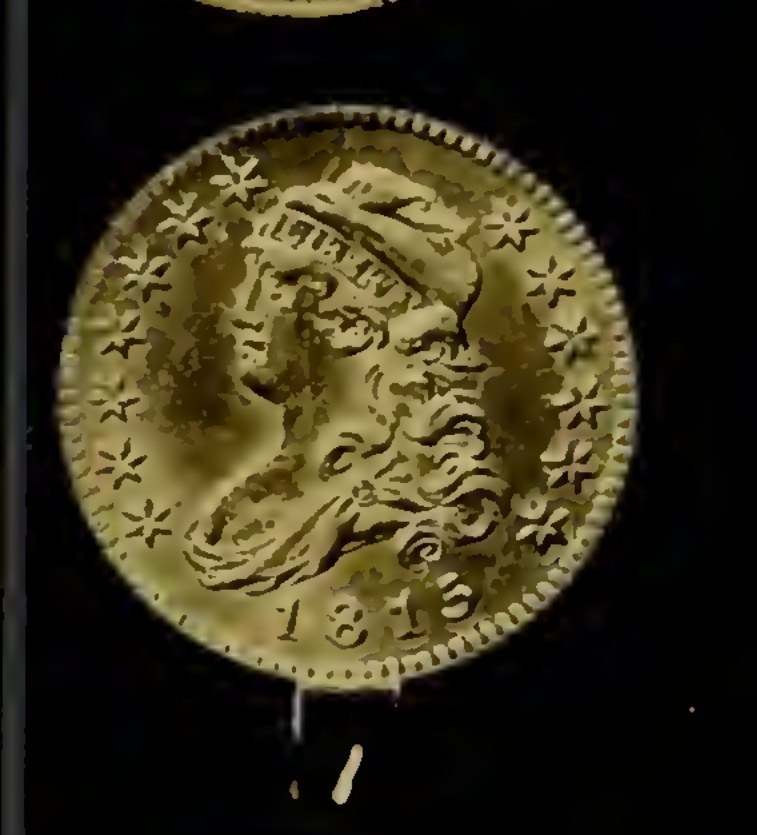
1815 — Browning plate figure · reference example · Browning 1925, public domain — a 1925 halftone, not a graded coin
THE WHOLE SILVER COINAGE OF A YEAR · 69,232 + 20,003 (merged as 89,235)
1815
The Capped Bust arrives — and the 69,232 quarters delivered in 1815 were the ENTIRE silver coinage of the United States that year: 69,232 × $0.25 = $17,308, the report's own total, exactly. A further 20,003 were delivered in the first days of 1816, before the Mint burned on January 11; no quarter bears the date 1816, and the trade's 89,235 merges the two deliveries. One Browning variety. PCGS estimates 1,875 survivors; record $282,000, MS67+★, November 2013.
PCGS estimate as of 2026-08-24: 1,875 all grades · 67 at MS60+ · 6 at MS65+ · R-4.6
All 32 issues of the set, sorted from rarest. Survival is all grades / 60 or better / 65 or better, with PCGS's Numismatic Rarity — all of it PCGS's own estimate, observed 2026-08-24. Note how the two 25/50 C. rows — die varieties inside ordinary years — sit above every date except the 1823/2 and the proof-only 1827s.
Issue
Rarity
All / 60+ / 65+
Auction record
1827/3 Original (Proof)PCGS mintage field: 12. The condition-census field separately records $705,000 (May 2015) — the two fields disagree.
R-9.6
8 / 5 / 2
$444,000 PR65 (Jan. 2019)
1827/3 Restrike (Proof)Struck in the Mint from an 1819 reverse die, at "a much later date" — Browning, 1925.
R-9.3
15 / 15 / 2
$168,000 PR66 (Jan. 2019)
1823/2The rarest business strike. No Uncirculated example is estimated to survive.
No row links to PCGS. A fabricated PCGS coin number returns a clean HTTP 200 with the wrong coin rather than an error, so this site's rule is that a commercial catalogue link must be title-gated — the page resolved and its own title checked — before it ships. That sweep has not been run for this series, so the attribution stands and the links wait. Two records above are from March 1980 (the 1804 and the 1819 Large 9): forty-six-year-old fields, cited as what PCGS's field says, never as current prices.
Tier three
Survival rates against the Mint's own record
Computed by OunceDesk from PCGS survival estimates (observed 2026-08-24) against the Mint's delivery figures. These rates are an analytical result of this reference, not a figure from any published authority. Where the denominator is a merge it is marked.
Date
Delivery of record
PCGS survival (all grades)
Implied rate
1796
5,894 + 252 (merged as 6,146)
650
~10.6%
1804
6,738
387
~5.7%
1806 (plain + 1806/5)
206,124
6,000
~2.9%
1805
121,394
2,875
~2.4%
1815
69,232 + 20,003 (merged as 89,235)
1,875
~2.1%
1828 (plain + 25/50C)
102,000
1,712
~1.7%
1820 (both)
127,444
2,075
~1.6%
1818 (plain + 1818/5)
361,174
5,375
~1.5%
1834
286,000
4,125
~1.4%
1819 (both)
144,000
2,012
~1.4%
1822 (both)
64,080
842
~1.3%
1831 (both)
398,000
4,500
~1.1%
1833
156,000
1,775
~1.1%
1821
216,851
2,400
~1.1%
1807
220,643
2,250
~1.0%
1837
252,400
2,400
~1.0%
1832
320,000
2,300
~0.7%
1836
472,000
3,125
~0.7%
1825 (1825/4/2 + 1824/2)
168,000
637
~0.4%
1838 Capped Bust
partition of 832,000
1,625
not computable against the record
1835
1,952,000
5,250
~0.27%
1823/2
17,800
33
~0.19%
The saved coin
1796 is a saved coin, and it is not close: ~10.6% overall and 90 estimated Uncirculated survivors from ~6,100 pieces. The first quarter dollar was set aside as a curiosity in numbers no other issue approaches — the mirror of the 1794 dollar and 1794 half dollar.
The pattern
The rate falls as the deliveries rise. 1835 delivered 1.95 million and preserved 0.27%; 1804 delivered 6,738 and preserved 5.7%. Coins made in bulk were spent; coins made in token quantities were kept.
The anomaly
1823/2 and the 1825 group are the anomalies, at 0.19% and 0.4%, well below their neighbours. The received explanation for the 1823 — Browning's melting hypothesis — rests on a mintage figure that is wrong. The honest statement is that nobody knows why the 1823/2 survived so poorly, and that a delivery of 17,800 at the series average would predict roughly 180 survivors rather than 33. That gap is a real open question, not a solved one.
What is missing from this page, and why
No population-report figures. Grading-service population data is proprietary. Everything above is a survival estimate, published with the name of the party that made it and the date it was observed.
No die-variety rarity ratings. The numeric ratings for individual Browning varieties are Tompkins' (2008) and Rea, Peterson, Karoleff & Kovach's (2010), which the OunceDesk Archive does not hold and does not reproduce. Browning's own prose ratings — "a rare variety," "very rare if sharp" — are public domain and held, and have not yet been tabulated; that is the single highest-value piece of work the acquisition still makes possible, and it is recorded as an open task rather than faked.
No proof-issue survey. Browning notes "Proofs were made from these dies" against numerous varieties; nobody, including this reference, has assembled them. The two 1827/3 proof issues are the exception, because PCGS catalogues them as the date's only coins.
No condition census below the top positions, except where PCGS publishes pedigreed chains — the 1823/2 and the 1827/3 Original — and those are reproduced with their sourcing labelled on the issue pages. Every post-1940 chain in this series is PCGS-only; exactly one link (Parmelee 1890, lot 975) is corroborated from a held public-domain primary.
Sources
OBSERVED
57 sources
ESTIMATED
1 source
DERIVED
1 source
Sourced figures on this page trace to the ledger below. Editorial judgement is labelled as ours, and prices we have not sourced are not published.
Survival estimates, Numismatic Rarity, condition census and auction records are PCGS CoinFacts' (S30), observed 2026-08-24. Delivery figures are the Mint's own contemporaneous reports; the implied survival rates are OunceDesk arithmetic over both (D1) and belong to no published authority. Plate figures are from Browning 1925 (S5), public domain.
OunceDeskPrecious Metals IntelligenceIndependent research, market data, tools and coin intelligence for people who take hard assets seriously.