CoinsEarly QuartersThe Browning Book
The Browning Book
Wayte Raymond, New York · 1925 · public domain · held in the OunceDesk Archive
The standard reference for this series is a hundred and one years old, still the numbering on the holders, and free — public domain by publication date, openly scanned, and until 2026 apparently unnoticed by anyone building coin references online. This chapter is about what is in it: the good, the wrong, and the genuinely astonishing.
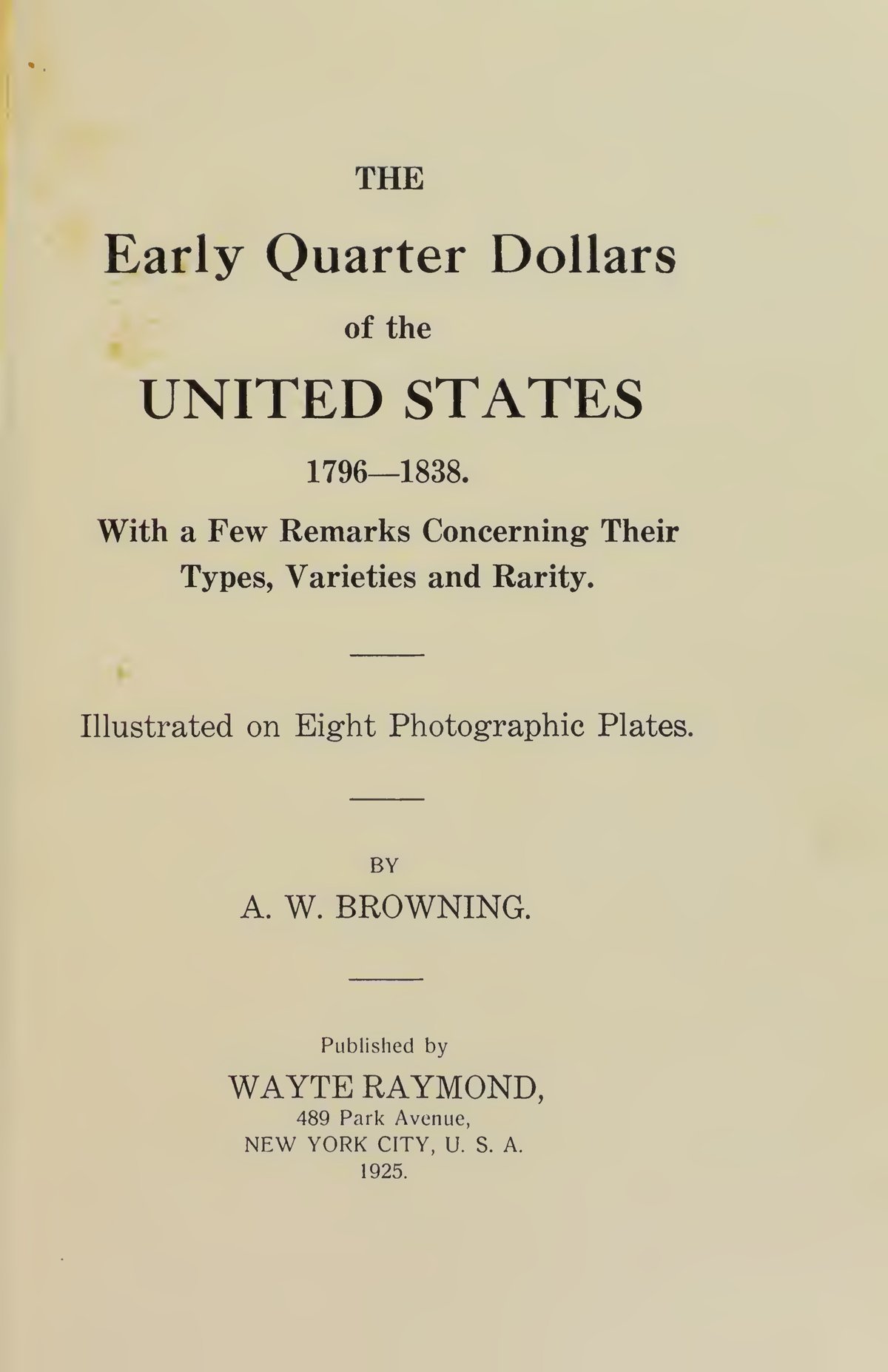
A. W. (Ard W.) Browning is a man about whom the record says almost nothing beyond his book — no located biography, no obituary yet found. The book itself establishes what matters: he assembled the collection the plates were made from ("The coins shown on the Plates are from the writer's collection, except a few pieces, which could not be secured"); he photographed ninety varieties on seven plates and then needed an eighth, "but a few recently discovered varieties made an eighth Plate necessary"; and where his own cabinet fell short, a collector named C. J. Detwiller "volunteered to place the coins needed in the collection to be photographed, thus enabling the Plates to show every date, together with every variety known." Detwiller is named once, in one sentence, and is the reason the reference is complete.
The predecessor was Haseltine's 1881 Type Table — sixty-three quarter varieties in prose, "the only catalogue describing varieties of this denomination ever published," in Browning's words. Browning replaced prose with photography, sixty-three with ninety, and his B-numbers have been the series' language ever since: PCGS carries die-variety pages titled "1796 25C Browning 1" today. The 2008 and 2010 revisions extend his numbering; neither replaced it.
The publisher matters to the story's ironies: Wayte Raymond, whose later Standard Catalogue series is a leading suspect for where the unmerged figures Browning printed became the merged ones the trade uses now. He published the book that got it right and, plausibly, the series that got it wrong.
What it gets right — including one thing a century early
The die work is the book's greatness and it is first-hand. Browning reconstructed the workshop from the coins: the 1822 shelved-obverse cascade ("Three other obverses evidently were prepared, which subsequently became over dates"), the 1815 dies reappearing as the 1818/5, the 1822 25/50 C. blunder returning in 1828, and the forensic separation of the 1827 Original from the Restrike by matching the Restrike's reverse to an 1819 die, crack for crack — with the verdict that the Restrike, though struck in the Mint, "is hardly proper to include it in the regular series." He tracked die states by narrating a die's working life, crack by crack, decades before die-state collecting had a vocabulary.
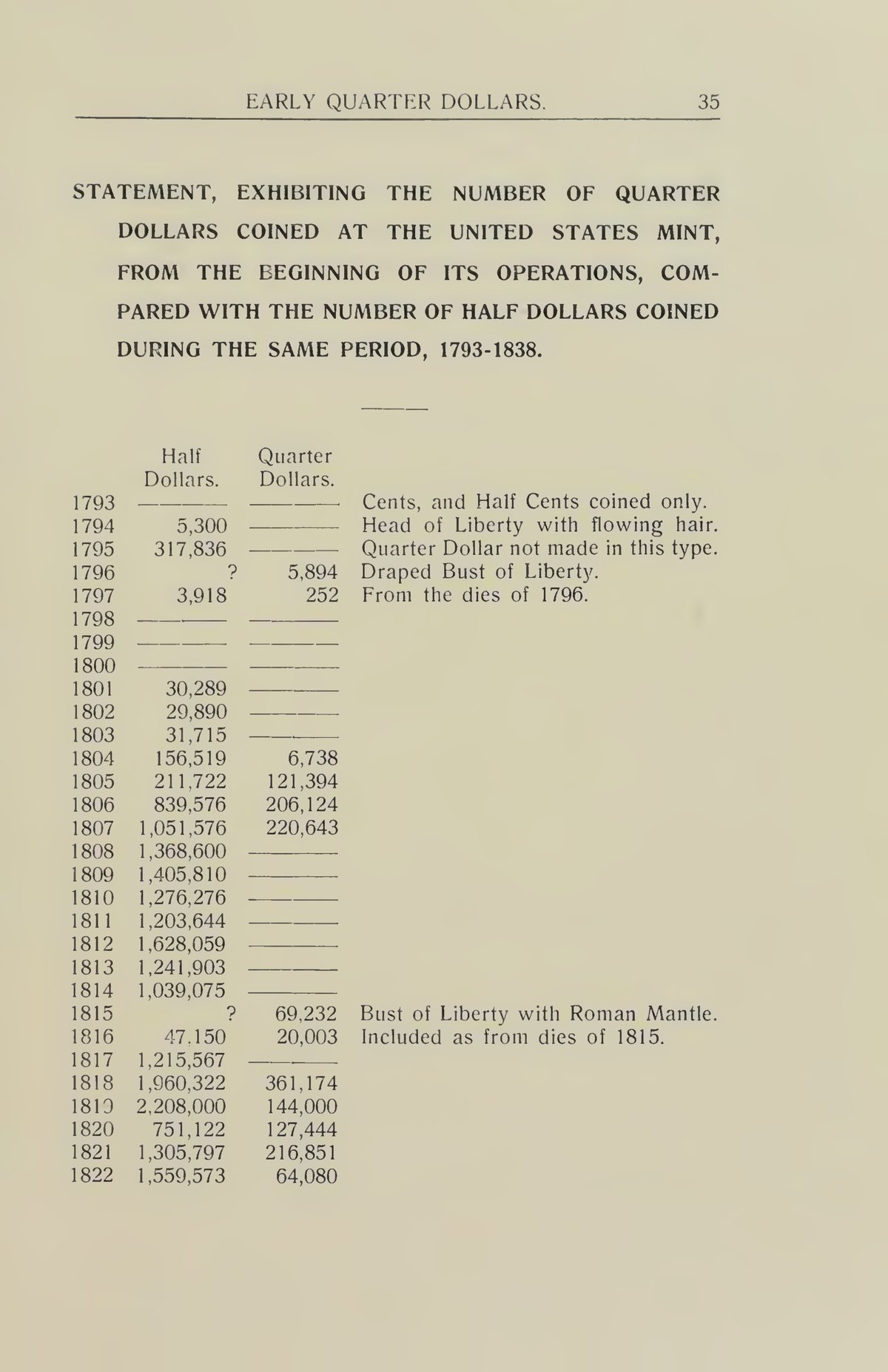
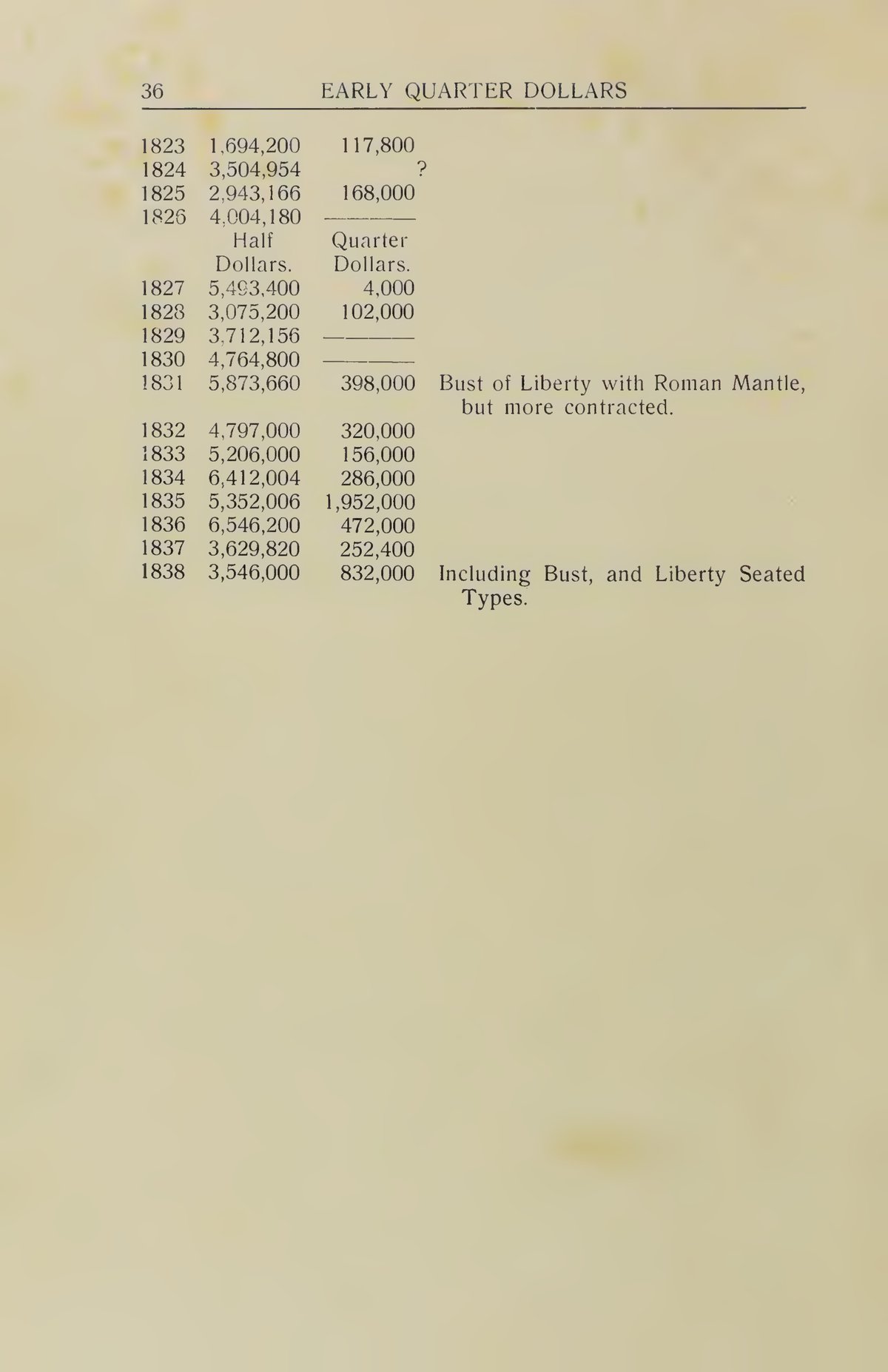
And then there is the table. On pages 35–36 Browning printed a comparative statement of quarter-dollar and half-dollar coinage, 1793–1838 — unmerged, with marginal notes saying which dates the coins bear: 5,894 and 252 on separate lines with "From the dies of 1796"; 69,232 and 20,003 with "Included as from dies of 1815." His table keeps three marks strictly apart: a figure where the record gives one, a question mark where it does not (1824), and a dash where nothing was delivered (the eighteen blank years). That is a finer distinction than the modern price guides make, and it is precisely the two-field mintage discipline this site adopted in 2026 — published in 1925. So far as the OunceDesk Archive can find, Browning's marginal notes are the earliest statement of the rule in American numismatics.
What it gets wrong — and the myth the error made
Browning's 1823 entry reads: "The mint records give the coinage for this year as 117,800 pieces, yet it is one of the two rarest dates in the whole quarter dollar series… Possibly the greater part of this coinage was melted up and converted into other denominations." The mint records give 17,800 — corroborated by the FY1888 registry's value column ($4,450.00, exactly 17,800 quarters) and printed correctly by Dickeson in 1859, sixty-six years earlier. Browning's figure appears twice, in the entry and in the table, and was verified in the type from 400 dpi page images of the held scan: it is his error, not a scanning artifact.
The error generated a hypothesis. A coinage of 117,800 leaving thirty-three survivors demands an explanation, and melting is a good one; a coinage of 17,800 leaving thirty-three needs much less. The melting story still circulates while the figure beneath it has quietly reverted to 17,800 — a myth outliving the typo that created it. The honest correction runs both ways, though: even at 17,800 the 1823/2's survival rate (~0.19%) is far below the series average (~1%), and nobody knows why. Rejecting Browning's explanation does not solve his puzzle; it reopens it.
One more caught act: Browning's 1831 paragraph on the size reduction is Mint Director Snowden's 1860 sentence, reproduced nearly verbatim, without attribution. The standard reference's historical passages are sometimes transmission rather than observation. The working rule this site applies everywhere: quote Browning on dies; check Browning on numbers.
The book that corrected two other series
Browning's comparative table carries a half-dollar column beside the quarter one — and it independently corroborates two findings the OunceDesk early-half-dollars research could previously support only from a single 1860 source. For 1794 half dollars Browning prints 5,300, matching Director Snowden's delivery record and not the trade's 23,464. For 1815 he prints a question mark, and against the 1816 row the note "Included as from dies of 1815" — a published 1925 statement that the half dollars delivered in calendar 1816 bear the date 1815, which is exactly what the early-half-dollars reference reconstructed from the Directors' prose totals a century later. A 1925 quarter-dollar book, bought for one series, turned out to hold the corroborating evidence for a hundred-year-old error in another denomination — and the half-dollar ledger now cites it. That is what a corpus is for.
(His table has its own slips beyond the 1823: the 1795 half-dollar figure of 317,836 fails to close against the Mint's combined total by eight pieces. Confirmed as printed; flagged; not used.)
A short essay in rights
Three statements about one book, all true at once
The book says
"Copyright 1925 by Wayte Raymond." True — a notice was printed, and in 1925 it secured a US copyright.
The repository says
Internet Archive attaches its orphan-work boilerplate: protected by copyright, no rightsholder locatable, use as the law permits. True as boilerplate — and immaterial, because a repository's template is not a rights determination.
The law says
Every US publication of 1925 entered the public domain no later than 2021. True, and decisive: the copyright the notice secured has expired. OunceDesk's determination — public domain by publication date — rests on the item's own publication facts, with all three statements preserved in the Archive's rights record.
The instructive contrast is the book OunceDesk did not take: B. Max Mehl's 1927 reprint of Haseltine's quarter descriptions sits behind the same repository's access control, flagged in-copyright. A 1927 US publication is, by the same reasoning, public domain — but the Archive defers to a repository's access restrictions regardless of its own analysis, and records the disagreement instead of resolving it by download. Rights discipline is not about what you can get; it is about what you can show your work for.
Why this matters to these pages
What one public-domain book unlocks
The plates illustrate the series
Ninety varieties of public-domain die photography — the only series on this site that needs no commercial imagery at all for variety illustration. The plates are reproduced in full on the varieties page, and cropped figures appear on the issue pages.
A named census coin, pictured
PCGS records that plate-matching by Rory Rea ties Browning's 1827 plate to the Seavey–Parmelee chain of the 1827/3 Original census. The photograph that did that work is on this site — a public-domain image of a named census coin, which is rarer than a photograph.
Quotable at length
Every Browning quotation on these pages is quoted, not paraphrased — the reference is PD. Where the modern revisions are cited, nothing is quoted, because they are not.
An open task, stated
Browning rates nearly every variety in prose ("a rare variety," "very rare if sharp"). Tabulating those ratings would give this series a free, attributable rarity scale — recorded as the acquisition's best remaining work, not silently skipped.
Read the book yourself: the full scan at the Internet Archive ↗
Sources
OBSERVED
57 sources
ESTIMATED
1 source
DERIVED
1 source
Sourced figures on this page trace to the ledger below. Editorial judgement is labelled as ours, and prices we have not sourced are not published.
View all sources & evidence methodology →Continue: varieties & the platesthe 1823/2 and the melting myththe complete historyseries overview
Quotations are from the held scan of Browning 1925 (S5), public domain; the 1823 correction rests on the FY1888 registry (S1), Dickeson 1859 (S7) and the contemporaneous 1823 report (MR1823); the half-dollar corroborations were verified from 400 dpi page images of the table. Biographical gaps — who Browning was, who Detwiller was — are stated as gaps.