The Fakes,
Shown Openly
The ghost census, the shipwreck that never sailed, and the Mint as its own counterfeiter — the series' syllabus, photographed.
On August 27, 1867 — weeks before the Mickley sale made the 1804 dollar a public sensation — the dealer W. Elliot Woodward examined a rubbing of an 1804 dollar offered to him for purchase, and reported the result to the numismatic press: "a comparison of which with the genuine Dollar in my possession at once revealed the fact that the new '1804' is simply an alteration… made from an 1803."1 He had offered up to a thousand dollars, sight unseen, if it proved genuine. It did not, and the first documented 1804 fake entered the record in the same season as the coin's first auction.
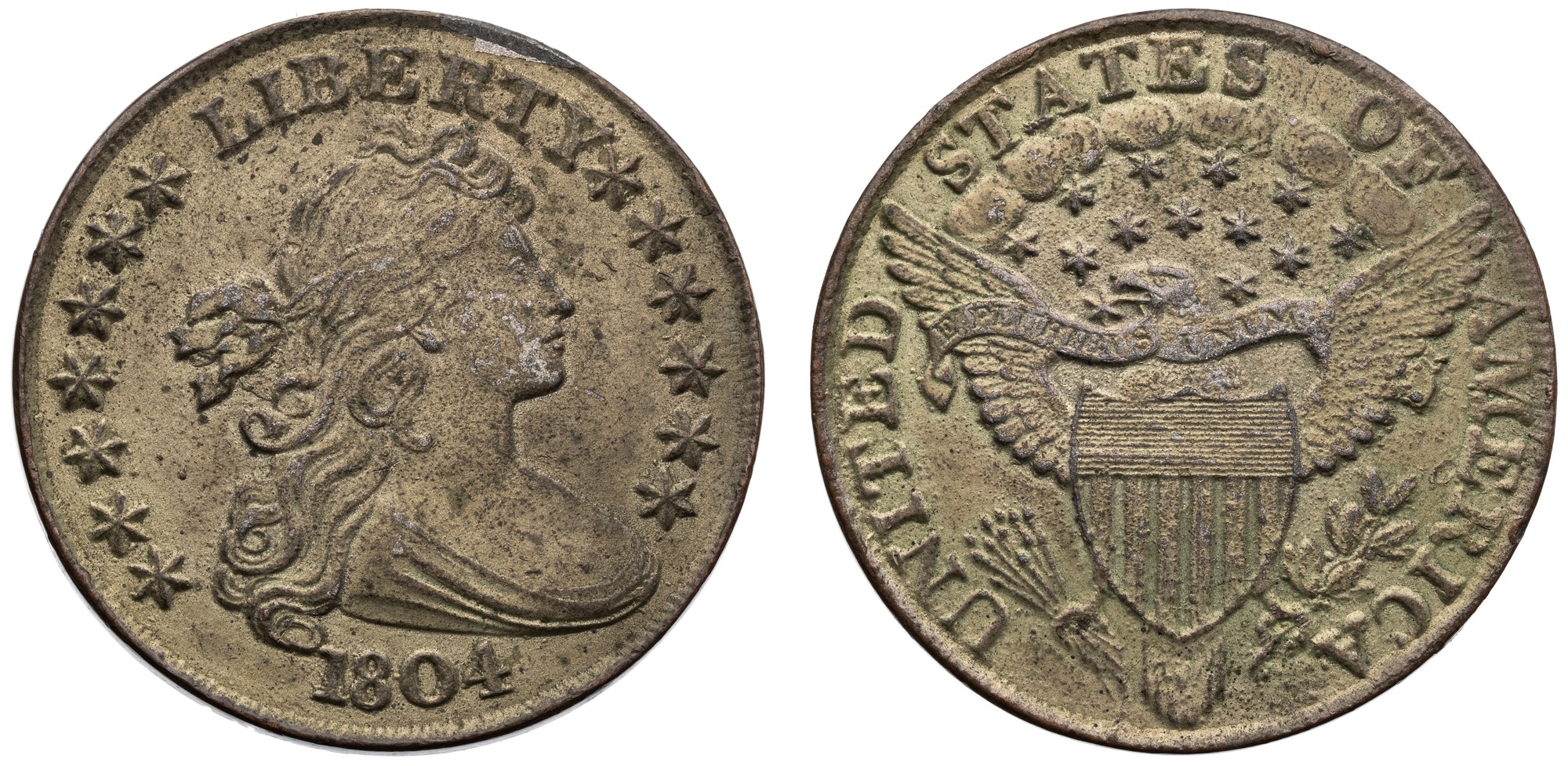
Coin books do not usually show you the fakes. This one does, because in this series the fakes are not a footnote to the story — they are half of it. For every genuine 1804 dollar there have been several offered as genuine, and the record of their rejection, name by name and date by date, is the best authentication course ever written. Two of the teachers are photographed in this chapter: a counterfeit 1794 dollar and a white-metal 1804 forgery, both catalogued and preserved — as fakes, openly — by the American Numismatic Society. Museums keep them for the same reason this book prints them. You learn a series' truths by studying its lies.
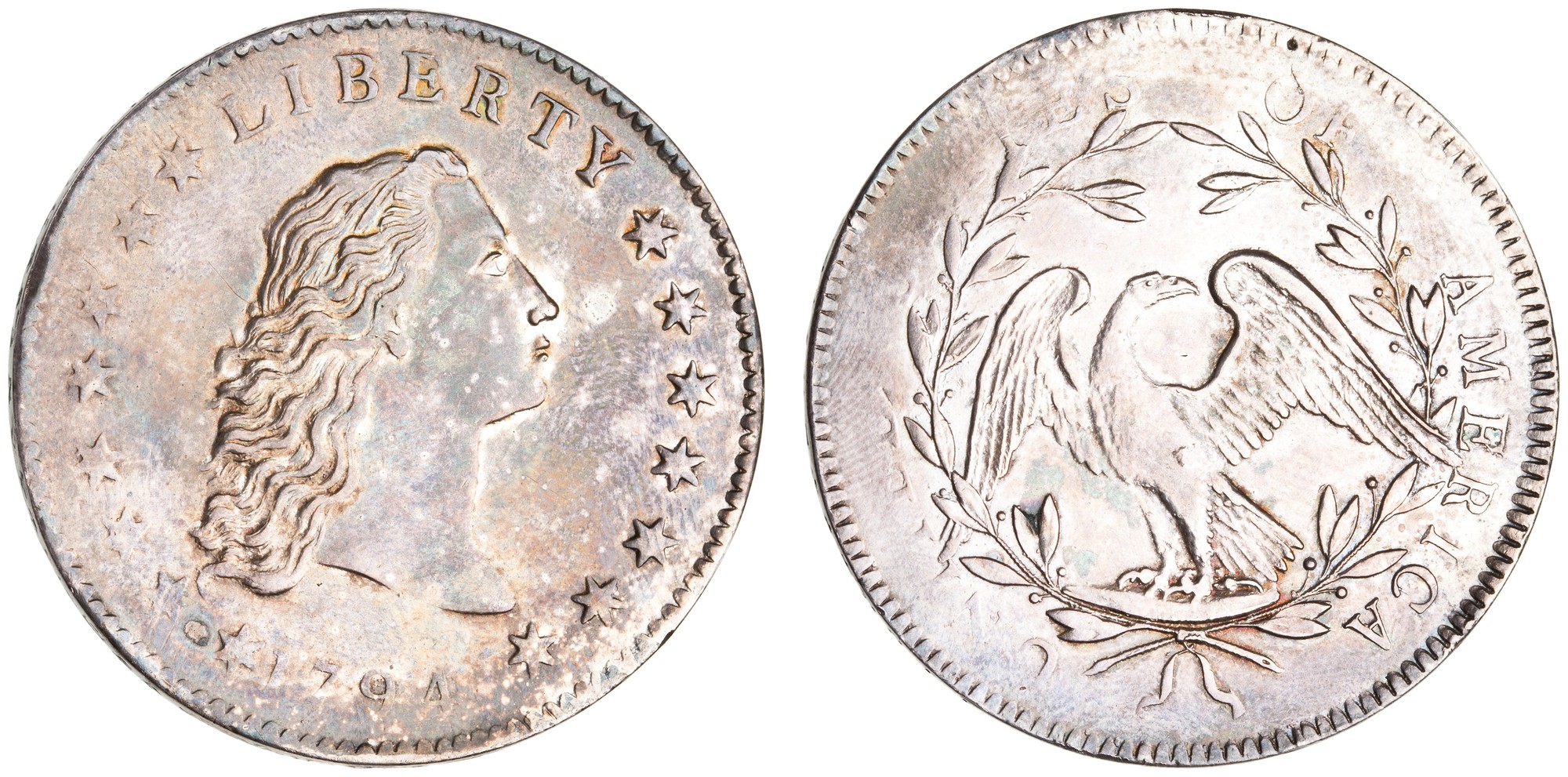
A counterfeit 1794 dollar, catalogued by the ANS as a fake of Bolender 1 and preserved as a teaching object — shown here for the same reason.
The ghost census
Assemble the rejections from the Archive and they make a census of their own — the coins that were never coins:
The altered 1803 offered to Woodward, 1867.1 The pieces of Mr. Walters of Liverpool, Mr. Furman of Providence, and Dr. Walther of St. Paul — carried in Nexsen's 1891 census under the flat verdict "believed to be altered pieces."2 The coin offered on Canal Street by Hugh Rodens, which Nexsen examined in person — "it was an altered coin; the alteration was skilfully executed" — and Mr. Smith of Chicago's, "altered, and in a very bungling manner," judged from a press impression against his comparison file.3 And, decades on, the Lancaster, Ohio coin, announced by the Cleveland Plain Dealer in 1921 as "the eighth 1804 dollar," about which an ANA member wrote the obituary of the whole genre: "This dollar of 1804 has been discovered annually for 15 or 20 years… It is nothing but an altered date… he gets good advertising out of it at intervals. I am told he is an ex-saloon keeper."4
The panics ran ahead of the facts, as panics do. In July 1887 a Boston newspaper announced "127 of the dollars of 1804, despite the fact that only six had been issued," the fakes allegedly struck from altered 1806 dollars, the discovery credited to a Secret Service captain.5 The Mint Cabinet's Assistant Curator answered with the driest sentence in this book: "It should be unnecessary to inform you there were no dollars struck in 1806, and the fright occasioned the numismatists was quite unnecessary."6 You cannot alter a coin that does not exist. The mintage table — read correctly, per Chapter 5 — is itself an authentication tool.
Two ghosts resist easy burial, and honesty keeps them on the list. The Spiers piece — obtained in Philadelphia around 1846, plain-edged, forty-six grains light, "a combination of tin and copper… plated with silver" — was carried by Nexsen in every census as a trial piece, "probably the first impression from the die," and appears in no modern census at all; it was last known lodged with the Society of California Pioneers.7 And the Haigh dollar of Somerville, which no less a judge than Crosby examined and pronounced "a genuine original dollar of 1804."8 Both are untraced. Whatever they were, someone should look for them.
The shipwreck that never sailed
The most durable fake in this series is not a coin at all. It is an explanation. As early as 1885 a Mint souvenir history reported, at arm's length: "It is said that the scarcity of this dollar was owing to the sinking of a China-bound vessel having on board almost the entire mintage of the 1804 dollars."9 By 1899 a New Orleans newspaper had grown it a full rigging — the whole 19,570, "just as it came from the stamping presses," dumped into an iron chest, consigned to a United States frigate in Oriental waters, lost to a Chinese typhoon, "where to the best of my information, she still remains, iron chest and all."10 The hobby never believed it — The Numismatist reported the same year that expert numismatists "ridicule it as a story without foundation"11 — and yet it returned in 1921, attached to the Lancaster fake, and it circulates today.12
Two things make the legend worth a collector's attention. First, its mechanism: the series genuinely has no hoard and no melt event, so the vacuum where an explanation should be attracted one — legends grow where records thin, which is a reason to love records. Second, its garbled truth: dollars really were leaving the country by the crate — to the West Indies, for arbitrage profit, as Chapter 2 documented from Hepburn and from Boudinot himself.13 The legend is a true mechanism pinned to the wrong coins, which is how the best false stories are always built.
A white-metal 1804 dollar forgery, 27.91 grams, in the ANS trays — the ghost census, made physical.
The Mint as its own counterfeiter
Now the uncomfortable center of the chapter. The most consequential maker of false 1804 dollars was the Mint of the United States.
Between about 1858 and 1869, the Philadelphia Mint produced, without authority, dollars dated 1804 — the Class II and Class III pieces — and proof "restrikes" of 1801, 1802, and 1803, from dies of the restrike era; PCGS recognizes six, ten, and ten known respectively, and the 1803 brought $1,110,000 at auction in May 2025.14 They were sold out of the building. The official story, as Nexsen received it, was that the plain-edge pieces had been recalled and "all were destroyed but one."15 Seven surviving Class III dollars say otherwise — plain-edge strikes, edge-lettered afterward with partial collar segments that repeat and drop letters, the diagnostic Chapman had already flagged on the Berg coin in 1885, seventy-seven years before the taxonomy existed.9
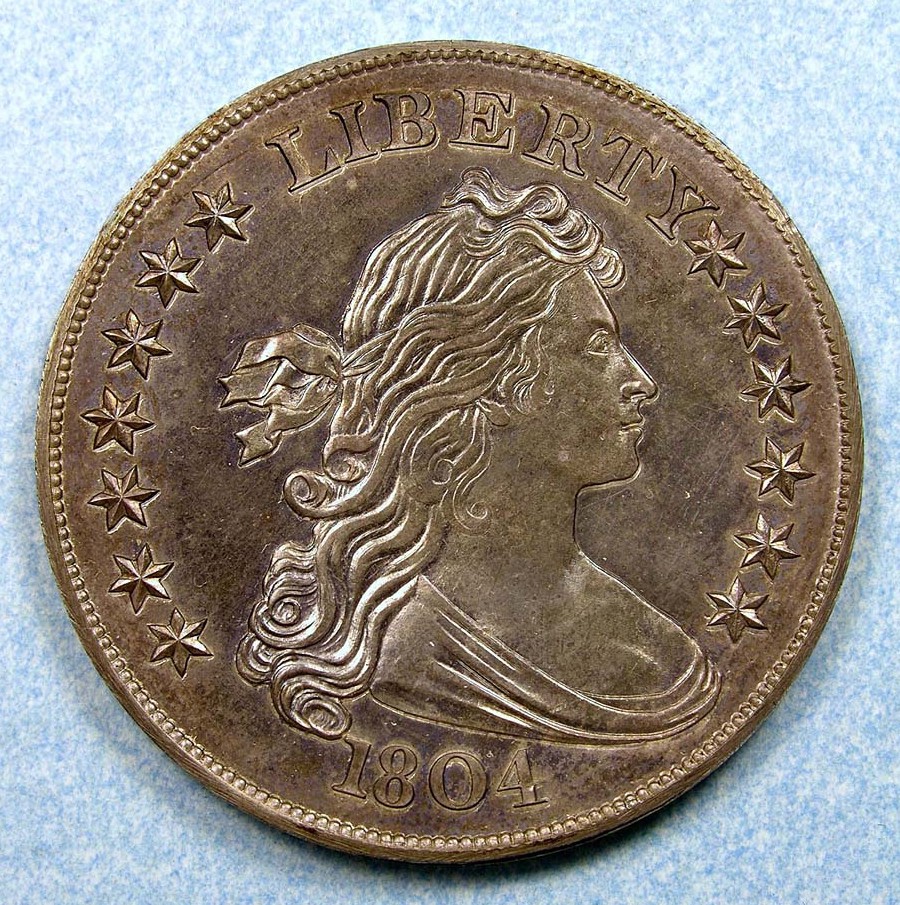
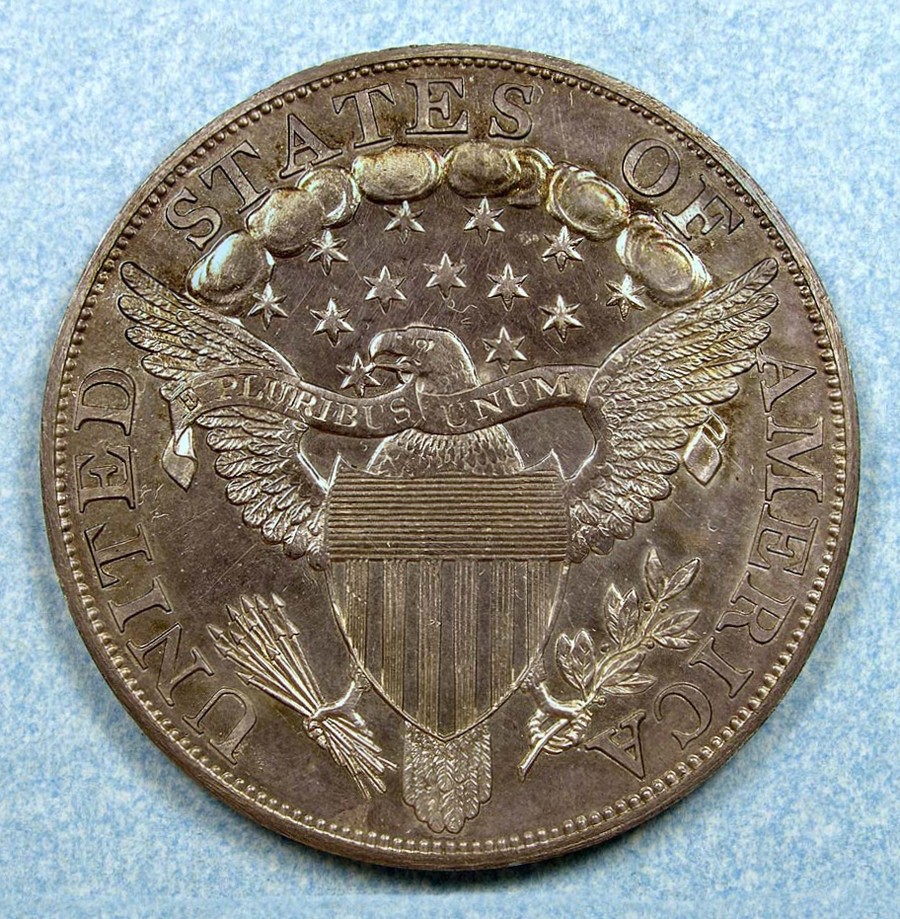
The Class III in the National Numismatic Collection — the Linderman coin, restruck at the Mint c. 1858–60 and edge-lettered after the fact.
One of those coins "passed directly from the U. S. Mint" to Henry R. Linderman — clerk in the Director's office, later Director of the Mint, later Superintendent of all mints. When his collection was sold in 1888, the coin brought $470, and the Government claimed a large part of the collection as its own property.16 The institution's most senior officer is in the census of its most famous unauthorized product. This book asserts what the documents support and stops there: the pieces exist, the edges betray the method, the official account of their destruction is false, and the motive was never written down. What can be said with documents is exactly what Royal's 1887 letter conceded from inside the building — the Mint kept one, "and is represented as such."6
The bench rules
Everything this series has taught since 1867 compresses into three rules, and each carries a name and a date.
Check the coin against the series, not the claim against the seller. The 1895 field guide from Chapter 4 — star rotations, curl positions — is how a reader with a loupe rejects an altered 1795 without ever knowing who owned it.17 Nexsen's border argument is the same move at census scale.18
Check the observations, then check the incentive. Haseltine's 1909 defense of the Idler coin is accurate in every observation and wrong in its conclusion, and the disclosure of forty years' interested silence is in his own letter.19 Expert testimony is evidence; so is the expert's position.
When a claim multiplies, consult the ledger. One hundred twenty-seven fakes from altered 1806 dollars died on a single line of the mintage table.6 The record, read the way Chapter 5 taught, is the cheapest authentication service you will ever use.
The fakes, in other words, are the series' syllabus. The coins photographed for this chapter — the ANS's counterfeit 1794 and its white-metal 1804 — sit in a museum's trays for the same reason they sit in these pages: because the only collector safe from them is the one who has seen them.
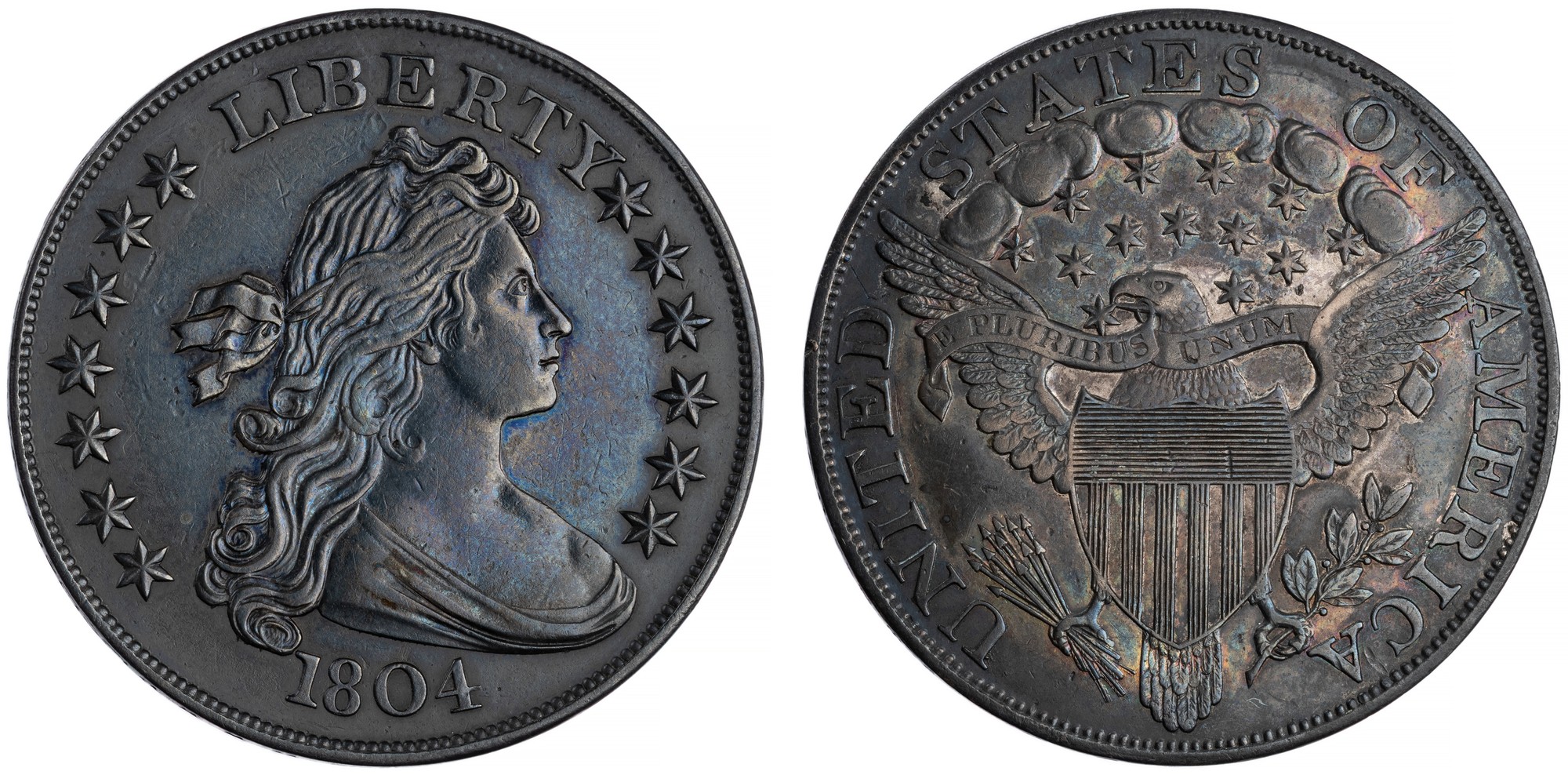
The Rosenthal Class III — authenticated by Nexsen from a press impression in 1894, given to the ANS in 1980.
ARCHIVE19 notes · 12 documents
Notes
- 1
- 2
- 3
- 4
- 5
- 6
- 7
- 8
- 9
- 10
- 11
- 12
1804 china shipwreck NUMISMATIC TRADITION
- 13
- 14
- 15
1804 restrikes all destroyed NUMISMATIC TRADITION
- 16
- 17
- 18
- 19