The Census-Taker
of Brooklyn
John A. Nexsen ran an eighteen-year census of the most disputed coin in America, found the decisive evidence, and repudiated his own theory in print.
In April 1887 the American Journal of Numismatics printed a short article by a Brooklyn collector named John A. Nexsen, listing every 1804 dollar he could verify — six pieces, with owners named and histories traced — and stating his purpose in a single dry clause: "In order that there might be a record of the 1804 Dollars."1
The hobby has forgotten him almost completely, and this chapter exists to say plainly what he did. Over eighteen years, out of his own house, Nexsen ran a census of the most disputed coin in America: he corresponded with owners, kept a physical file of press impressions — rubbings — to compare against claimed specimens, published four censuses, found the decisive physical evidence himself, and then, when the evidence overturned the theory he had spent his life on, said so in print. The essential conclusion of the modern literature on the 1804 dollar was reached, printed, and signed sixty-five years before the modern literature existed.
The categories that had to die
Nexsen's 1891 census — grown to twelve pieces — formalized the century's working theory:
"The term Original is applied to pieces which were struck from the original dies in the year of their date. Of the Dollars enumerated in the following list, the first two are universally conceded to be ORIGINAL, being the only ones reclaimed from circulation, and without doubt were coined in 1804."2
The test being applied is evidence of circulation — the Mickley coin from the bank window, the Cohen coin from a Richmond exchange office. It is a reasonable test, honestly applied, and wrong: wear can tell you a coin has lived, not when it was born. The categories ORIGINAL and RE-STRIKE would organize every discussion of the coin for decades, and they rested, all along, on a circulation test that could not bear the weight.
The Mint itself, meanwhile, was correcting the record where it could. When a Boston newspaper panicked the hobby in 1887 with a claim of 127 fakes made from 1806 dollars, E. L. Royal, Assistant Curator of the Mint Cabinet, replied in the AJN with the two facts that mattered: "we have but one dollar of 1804 in the Mint, and that has a lettered edge. The second piece… is only a re-strike… It should be unnecessary to inform you there were no dollars struck in 1806."3 A myth killed by a mintage table — which is what mintage tables are for.
The dissent, printed in full
The best evidence that this argument was conducted honestly is who published what. In April 1891, in the same journal, Sylvester Crosby argued the other side. He printed the Northampton newspaper abstract of March 1805 — the earliest surviving printing of the 19,570 figure4 — reasoned from the 1805-over-1804 half-dollar overdate that 1804 dies had existed and been used, reported a dollar "which I believe to be genuine, struck from a die altered from 1803," and championed a Somerville coin, the Haigh dollar, as a true original. And in the same issue he printed the Mint's delivery-vs-date NOTE and the list of impossible coins — the strongest weapon the other side would ever have.5 Crosby was wrong about the 1804 dollar and right about the method, and he put both into the record himself. Every field should argue this way.
The border
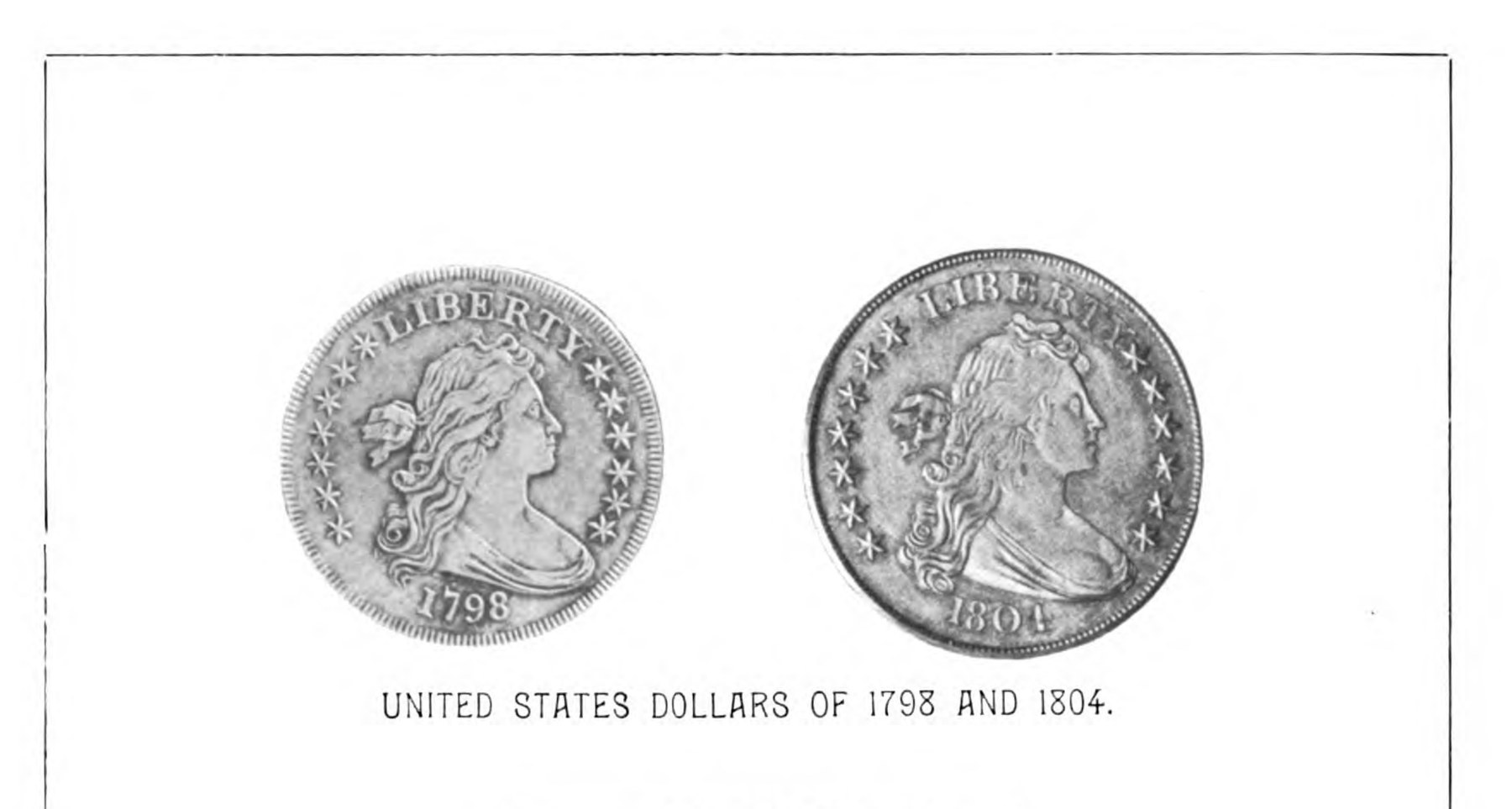
Nexsen's decisive contribution came in July 1897, and it is a die-marriage argument — the instrument of Chapter 3, raised to its highest use. He published a plate: a 1798 dollar beside an 1804. And he described what any reader could verify:
the 1798 shows "milling or lines extending to the edge of the piece, as on all Dollars coined from 1794 to 1803 inclusive"; the 1804 shows "a beading with plain rim outside. This style of beading commenced with the 1836 Dollar… what inference can be drawn other than that the die was cut between the year 1836 and 1842?"6
No document, no testimony, no ledger — a border. The 1804 dollar wears the rim technology of the Gobrecht era, and rims do not time-travel. The die that struck every "original" was cut in the late 1830s, which is to say: there are no originals. There are only earlier restrikes and later ones.
The most important illustration in the series' historiography: Nexsen's 1897 plate — a 1798 dollar with milling to the edge beside an 1804 with beading and plain rim.
Eight years afterward, in April 1905, Nexsen published his final census — thirteen pieces — and the sentence that should be his monument:
"researches in connection with these pieces have entirely upset the former theories entertained respecting them. No one now believes that they were coined in 1804. I must therefore repudiate all that I said in these articles about originals and restrikes."7
Eighteen years of published work, repudiated by its author because the coins said so. The word "original" survives today only with a changed meaning — Class I, struck in the mid-1830s from a die made then — which is not what any nineteenth-century writer meant by it.
The counter-readings
Two competent men read the same physical facts the other way, and both belong in the record. Henry Chapman, cataloguing the Stickney coin in 1907, used the beading itself as evidence for an 1804 striking: "Borders are beaded as are the dimes of this year."8 Same feature, opposite conclusion, ten years after Nexsen — a standing lesson that a diagnostic is only as good as the comparison set behind it.
And in April 1909, Capt. John W. Haseltine — the same Haseltine whose Type Table founded variety scholarship — defended the newly surfaced Idler coin as an original, in a letter that is a masterclass in accurate observation bent by interest. Thirteen arrows in the eagle's claw where the others show twelve; intact edge lettering; weights cited to the fraction of a grain. Every observation checks out. And then the sentence that gives the whole game away:
"Forty years ago I knew that Mr. Idler had an 1804 Dollar and he bound me to secrecy in reference to it, as he made his electrotypes from it."9
The coin was his father-in-law's; he had kept its existence secret for forty years; and the modern attribution places it among the Class III restrikes.10 Check the observations, then check the incentive — Chapter 8 makes that a rule.
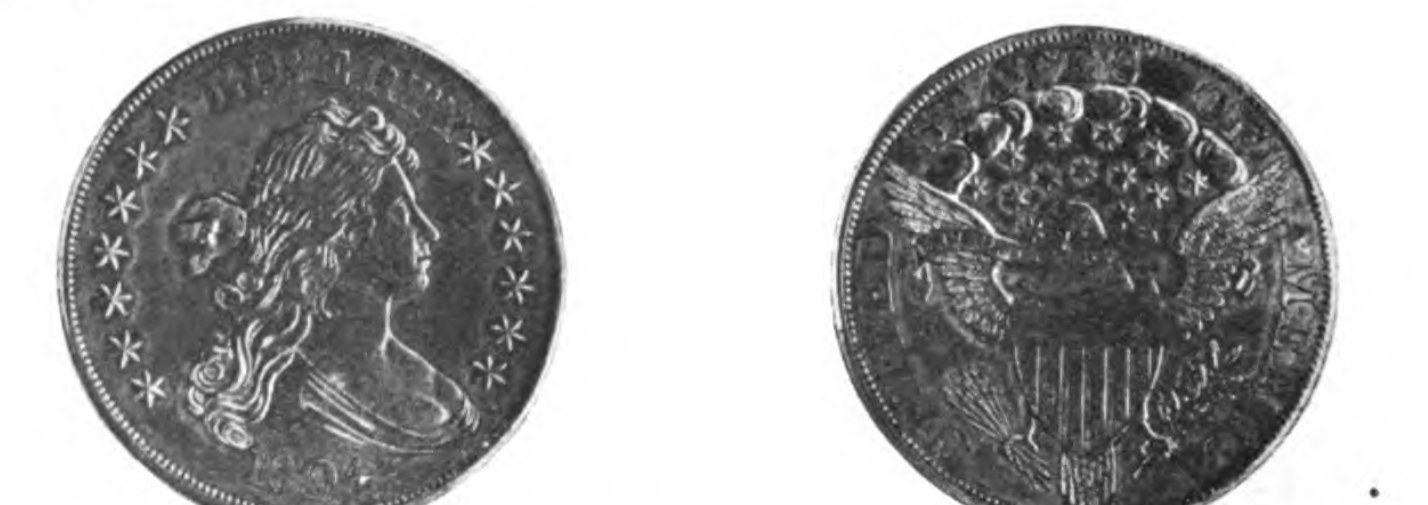
The Idler–Granberg dollar as The Numismatist printed it in 1909, enlarged to show the thirteen arrowheads Haseltine argued from.
What the argument settled
Edgar H. Adams took Nexsen's result and generalized it to the entire series in 1910: "it is extremely doubtful if a single piece bearing the date of 1804 was struck in that year at the mint and possibly the issue mentioned should be credited to 1803."11 That sentence closes the loop this book opened in Chapter 2: the 1797 anomaly, the ledger doctrine of Chapter 5, and the 1804 dollar are one problem, solved by one method. In 1962 Newman and Bressett gave the answer its modern architecture — the Class I, II, and III taxonomy, the 1834 diplomatic origin12 — sixty-five years after a Brooklyn census-taker reached the essential conclusion by a different route.
And the census he started is still moving. In December 2025 a Class III dollar unknown to every list since 1867 — held quietly in one family since before 1951, "unpublished until 2025" — sold at auction for $6,000,000.10 The count of 1804 dollars, argued over since Woodward wrote "of the four specimens known" in 1867, changed in living memory from fifteen to sixteen. Nexsen's project has outlived every theory it was built to test, including his own. That is what a census is for.
ARCHIVE12 notes · 7 documents
Notes
- 1
- 2
1804 originals vs restrikes NUMISMATIC TRADITION
- 3
- 4
- 5
- 6
- 7
- 8
- 9
- 10
- 11
- 12
The Fantastic 1804 Dollar (1962; Tribute edition 2009)