Presents
for Kings
The Mint's cabinet had no 1804 dollar in 1838 — because the coins were only then being made, as gifts for a Sultan and a King.
In 1838 a travelling French collector named Alexandre Vattemare visited the Mint of the United States. We know what he did not find there, because a Brooklyn collector recorded it a half-century later with the care of a man who understood what it proved: "The United States Mint did not have in its possession a Dollar of 1804 when M. Alexandre Vattemare visited the Mint in 1838."1
Sit with that. The Mint's own registry showed 19,570 dollars delivered in 18042; the Mint's own cabinet, formed in 1838 to keep one of everything, had no dollar dated 1804 to keep. The institution that supposedly struck them could not produce one. Everything strange about the most famous American coin is already present in that single absence — and the coins themselves were, at that very moment, being made.
The diplomatic sets
The account the modern hobby accepts runs as follows. In 1834 the State Department ordered complete cased sets of American coins as diplomatic gifts for Edmund Roberts' mission to Siam and Muscat. The Mint, having no dollar of current date — none had been struck since the deliveries of 1804–05 — struck dollars dated 1804, the last year its records showed a dollar coinage. Two of those coins went into presentation sets for Sayyid Sa'id bin-Sultan of Muscat and King Ph'ra Nang Klao of Siam, neither of whom collected coins.
This book tells you, per its standing rule, exactly how well that account is sourced: it is the consensus established by Newman and Bressett in 19623, and PCGS's own pedigree fields name "U.S. Department of State, c/o Edmund Roberts" for the two finest Class I coins4 — but the Archive behind this book holds no primary document for the 1834 order, and the claim is carried as PROBABLE, with an evidence order standing against it. The Sultan's coin resurfaced in Liverpool in 1917 and sold in August 2021 for $7,680,000; the King of Siam's set, complete in its case, surfaced in 1962 and was reported sold privately in 2005 for around $8.5 million.4 The rarest and most famous American coin was created as a diplomatic courtesy and given away, twice, to men with no idea what they were holding — because they could not have known. Nobody could. The coins' own country would not notice them for another decade.
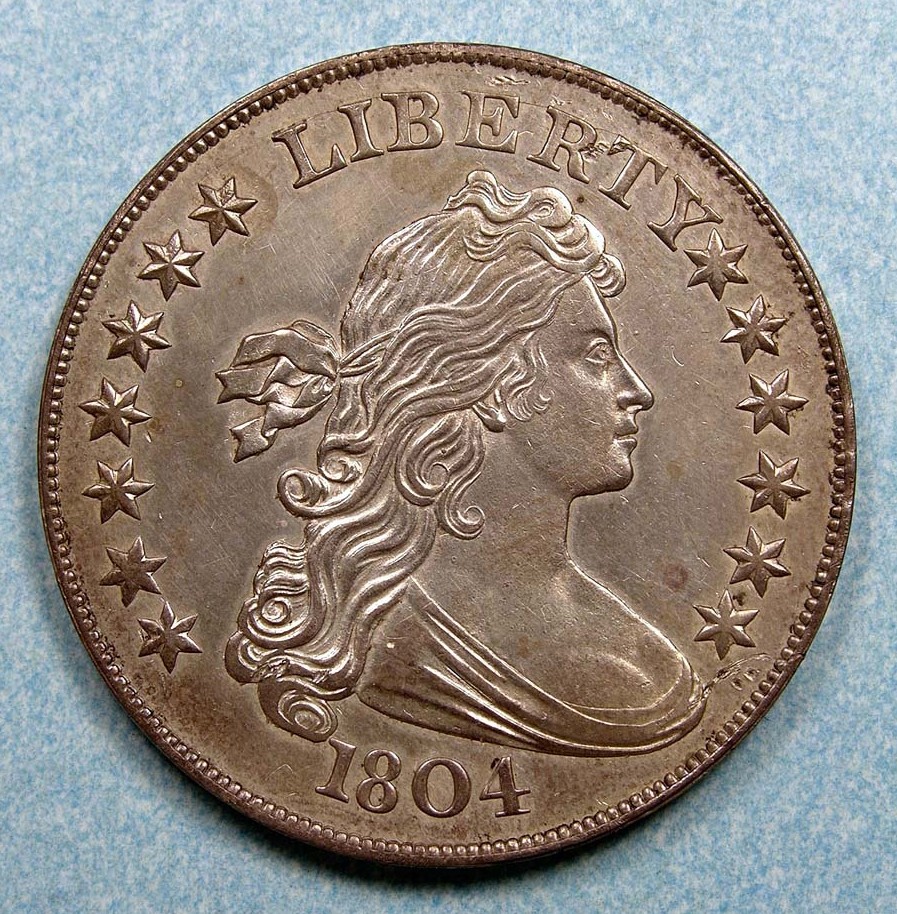
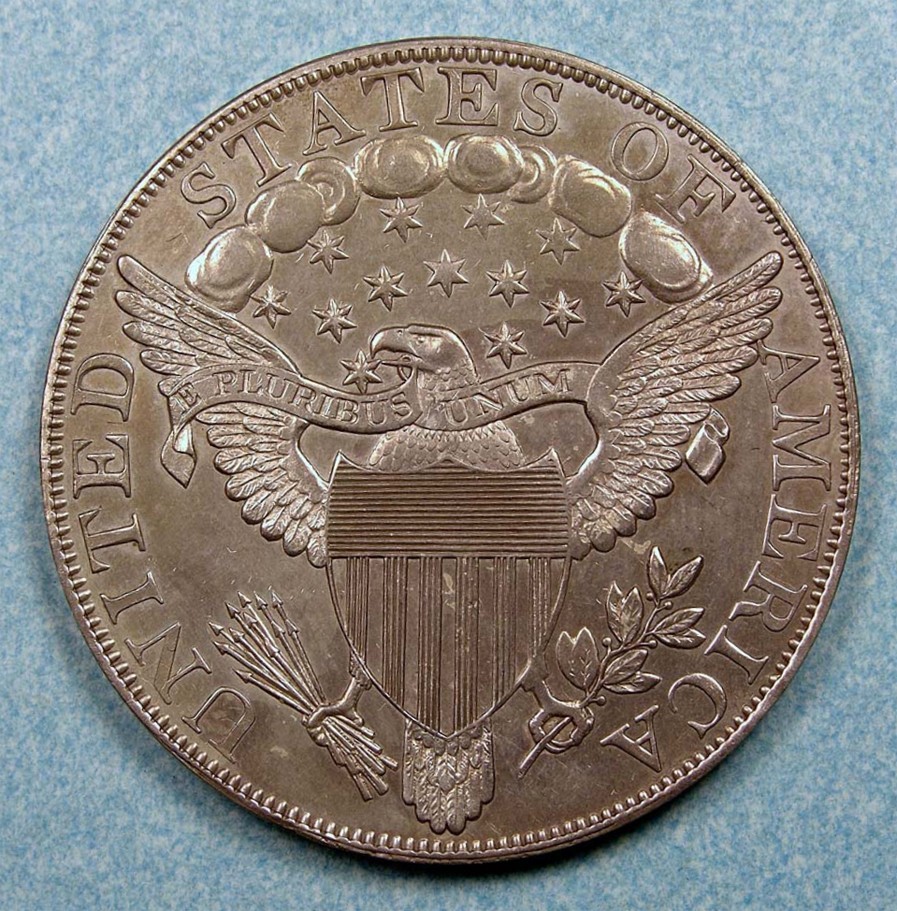
The 1804 dollar, Class I — the Mint Cabinet specimen, the one coin in the census that has never left government hands.
First appearances
The 1804 dollar entered the printed record sideways. In 1842 the Mint's assayers, Jacob Eckfeldt and William DuBois, published a Manual of Gold and Silver Coins of All Nations, illustrated by a machine that traced electrotype copies of coins from the Mint Cabinet — "the finest specimens of coin, belonging to the cabinet of the Mint, were at our command for this purpose."5 Plate II, number 3, is a dollar, captioned with a type range — "Dollar, 1797–1805" — and the later authorities who examined the book identified the coin ruled for that plate as an 1804.6 That identification rests on their testimony rather than on a legible date in the plate, and the claim is carried accordingly.7 What matters for the story is what happened next: a picture existed. And a picture creates wanters.
On May 9, 1843, the first 1804 dollar passed into private hands, and we have the new owner's own account, written in 1867 and reprinted by the man who later sold his collection:
"Of the genuineness of my U.S. Dollar of 1804, I think there cannot be entertained a doubt, as it was handed me directly from the Cabinet of the U.S. Mint in Philadelphia, on the 9th of May, 1843, by one of its officers, (Mr. W. E. DuBois,) who still holds the same situation there, and can testify to it. It was not then considered any more valuable than any other of the series…"8
Matthew Adams Stickney of Salem — "the father of advanced collectors in America," in Farran Zerbe's later phrase9 — traded the Mint for it, giving up, among other coins, a unique 1785 Immune Columbia in gold.10 Note the actors: the officer who handed the coin across the counter, W. E. DuBois, is the co-author of the 1842 book that had just published it. The same man put the coin in print and gave one away, and it appears to have occurred to no one at the time that this was remarkable. Stickney kept his dollar for fifty-one years, refused a thousand dollars in gold for it, and guarded it with a collector's particular paranoia — "I was very careful that Monsieur Vattemare, when at my house, should not by some sleight of hand exchange it."11
Over the counter
The other early coins came into the world just as casually. An elderly woman obtained one from the Mint at face value during Polk's administration; it surfaced through a New York dealer in 1868 and sits today in a museum in Omaha.12 Another was taken over the counter of the Bank of Pennsylvania by a teller named Henry C. Young, and passed to Joseph J. Mickley, the Philadelphia collector whose name it still carries — the accounts differ on the year, "about the year 1850" in one telling, circa 1847 in another, and this book leaves the disagreement standing.13 A dollar dated 1804, passed in change at a bank window: it is the single most collected fact in the series, and it is also evidence — a Class I coin that actually circulated, which is why the century's first experts treated wear as the test of authenticity. They were wrong about what it proved, but they were reasoning from the coin in front of them, which is more than can be said for the ledger readers.
The Mint does it again
Around 1858, the story turns. Mint employees struck new pieces from the 1804 dies — without authority, without the lettered-edge collar, on whatever planchets came to hand. One sold for seventy-five dollars; others were offered. The official account, as the hobby received it, was tidy:
"It is said that these were returned to the Mint, and that all were destroyed but one, which is the specimen now in its collection with a plain edge."14
Chapter 8 weighs that sentence against the seven surviving coins it cannot explain.15 For now, mark the date and the method: plain-edge pieces, struck decades after 1804, some of them later edge-lettered with partial collar segments that repeat and drop letters16 — the diagnostics you already own from Chapter 4. The dies themselves were destroyed in the winter of 1868–69.16
The gem of the collection
By 1867 there were, by the best contemporary count, four known 1804 dollars, and the finest of them came to auction when Mickley's collection was sold that October. Lot 1696 — and the catalogue entry is the earliest census of the coin this Archive holds:
"This piece is regarded by all American collectors as the gem of Mr. Mickley's Collection. It has been in circulation, but is still in the finest condition… Of the four specimens known, two, it is certain, were struck at a period subsequent to 1804."17
Read that last sentence again. In 1867, at the very first auction of an 1804 dollar, the cataloguer states in print that half the known census was struck later. The restrike problem is not a modern discovery; it was admitted at the coin's market debut. The coin brought $750 — a sensation — and the modern record, for the sake of the note-takers, is that PCGS's published pedigree gives this sale as lot 1676; the Archive holds both the priced and unpriced catalogues, the dollars run from lot 1673 to 1696, and the 1804 is lot 1696. Lot 1676 is an 1795.18 Small correction, real point: even for the most documented coin in America, the paper disagrees with the database, and the paper wins.
Four coins, one of them worn from a bank window, two admitted restrikes, a picture in a Mint book, and a mintage line of 19,570 that nobody could match to a single specimen with milling to its edge. The stage was set for somebody to start counting properly. He lived in Brooklyn, and he is the next chapter.
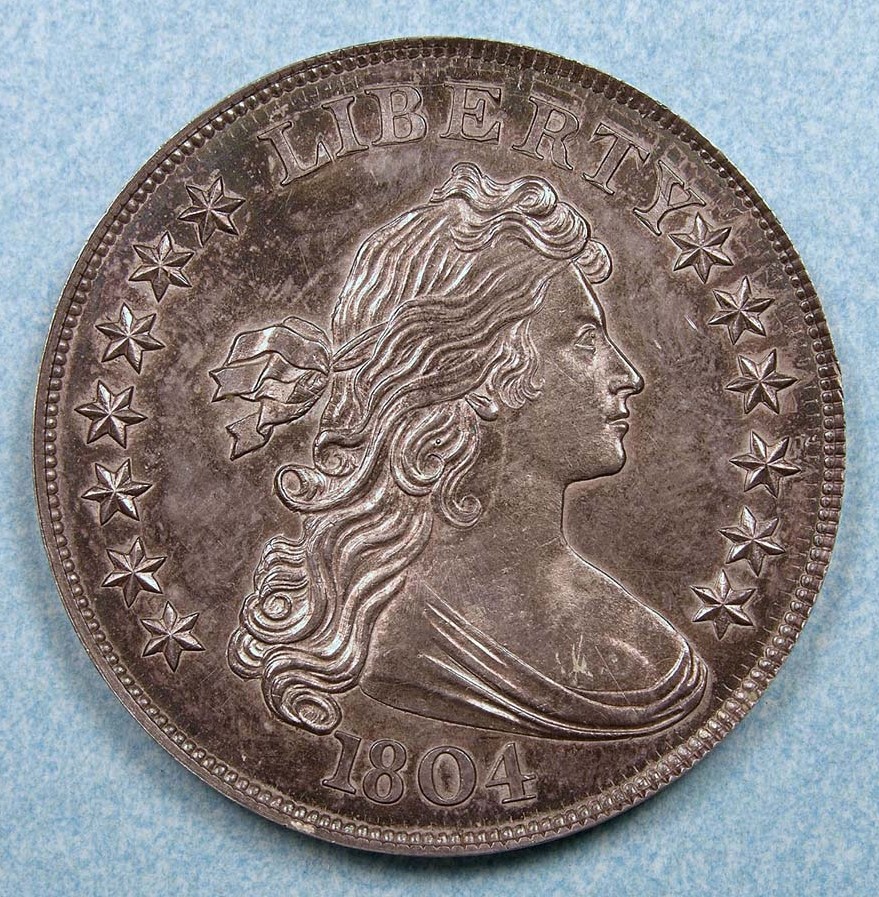
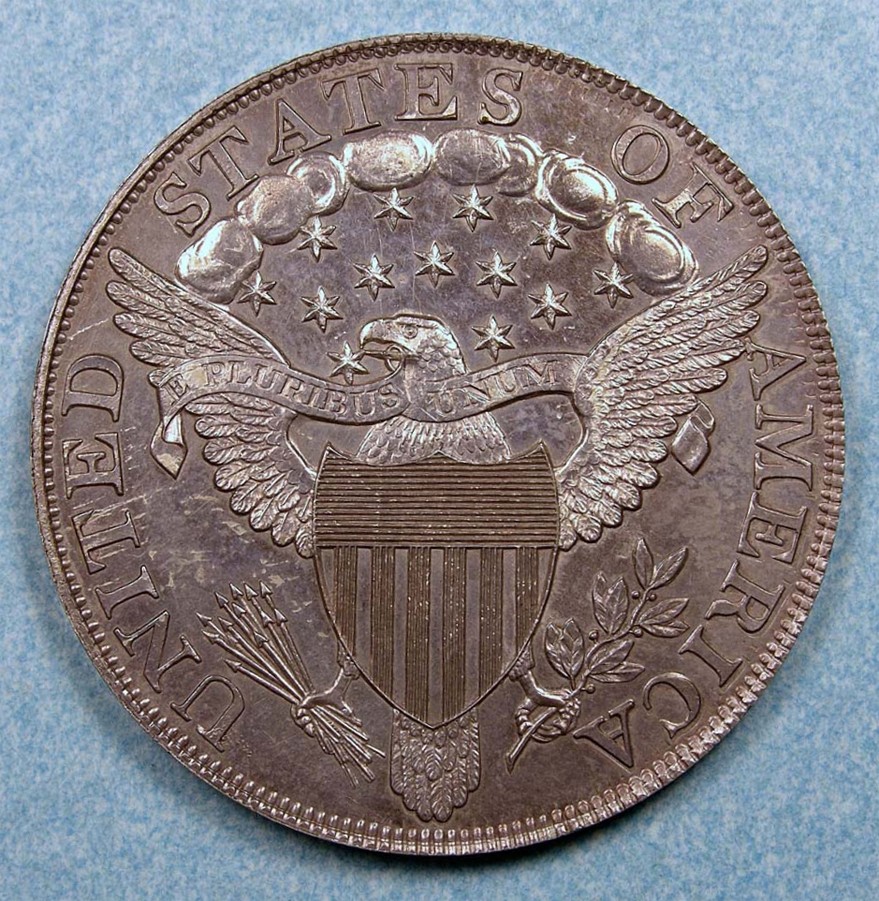
The unique Class II: plain edge, 381.5 grains, retained by the Mint in 1858 — “intended merely to exhibit the reverse side of the coin.”
ARCHIVE18 notes · 9 documents
Notes
- 1
- 2
19,570 silver dollars were delivered by the U.S. Mint between 1 January and 31 December 1804. CONFIRMED
- 3
The Fantastic 1804 Dollar (1962; Tribute edition 2009)
- 4
- 5
- 6
- 7
The 1804 dollar first appeared in print in Eckfeldt and DuBois's Manual of Gold and Silver Coins of All Nations (Philadelphia, 1842), on a plate engraved by Joseph Saxton's medal-ruling machine. PROBABLE
- 8
Matthew A. Stickney received his 1804 dollar from the cabinet of the U.S. Mint on 9 May 1843, from Assayer William E. DuBois, in exchange for the 1785 Immune Columbia in gold and other coins. CONFIRMED
- 9
- 10
- 11
- 12
- 13
- 14
- 15
1804 restrikes all destroyed NUMISMATIC TRADITION
- 16
- 17
W. Elliot Woodward, Priced catalogue of the numismatic collection formed by Joseph J. Mickley (1867) p. 99
The Mickley 1804 dollar was lot 1696, not lot 1676, in W. Elliot Woodward's sale of the Mickley collection, 28 October to 2 November 1867. CONFIRMED
- 18