Collecting
the Series
What a completable set means in a series whose best coins live in museums — three honest paths, and two habits of numerical hygiene.
In June 1907 the collection of Matthew Stickney — held since 1843, never out of his house — crossed the auction block in Philadelphia over five days, and Farran Zerbe reported the result for The Numismatist: the 1804 dollar at $3,600 to a buyer announced only as "Hercules," the highest price then ever paid for a United States coin. "The 1804 dollar has been restored as the 'King of American Rarities,'" Zerbe wrote — restored, because two days earlier the Brasher doubloon had brought $6,200 in the same rooms.1 The title, in other words, was understood even then to be contested and transferable: a championship belt, not a fact. That is the correct spirit in which to collect this series, and this chapter is about doing it honestly.
What the famous prices are
The market arc of the early dollars is real history and terrible guidance. Mickley's 1804 brought $750 in 18672; the Dexter coin $1,000 in 1885, the Berg coin $740 in 1883, the Linderman coin $470 in 18883; Stickney's $3,600 in 1907. In the modern era: $10,016,875 for the silver-plug 1794 in January 2013 — the first coin of any nation to cross eight figures; $7,680,000 for the Sultan of Muscat's Class I in 2021; $6,600,000 for the Strickland–St. Oswald 1794 the same summer; $6,000,000 for the newly surfaced James A. Stack Class III in December 2025; $3,538,000 for the Presidio Class III in January 2026.4 Those numbers are the series' celebrity tier, and the only working advice they contain is indirect: every coin in that tier is famous for its documentation as much as its condition. The market's deepest prices in this series are paid for provenance — for coins that are also records. A collector at any budget can act on that.
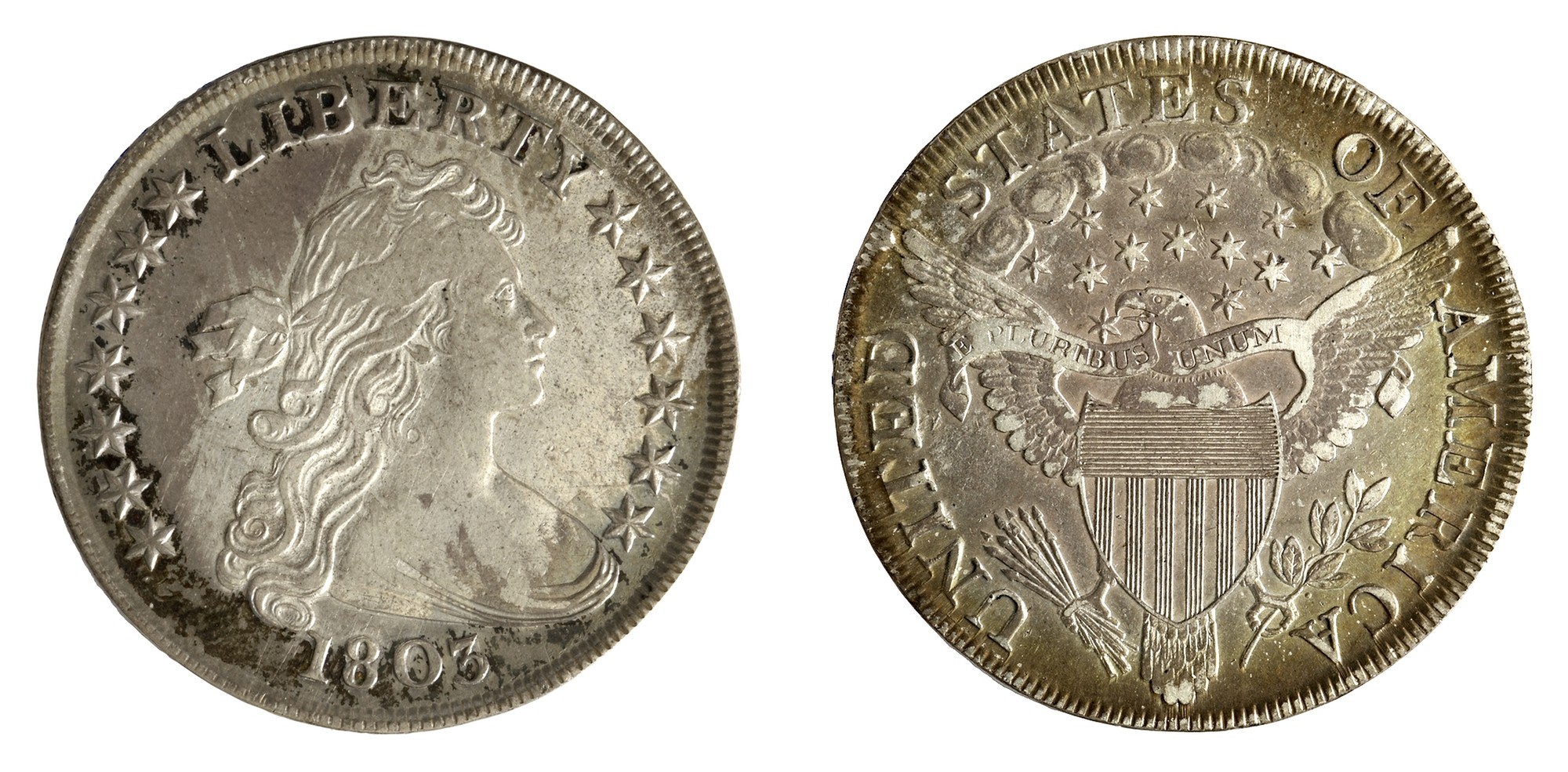
An 1803 dollar (ANS attribution B-6) — the series' closing date for circulation coinage, obtainable and honest.
The institutional fact
Here is the honest reality no sales brochure will lead with. The best coins in this series are not for sale, and several never will be. Of the eight Class I 1804 dollars, three sit in public institutions: the Mint Cabinet coin at the Smithsonian — the one with the shortest, cleanest chain in the census, "Mint Cabinet, continuously"5 — the Parmelee coin in a museum in Omaha, and the Cohen coin, recovered in Zurich in 1993 after an armed robbery, at the ANA's museum by the donation of the collector it was stolen from.4 The unique Class II has never left government hands and has no market at all. The Rosenthal Class III — the coin Nexsen authenticated from a press impression in 18946 — was given to the American Numismatic Society in 1980.4
A completable early-dollar collection therefore does not mean what it means in later series. Nobody completes the 1804s; two of the last three men who came close gave their coins to museums. Completable, here, has three honest senses, and each is a real collection.
Three ways in
The type set. Four coins: a Flowing Hair dollar, a Draped Bust with the small eagle, a Draped Bust with the heraldic eagle — and, if the wallet allows, a 1794 as the origin coin. Nothing in this series is common in absolute terms, but the type coins are obtainable: PCGS estimates several thousand survivors each for the workhorse issues — 1799 around 8,000 in all grades, the 1795 3 Leaves around 6,000, the 1798 Large Eagle around 5,000 — figures that are PCGS's own, as of August 2026, and quoted here with that label per this book's standing rule.4
The date run, 1795–1803. Nine dates, every one obtainable in circulated grades, with 1797 — the series' lowest delivery year, 7,776 pieces7 — as the run's respectable challenge. The run's boundaries are themselves a lesson in the series' honesty: it opens in 1795 because 1794 is a wealth event, and it closes in 1803 because no dollar dated 1804 or 1805 was struck for circulation — the ledger's dates and the coins' dates part company at both ends, exactly as Chapter 5 taught.8
The teaching marriages. The twelve of Chapter 4, or as many as the budget reaches — the 2 Leaves and 3 Leaves side by side, an AMERICAI, an overdate, a coin with honest adjustment marks bought on purpose. This is the cheapest of the three collections and the one that builds the skill the other two spend. A collector who owns the 1795 leaf pair and can explain why the plug coin is not damaged has more of this series than a vault holding one unattributed 1799.
Reading the numbers like an owner
Whatever the path, the series imposes two habits of numerical hygiene, and they are this book's parting discipline.
Survival estimates have owners and dates. "About 150 survivors" for the 1794 is PCGS's estimate, observed August 20264; Haseltine's "excessively rare" meant one specimen seen in five years of looking9. Neither is "the" number; both are opinions with authors, separated by a century and a half of survivorship and searching. Quote them with their owners attached and you will never be stampeded by a population report or a rarity scale again.
Census numbers carry a class and a date. "How many 1804 dollars are there?" has had the published answers four (1867), six (1887), seven (1885's "originals"), twelve (1891), thirteen (1905), six again (1907, counting a narrower class), fifteen (1962), and sixteen (since December 2025).10 None of those answers is wrong. Each is a count of a stated class at a stated time, and a number missing either label is not a fact about the coins — it is a fact about a year. When the next 1804 surfaces — and December 2025 is standing proof that "next" is a live word — the collector trained by this series will ask the two questions that matter before believing anything: which class, and says who?
The open ledger
This series' record is not finished, and the unfinished parts are listed in the back of this book where a collector can adopt one: the Mint's own delivery warrants for 1794–1805, which would harden every number in Chapter 5; the State Department's 1834 papers, which would convert the diplomatic-set story from PROBABLE to documented; the fate of Nexsen's press-impression file; the Spiers piece, last seen in San Francisco; the Mickley 1794, "one of the finest dollars of this date in existence" in 186711, never yet matched to a modern specimen.
That last item is the right note to end on. Somewhere in a holder, under a modern grade and a modern label, a specific 1794 dollar is the Mickley coin, and nobody has done the catalogue work to say which. The series that began with 1,758 coins on an October afternoon still has census work open after two hundred and thirty years. The documents are waiting. So, somewhere, is the coin.
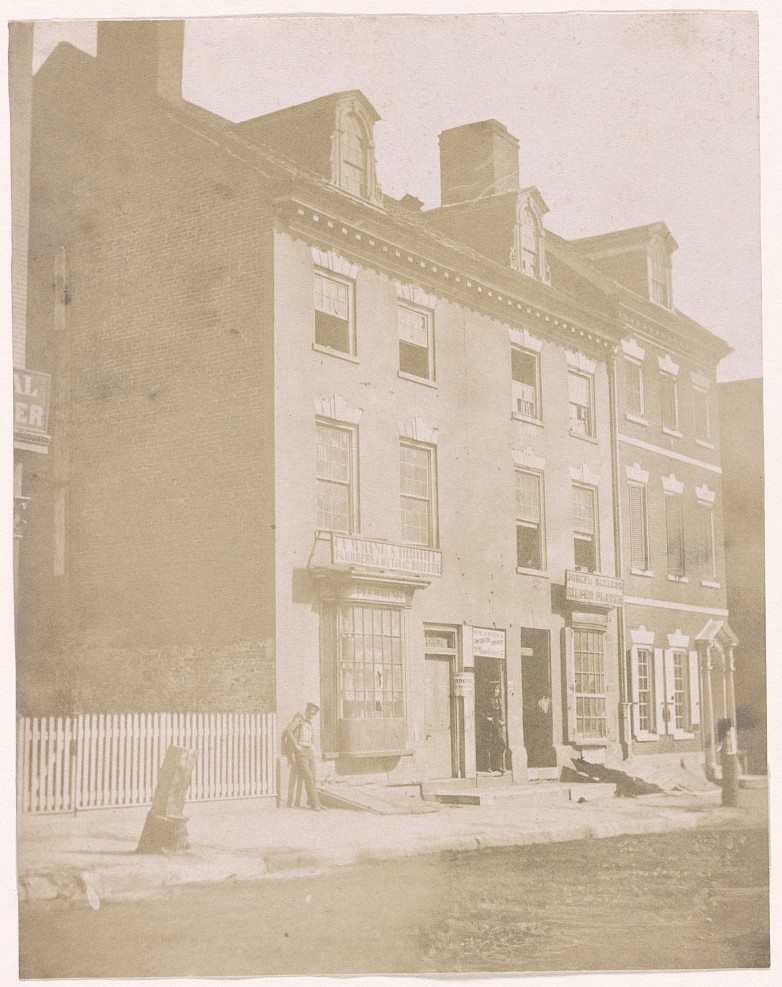
The first Mint on Seventh Street, photographed in the 1850s — decades after the Mint moved out, when the building had become shops. The series' birthplace, as the camera found it.
ARCHIVE11 notes · 7 documents
Notes
- 1
- 2
- 3
- 4
- 5
- 6
- 7
- 8
No silver dollar bearing the date 1804 was struck during the year 1804; the 19,570 dollars delivered in calendar 1804 bore earlier dates. CONFIRMED
- 9
- 10
- 11